
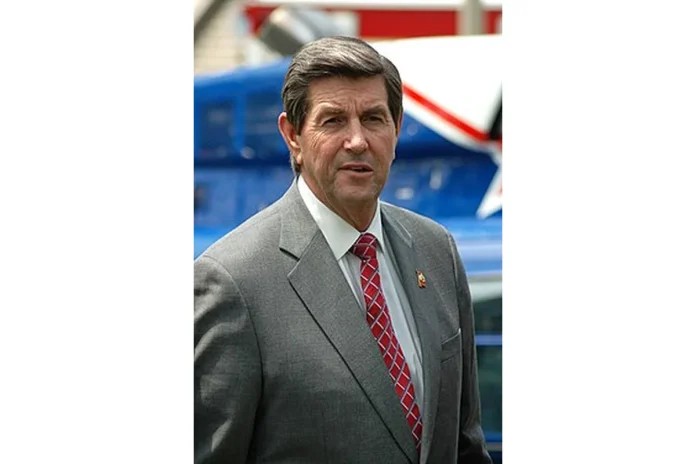
Bob Riley Bio
Robert Renfroe Riley (born October 3, 1944) is an American retired politician and businessman who served as the 52nd governor of Alabama from 2003 to 2011. A member of the Republican Party, Riley represented Alabama’s 3rd congressional district in the U.S. House of Representatives from 1997 to 2003 before leaving Congress to run for governor. He built his career on small-business leadership in rural Alabama and later promoted tax restructuring, education accountability, and workforce development at the state level.
As governor, Riley pursued ambitious fiscal reform, led the state through major hurricane responses, and recruited one of the largest industrial projects in Alabama history. After leaving office, he retired from public life and remained active in business and civic affairs in his home state.
Early Life and Background
Robert Renfroe Riley was born on October 3, 1944, in Ashland, a small town in Clay County, Alabama. His family had ranched and farmed in the area for six generations, giving him a lifelong connection to rural Alabama. Growing up in this agricultural setting shaped his later interest in business, land, and small-town enterprise.
Riley attended the University of Alabama, where he joined the Phi Kappa Sigma fraternity and earned a bachelor’s degree in business administration. His college years introduced him to a wider professional network and gave him the formal training that he would later apply to his private businesses and political career.
Path to US Politics
Before entering politics, Riley built a varied business career in Clay County and across Alabama. He owned a car dealership and a trucking company, worked as a cattleman, and operated as a commercial and residential realtor. These enterprises gave him practical experience in management, finance, and small-business survival.
In 1996, Riley made his first run for elected office, winning a seat in the U.S. House of Representatives for Alabama’s 3rd congressional district. He defeated State Senator T. D. “Ted” Little and a Libertarian candidate, becoming only the second Republican to represent the district since Reconstruction. His election marked the start of a national political career rooted in his local business background.
Bob Riley Career
Early Career (1997-2002)
After his first congressional victory, Riley settled into the U.S. House and focused on the priorities of his east Alabama district. He was reelected in 1998 with 58 percent of the vote, defeating Democrat Joe Turnham. In 2000, he faced only a Libertarian challenger, reflecting his growing strength at home.
As a supporter of term limits, Riley pledged to serve only three terms in the House. He kept that promise by not seeking reelection in 2002, choosing instead to run for governor of Alabama.
Breakthrough (2002-2003)
The 2002 gubernatorial race was the closest in Alabama history. Riley defeated Democratic incumbent Don Siegelman by approximately 3,000 votes, a result that was contested on election night. The narrow win demonstrated both Riley’s political skill and the evenly divided nature of the state at the time.
Within months of taking office, Riley proposed “Amendment One,” a sweeping plan to reshape Alabama’s tax system. The proposal combined income tax breaks for lower brackets with higher taxes on consumption, property, and upper-bracket income, and it bundled in education reforms such as teacher tenure changes and a new college scholarship program. The plan attracted unusual cross-pressure support and opposition, drawing both pro-business groups and the Alabama Education Association while being rejected by the Alabama Farmers Federation and a faction of the Christian Coalition.
On September 9, 2003, Alabama voters rejected Amendment One by 68 percent, a major political setback. Even so, the national profile Riley gained through the campaign was significant. Governing magazine named him “Public Official of the Year” in 2003, and Time magazine recognized him as one of the nation’s “most courageous politicians” the same year.
Republican Era (2003-2011)
Riley’s first term was dominated by the aftermath of Amendment One and a series of natural and political tests. He moved forward with portions of his reform agenda, such as raising the minimum tax threshold, and pointed to falling unemployment as a sign of progress. By March 2006, Alabama’s unemployment rate had dropped to 3.3 percent, the lowest figure recorded since the state began tracking the statistic in 1976.
In 2005, Riley led Alabama’s response to Hurricane Katrina, declaring a state of emergency on August 28 and securing a federal disaster declaration for six southern counties. His handling of the crisis was widely credited with boosting his public approval, and he called out 350 National Guard members to support recovery operations. The same year, he drew national attention by calling for a citizens’ boycott of Aruba in the case of Natalee Holloway, an Alabama native whose disappearance remained unsolved.
Riley won reelection in 2006, defeating Democratic Lieutenant Governor Lucy Baxley as his approval ratings recovered. His second term brought both major industrial recruitment and economic strain. In May 2007, he announced that ThyssenKrupp would build a 4.2 billion dollar steel mill north of Mobile, the largest economic development project in Alabama history and, at the time, the largest corporate project in U.S. history. The facility eventually employed about 2,700 workers.
His second term also coincided with the late-2000s recession. Alabama’s unemployment rate climbed from 3.3 percent in April 2007 to 9.8 percent by May 2009, a 25-year high for the state. Riley’s administration was named “State of the Year” by Southern Business and Development magazine for four consecutive years and earned national recognition for workforce and tourism programs, but critics pointed to job losses in textiles and rising unemployment.
Notable Events and Milestones
Riley’s tenure included the rejection of Amendment One in 2003, the governor’s widely covered response to Hurricane Katrina in 2005, and the ThyssenKrupp steel mill announcement in 2007. He also signed a 2007 legislative resolution apologizing for slavery in Alabama, oversaw 25 executions during his time in office, and briefly drew 2012 presidential speculation before deciding not to run.
Bob Riley Career Wins
Bob Riley’s career featured a series of notable political victories and recognitions, from his first congressional win in 1996 to his two gubernatorial elections. His political success was matched by major economic development achievements during his time as governor.
Gubernatorial and Congressional Highlights
Riley won his first race for the U.S. House in 1996 by roughly 6,000 votes, becoming only the second Republican to represent Alabama’s 3rd district since Reconstruction. He followed that with comfortable reelection wins in 1998 and 2000. In 2002, he captured the governorship by about 3,000 votes over Don Siegelman, the narrowest margin in Alabama gubernatorial history. His 2006 reelection against Lucy Baxley cemented his hold on the office.
Other Wins and Achievements
Riley was named “Public Official of the Year” by Governing magazine in 2003 and recognized by Time magazine as one of the nation’s “most courageous politicians” that same year. His administration was honored as “State of the Year” by Southern Business and Development magazine four years in a row, and the Alabama Office of Workforce Development and Alabama Industrial Development Training earned top national rankings for workforce programs.
Bob Riley Family
Family Background and Lineage
Riley comes from a Clay County, Alabama, family that had ranched and farmed the same area for six generations. This deep agricultural heritage informed his approach to business and public service, grounding his political identity in rural Alabama values and self-reliance.
Personal Life
Riley married Patsy Adams, also from Clay County, in 1964. The couple had four children: Rob, Jenice, Minda, and Krisalyn. Their eldest daughter, Jenice, who had served as a campaign fundraiser, died in August 2001. The Rileys have three granddaughters and three grandsons. Riley is a member of the Phi Kappa Sigma fraternity, and in June 2011 he was seriously injured in a motorcycle crash on the Dalton Highway in Alaska while on a cross-country trip.