
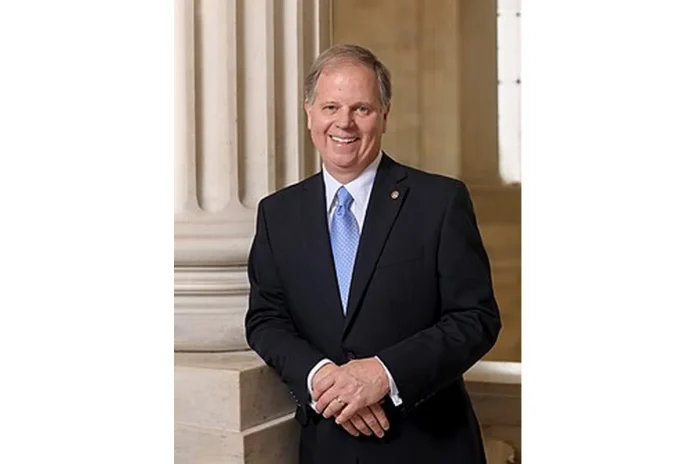
Doug Jones Bio
Gordon Douglas Jones (born May 4, 1954) is an American politician and attorney who served as a United States senator from Alabama from 2018 to 2021. A member of the Democratic Party, Jones built a long career in public service and the law, most notably as U.S. Attorney for the Northern District of Alabama from 1997 to 2001, where he led several high-profile civil rights and domestic terrorism prosecutions. He is considered a moderate Democrat and, as of 2025, is the last Democrat to have won statewide office in Alabama.
Early Life and Background
Doug Jones was born in Fairfield, Alabama, to Gordon and Gloria (Wesson) Jones. His father worked at U.S. Steel, and his mother was a homemaker, giving the family a working-class background rooted in Alabama’s industrial communities. Jones attended Fairfield High School, where he began to develop the interest in public affairs that would shape his later career.
He went on to earn a Bachelor of Science in political science from the University of Alabama in 1976, becoming a member of the Beta Theta Pi fraternity during his college years. Jones then attended the Cumberland School of Law at Samford University, where he received his Juris Doctor in 1979. His education in Alabama politics and law provided a strong foundation for the work he would later do as a prosecutor and senator.
Path to U.S. Politics
Jones’s political career began in Washington, D.C., where he served as staff counsel to the U.S. Senate Judiciary Committee for Alabama Senator Howell Heflin. After that role, he returned to Alabama and worked as an Assistant U.S. Attorney from 1980 to 1984, gaining early experience in federal prosecution. In 1988, Jones served as co-chair for Joe Biden’s 1988 presidential bid, a connection that would last for decades.
He resigned from the U.S. Attorney’s office in 1984 to enter private practice at a Birmingham law firm, where he worked until 1997. During this period, he also ran in the 1994 Democratic primary for District 6 of the Alabama House of Representatives, though he did not advance to the runoff. In 1997, President Bill Clinton appointed Jones as U.S. Attorney for the Northern District of Alabama, launching the most prominent chapter of his legal career.
Doug Jones Career
Early Career (1997–2001)
As U.S. Attorney for the Northern District of Alabama, Doug Jones took on several of the most significant cases in the region’s recent history. He prosecuted Thomas Edwin Blanton Jr. and Bobby Frank Cherry, two Ku Klux Klan members responsible for the 1963 16th Street Baptist Church bombing in Birmingham that killed four African-American girls. Blanton was found guilty in 2001 and Cherry in 2002, and both were sentenced to life in prison.
Jones also coordinated the federal and state response to the 1998 New Woman All Women Health Care Center bombing in Birmingham, linked to domestic terrorist Eric Rudolph. He successfully argued that Rudolph should be tried in Birmingham first before being extradited to Georgia. After leaving office in 2001, Jones returned to private practice, eventually founding the Birmingham firm Jones & Hawley, PC in 2013.
U.S. Senate Career (2018–2021)
Jones announced his candidacy for the 2017 U.S. Senate special election after Republican incumbent Jeff Sessions resigned to become U.S. Attorney General. He won the Democratic primary in August 2017 and faced former Alabama Supreme Court Justice Roy Moore in the general election. Although considered a long-shot in a deeply Republican state, Jones won the seat by roughly 22,000 votes, taking 50.0% to Moore’s 48.3%. He was sworn in on January 3, 2018, becoming the first Democrat to represent Alabama in the U.S. Senate in 21 years and the first Democrat elected to the seat in 25 years.
During his single term, Jones was known as a moderate who often worked across the aisle. He was one of five Democratic senators to vote for the January 2018 continuing resolution that led to a brief government shutdown, and he later voted to convict President Donald Trump in his first impeachment trial in February 2020. Newsweek described him as an economic populist, and a 2018 NBC News analysis noted that he voted with President Trump more often than all but three of his fellow Democratic senators while also supporting liberal positions such as LGBT rights.
Post-Senate Career (2021–Present)
After losing his 2020 reelection bid to Republican Tommy Tuberville in a 60% to 40% landslide, Jones transitioned into commentary and public policy work. In January 2021, he joined CNN as a political commentator and became a politics fellow at Georgetown University’s Institute of Politics and Public Service during the spring 2021 semester. In May 2021, he joined the law firm Arent Fox in Washington, D.C., and was also named a Distinguished Senior Fellow at the Center for American Progress.
In January 2022, President Joe Biden named Jones as his advisor for legislative affairs, helping guide the successful Supreme Court nomination of Ketanji Brown Jackson, who was confirmed on April 7, 2022. Jones later served as a distinguished Pritzker Fellow at the University of Chicago’s Institute of Politics during the fall of 2022. On November 24, 2025, he announced his candidacy for governor of Alabama.
Notable Events and Milestones
Jones’s career is defined by landmark civil rights and counterterrorism work, including the 2001 and 2002 convictions of two Klan members for the 1963 Birmingham church bombing and the coordination of the federal response to the Eric Rudolph bombings. He also secured a U.S. Senate seat in a special election decided by about 22,000 votes and later played a key advisory role in the confirmation of Supreme Court Justice Ketanji Brown Jackson in 2022.
Doug Jones Family
Family Background and Personal Life
Jones was raised in Fairfield, Alabama, by his father Gordon, a U.S. Steel worker, and his mother Gloria (Wesson) Jones, a homemaker. He married Louise New on December 12, 1992, the same day he won his Senate special election years later. The couple has three children. Jones has been a member of the Canterbury United Methodist Church in Mountain Brook for more than three decades and serves on the advisory board of the Blackburn Institute at the University of Alabama.
His son Carson is gay, and Jones has said that Carson’s experiences helped shape his support for same-sex marriage and broader LGBT rights. Jones’s father died of dementia on December 28, 2019, during his Senate term.