
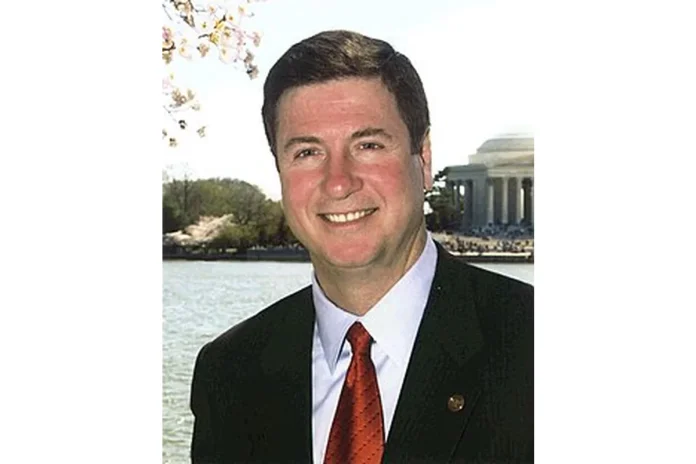
George Felix Allen Bio
George Felix Allen (born March 8, 1952) is an American politician and lawyer who served as a United States senator from Virginia from 2001 to 2007. A Republican, he previously served as the 67th governor of Virginia from 1994 to 1998 and represented parts of central Virginia in the Virginia House of Delegates from 1983 to 1991 before winning a 1991 special election to the U.S. House. As governor he advanced welfare reform, truth-in-sentencing, and education standards; as senator he chaired the National Republican Senatorial Committee and worked on technology and nanotechnology policy.
Early Life and Background
George Felix Allen was born in Whittier, California on March 8, 1952. His father, George Herbert Allen, was a National Football League coach who was inducted into the Pro Football Hall of Fame in 2002. During his mother’s background, Allen referred to her as being “French-Italian, with a little Spanish blood in her.” He has a younger sister, Jennifer, an author and correspondent for NFL Network, and two brothers, including Bruce Allen, a former NFL team executive. The family moved frequently due to his father’s coaching career, living in California, Chicago, and returning to Southern California when his father became head coach of the Los Angeles Rams in 1966.
Allen graduated in 1970 from Palos Verdes High School, where he was a member of the falconry club and the car club, and served as quarterback of the varsity football team. He then attended the University of California, Los Angeles, for a year before transferring to the University of Virginia in 1971, where he received a B.A. degree with distinction in history in 1974. At UVA, he was class president in his fourth year and played on the university’s football and rugby teams.
After graduating, Allen completed a Juris Doctor degree from the University of Virginia School of Law in 1977. In 1976, he was the chairman of “Young Virginians for Ronald Reagan.” Out of law school, he served as a law clerk for Judge Glen Morgan Williams of the United States District Court for the Western District of Virginia.
Path to US Politics
Allen entered Virginia politics in 1979 when he ran for the Virginia House of Delegates in the 26th House District, placing third in a field of four candidates. He ran again in 1982 for the House in the 58th House District and won the election, defeating incumbent Democrat James B. Murray by 25 votes out of nearly 14,000 cast. He faced Murray again in a 1983 rematch, defeating him 53%–47%. He ran unopposed in 1985, 1987, and 1989, representing a seat previously held by Thomas Jefferson.
During his time in the House of Delegates, Allen established himself as a conservative advocate. He was a strong supporter of the death penalty, introducing bills that would add murder in commission of an attempted robbery to the list of capital crimes. He also supported a statewide referendum on creating a state lottery system and in 1986, proposed a referendum allowing assets of illegal drug dealers to go to law enforcement. His legislative work in the House positioned him for higher office as he built a reputation as a conservative willing to take strong positions on key issues.
George Felix Allen Career
Early Career (1983–1993)
In 1991, Allen won a special election for Virginia’s 7th congressional district after incumbent Republican U.S. Representative D. French Slaughter Jr. resigned due to health issues. Allen defeated Slaughter’s cousin, Kay Slaughter, who was also a Charlottesville City Councilor, with 64% of the vote. He served in the U.S. House of Representatives for the remainder of the 102nd Congress. During his brief congressional tenure, Allen established his conservative credentials and positioned himself for a statewide run.
After redistricting eliminated his district in 1992, Allen decided against running for a full term. Instead, he sought the governorship of Virginia in the 1993 election. His opponent, Democratic Attorney General Mary Sue Terry, held an early 29-point lead in polls and a significant fundraising advantage. However, Allen’s campaign promise to abolish parole resonated during a surge in crime in the state, and he benefited from the 1994 Republican wave. He defeated Terry with 58.3% of the vote, the largest margin since 1961.
Governor of Virginia Era (1994–1998)
As governor, Allen implemented several significant conservative policies. In 1995, he signed a bipartisan welfare reform bill that created the Virginia Initiative for Employment Not Welfare (VIEW), which limited Temporary Assistance to Needy Families benefits to two years and required recipients to work within ninety days of receiving benefits. Following VIEW’s implementation, welfare caseloads decreased by 33%, and in areas where VIEW existed for twelve months, 74% of recipients were employed compared to only 31% nationally.
Allen also fulfilled his campaign promise to implement truth-in-sentencing legislation, abolishing parole for those convicted of felonies after January 1, 1995. The law ensured that inmates serve a minimum of 85% of their sentence, causing first-degree murderers to go from serving 29% of their imposed sentence to 91%. Additionally, Allen championed education reform by implementing the Standards of Learning (SOLs) program, which established statewide standardized tests to measure student achievement in core subjects. These initiatives established Allen as a leading conservative governor and positioned him for a potential presidential run.
U.S. Senate Era (2001–2007)
In 2000, Allen was elected to the United States Senate, defeating two-term Democratic incumbent Chuck Robb with 52% of the vote. He was the only Republican to unseat a Democratic incumbent that year. As a senator, Allen served on the Commerce, Science, and Transportation Committee, the Small Business and Entrepreneurship Committee, the Foreign Relations Committee, and the Energy and Natural Resources Committee.
Allen was elected as Chairman of the National Republican Senatorial Committee in 2002, overseeing a net gain of four seats for Republicans in the 2004 Senate elections. He also co-sponsored bipartisan legislation promoting nanotechnology research and development, which became the 21st century Nanotechnology Research & Development Act in 2003. Allen was the founding Chair of the Congressional Nanotechnology Caucus and later joined the board of Nano Risk Assessment, Inc. in 2009. His Senate career was notable for both policy achievements and the controversial “macaca incident” that contributed to his defeat in 2006.
Notable Events and Milestones
One of the most significant moments in Allen’s political career occurred during his 2006 Senate reelection campaign. At a campaign stop in Breaks, Virginia, he used the racist slur “macaca” to refer to S. R. Sidarth, who was filming the event as a “tracker” for the opposing Jim Webb campaign. The remarks went viral and became a major news item, with Allen’s defeat widely attributed to this “macaca moment.” Webb won by approximately a third of a percent, with 9,329 votes separating the candidates.
George Felix Allen Career Wins
Throughout his political career, George Allen has secured several significant victories across different levels of government, establishing himself as a prominent conservative voice in Virginia and national politics. His wins spanned local, state, and federal offices, with each victory building his political influence and conservative credentials.
Political Office Highlights
Allen’s most notable electoral victories include his 1993 election as Governor of Virginia, where he defeated incumbent Attorney General Mary Sue Terry by 58.3% to 40.9%, a margin of 17.4 points. His 2000 Senate victory against incumbent Chuck Robb was particularly significant as he was the only Republican that year to defeat a Democratic incumbent. Allen also won five consecutive elections to the Virginia House of Delegates (1982, 1983, 1985, 1987, and 1989), each time with increasing margins of victory.
Other Wins & Achievements
Beyond electoral victories, Allen achieved significant policy success as governor. His welfare reform initiative, VIEW, reduced welfare caseloads by 33% and saved taxpayers approximately $70 million over three years. His truth-in-sentencing legislation transformed Virginia’s criminal justice system by eliminating parole and requiring inmates to serve 85% of their sentences. Allen also successfully implemented the Standards of Learning program, earning an “exemplary” rating from the American Federation of Teachers in core subjects.
| Position | Won | Year |
|---|---|---|
| Virginia House of Delegates | 5 | 1982-1991 | 1 | 1993 |
| U.S. Senate | 2 | 2000, 2006 (lost) |
George Felix Allen Family
Family Background and Political Lineage
George Felix Allen was born into a family with notable sports connections. His father, George Herbert Allen, was a successful National Football League coach inducted into the Pro Football Hall of Fame in 2002. Allen’s family frequently relocated due to his father’s coaching career, living in California, Illinois, and Virginia. He has a younger sister, Jennifer, who became an author and correspondent for NFL Network, and two brothers, including Bruce Allen, who served as an NFL team executive.
Personal Life
Allen has been married twice. He first married Anne Patrice Rubel in June 1979, but the couple divorced in 1983. In 1986, he married Susan Brown, and together they have three children. The Allens reside in Virginia Beach, Virginia. Allen is a member of the Presbyterian Church and is known for frequently using football metaphors in his speeches and public remarks, a tendency that has been noted by journalists and political commentators throughout his career.