

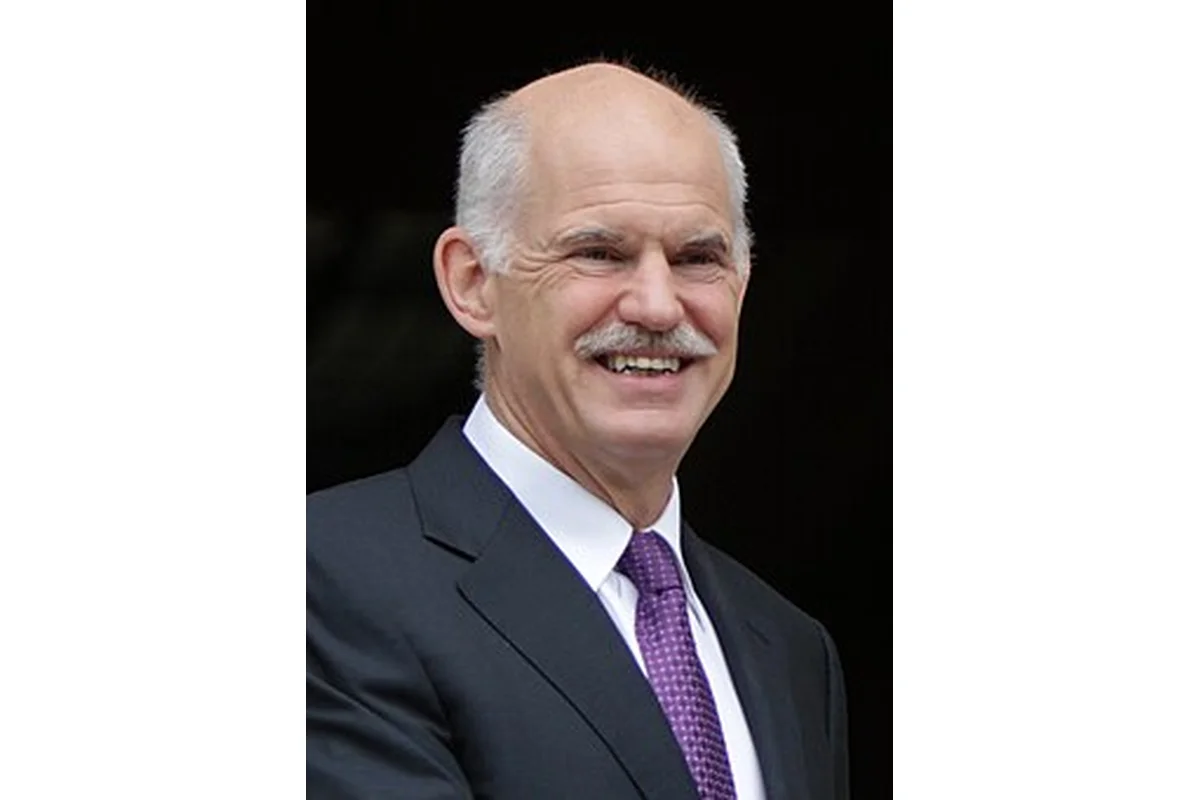
George Papandreou Bio
George Andreas Papandreou (born 16 June 1952) is an American-born Greek politician who served as the 182nd Prime Minister of Greece from October 2009 to November 2011. A member of the storied Papandreou political dynasty, he led the Panhellenic Socialist Movement (PASOK) from 2004 to 2012 and served as president of the Socialist International from 2006 to 2022. His tenure as prime minister was dominated by the Greek government-debt crisis, during which his government secured Greece’s first international bailout and introduced sweeping austerity measures. In 2015, he founded the Movement of Democratic Socialists and returned to the Hellenic Parliament in 2019 representing Achaea.
Early Life and Background
George Andreas Papandreou was born on 16 June 1952 in Saint Paul, Minnesota, in the United States. His father, Andreas Papandreou, was a Greek economist who at the time held a professorship at the University of Minnesota, and his mother was the American-born Margaret Papandreou, née Chant. He renounced his United States citizenship in 2000. He grew up partly in the United States, partly in Sweden, and finished his secondary education at King City Secondary School near Toronto in Canada in 1970.
He went on to attend Amherst College in Massachusetts, earning a Bachelor of Arts in sociology in 1975, and later obtained a Master of Science in sociology from the London School of Economics in 1977. He also studied at Stockholm University, where he conducted research on immigration issues during 1972–73, and was a fellow at the Foreign Relations Center of Harvard University in 1992–93. At Amherst, he was a friend and dormitory roommate of Antonis Samaras, who would later become a political rival and prime minister of Greece.
Path to Politics
The younger George Papandreou moved to Greece after the restoration of Greek democracy in 1974 and joined the political party his father had founded, the Panhellenic Socialist Movement (PASOK). He became active in the party’s central committee in 1984 and was elected to the Greek Parliament in 1981 as MP for the constituency of Achaea, the same year his father became prime minister. He was first appointed to government as Under Secretary for Cultural Affairs in 1985, signaling the start of a long ministerial career.
He served as Minister of Education and Religious Affairs in 1988, returned to the same portfolio in 1994–1996, and was Deputy Minister of Foreign Affairs in 1993 and again in 1996. In 1997, he served as Minister Responsible for Government Coordination for the 2004 Olympic Games bid. In his second term as education minister, he became the first politician in Greece to introduce affirmative action, allocating five percent of university posts for the Muslim minority in Thrace, and he helped initiate the Open University of Greece.
George Papandreou Career
Early Career (1981–1998)
George Andreas Papandreou’s parliamentary career began in 1981 when he was elected as MP for Achaea at the age of 29. Throughout the 1980s and 1990s, he built experience in a series of junior and senior cabinet posts, working closely with both his father Andreas Papandreou and Prime Minister Costas Simitis. His portfolio centered on education, religious affairs, and cultural policy, before he transitioned into foreign affairs.
During this formative period, he developed a reputation for institutional reform and outreach to neighboring countries. His work in the education portfolio and his coordination of the 2004 Olympic bid positioned him as a modernizing figure within PASOK, while his growing fluency in regional diplomacy laid the groundwork for his later appointment as foreign minister.
Foreign Affairs Breakthrough (1999–2004)
In February 1999, George Papandreou was appointed Minister for Foreign Affairs under Prime Minister Costas Simitis, a role he held until 2004. In that capacity, he fostered closer relations with Turkey and Albania, worked to resolve tensions surrounding the Macedonia naming dispute, and stated in 1999 that he supported Turkey’s application to join the European Union. He also engaged in efforts to solve the long-running dispute over Cyprus.
His diplomatic profile earned him international recognition. In December 2003, the publication European Voice shortlisted him for nomination of the Europeans of the Year award as Diplomat of the Year, calling him The Bridge-Builder and quoting Le Monde, which dubbed him the architect of Greek-Turkish rapprochement. He is also a founding member of the Helsinki Citizens’ Assembly.
PASOK Leadership Era (2004–2012)
In January 2004, with PASOK facing a likely defeat in the upcoming elections, Prime Minister Costas Simitis passed the party leadership to George Papandreou. On 8 February 2004, PASOK introduced open primaries for the election of party leadership, a move Papandreou championed to democratize the party and break from the tradition of dynastic politics. In May 2005, he was elected vice president of the Socialist International, and in January 2006 he was unanimously elected president of the Socialist International.
Under his leadership, PASOK lost the 2007 general election to Kostas Karamanlis’s New Democracy party, and Papandreou briefly faced an internal challenge from Evangelos Venizelos and Kostas Skandalidis before retaining control of the party in a leadership contest that November. In June 2009, PASOK under Papandreou won the 2009 European Parliament election in Greece. Four months later, in October 2009, PASOK won the general elections with 43.92 percent of the popular vote against New Democracy’s 33.48 percent, securing 160 parliamentary seats and clearing the way for Papandreou to become prime minister.
Prime Minister Era (2009–2011)
George Andreas Papandreou was inaugurated as the 182nd Prime Minister of Greece on 6 October 2009. Shortly after taking office, his government revealed that the country’s fiscal deficit reached 12.7 percent of GDP, roughly four times the eurozone limit, while public debt stood at 410 billion dollars. Papandreou responded by promoting austerity measures, cutting spending, raising taxes, freezing additional hiring, and introducing measures to combat widespread tax evasion and reduce the public sector. The reforms triggered a wave of nationwide strikes and protests.
On 23 April 2010, during a visit to the island of Kastelorizo, Papandreou announced that he had instructed his finance minister to officially request activation of the European Union’s support mechanism. On 9 May 2010, his government secured a 110 billion euro bailout package from the European Union and the International Monetary Fund. In October 2011, with his approval ratings collapsing, Papandreou proposed a referendum on the eurozone bailout, then scrapped it after fierce criticism. After surviving a narrow confidence vote on 5 November 2011, he agreed to step aside in favor of a national unity government. He formally resigned on 10 November 2011, and a coalition headed by former European Central Bank vice president Lucas Papademos was sworn in on 11 November 2011.
Comeback and Movement for Change (2012–Present)
In August 2012, George Papandreou was re-elected president of the Socialist International at its congress in Cape Town. In January 2015, he left PASOK and founded his own party, the Movement of Democratic Socialists (KIDISO), to contest that month’s parliamentary elections. The party received 2.46 percent of the vote, falling short of the three percent threshold needed to enter Parliament and ending the Papandreou family’s continuous presence in the Hellenic Parliament since 1923.
In 2017, KIDISO joined the Democratic Alignment, a centre-left coalition that later evolved into Movement for Change. Papandreou was re-elected president of the Socialist International in Cartagena, Colombia, in March 2017, a post he held until November 2022. In the 2019 Greek legislative election, Movement for Change emerged as the third most voted-for party, and Papandreou returned to Parliament as an MP for Achaea. On 20 October 2021, he announced his candidacy for the leadership of Movement for Change in Greece.
George Papandreou Career Wins
George Andreas Papandreou’s career is marked by several major political victories, including winning the 2009 Greek general election, securing Greece’s first international bailout during the 2009–2011 debt crisis, and returning to the Hellenic Parliament in 2019 after an absence.
Parliamentary and Leadership Highlights
Papandreou was first elected to the Greek Parliament in 1981 as MP for Achaea. He became leader of PASOK in 2004 and led the party to victory in the October 2009 general election, winning 43.92 percent of the vote and 160 parliamentary seats. He returned to Parliament in 2019 as MP for Achaea representing the Movement for Change.
International Leadership Highlights
In addition to his domestic record, Papandreou served as president of the Socialist International from January 2006 to November 2022, a tenure of more than 16 years. He also secured Greece’s first international bailout, a 110 billion euro package from the European Union and the International Monetary Fund in May 2010, a defining moment of his premiership.
George Papandreou Family
Family Background and Political Lineage
George Andreas Papandreou belongs to one of Greece’s most prominent political dynasties. His father, Andreas Papandreou, founded PASOK and served as prime minister, while his paternal grandfather, Georgios Papandreou, was a three-time prime minister of Greece. He has two younger brothers, Nikos Papandreou and Andreas Papandreou, and two younger sisters, Sophia Papandreou and Emilia Nyblom. One of his paternal great-grandfathers, Zygmunt Mineyko, was an army officer and engineer of Polish-Lithuanian descent.
Personal Life
George Andreas Papandreou was first married to Evanthia Zissimidou from 1976 to 1987, with whom he has a son, Andreas, born in 1982. He later married Ada Papapanou, with whom he has a daughter, Margarita-Elena, born in 1990; the couple divorced in 2016. Apart from Greek and English, he is fluent in Swedish.