

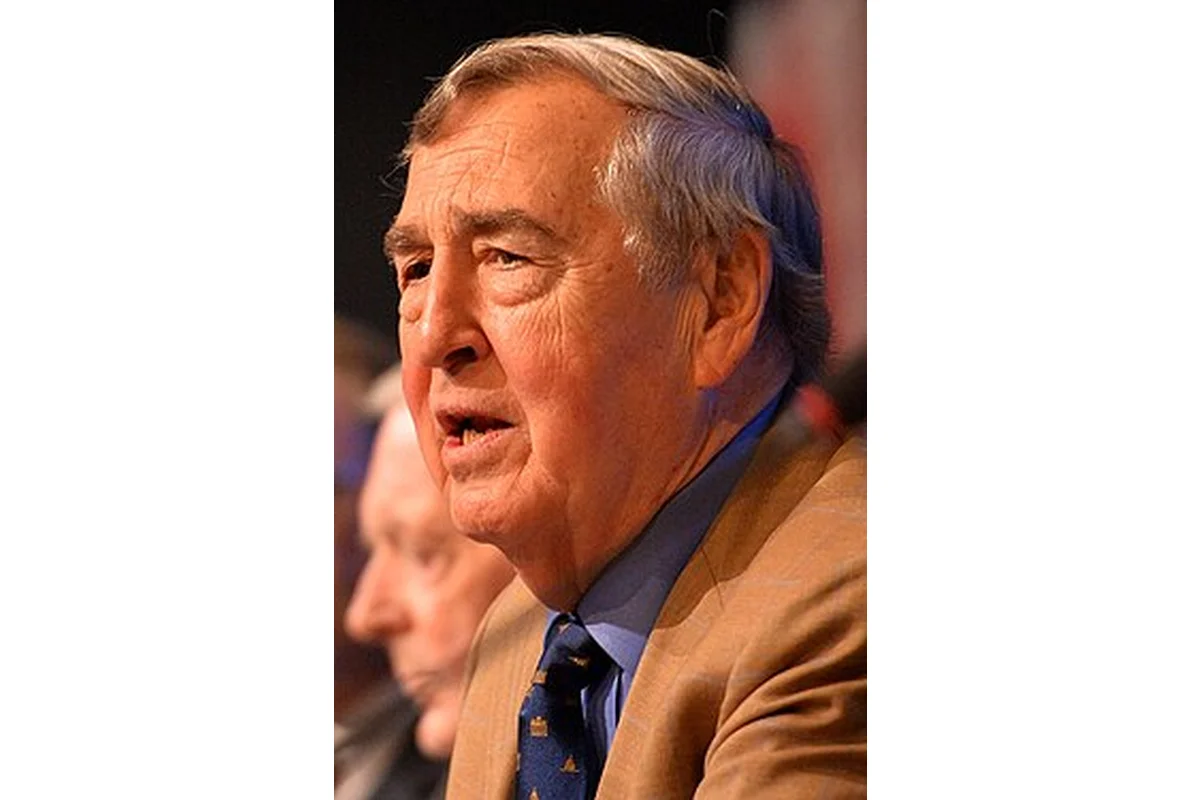
Graham Allison Bio
Graham Tillett Allison Jr. (born 23 March 1940) is an American political scientist and the Douglas Dillon Professor of Government at the Harvard Kennedy School. He is best known for pioneering organizational and bureaucratic models of decision-making in Essence of Decision (1971), which transformed the study of crisis-era foreign-policy choices. Allison served as dean of the Kennedy School from 1977 to 1989, directed the Belfer Center for Science and International Affairs from 1995 to 2017, and has advised U.S. defense policy across multiple administrations. His later work focuses on great-power competition, and he popularized the concept of the “Thucydides Trap” to analyze rising tensions between the United States and China.
Early Life and Background
Graham Tillett Allison Jr. was born on 23 March 1940 in Charlotte, North Carolina. He grew up in the city during the post-World War II era and came of age as the United States emerged as a global superpower competing with the Soviet Union. These early Cold War surroundings helped shape his lifelong interest in government decision-making and international security.
Allison graduated from Myers Park High School in 1958, completing his secondary education in Charlotte. He then spent two years at Davidson College before transferring to Harvard University, where he earned a Bachelor of Arts degree in 1962. Selected as a Marshall Scholar, Allison continued his studies at Oxford University, completing both a Bachelor of Arts and a Master of Arts in philosophy, politics, and economics in 1964. He returned to Harvard to finish a Ph.D. in political science in 1968, studying under future Secretary of State Henry Kissinger, who was one of his professors.
Path to Political Science
Allison’s path into political science was forged through a combination of rigorous academic training and exposure to high-level policy thinking at Harvard. His graduate work coincided with the Cuban Missile Crisis of 1962, an event that exposed the limits of rational-actor explanations of state behavior and pointed him toward studying how organizations and bureaucracies actually make decisions under pressure.
His doctoral research, completed in 1968, became the foundation for his first major book. That same year, Allison was appointed assistant professor in Harvard’s Department of Government, beginning a long academic career at his alma mater. Mentors such as Henry Kissinger and the wider Harvard policy community helped him connect scholarship to practice, setting the stage for his rise within the Kennedy School.
Graham Allison Career
Early Career (1968–1976)
Graham Allison joined Harvard’s Department of Government as an assistant professor in 1968, was promoted to associate professor in 1970, and became a full professor in 1972. His academic reputation grew rapidly with the 1971 publication of Essence of Decision: Explaining the Cuban Missile Crisis, which introduced an organizational process model and a bureaucratic politics model to challenge the prevailing rational-actor framework in foreign policy analysis. The book reshaped the study of decision-making in political science and beyond.
During the mid-1970s, Allison broadened his focus to organizational reform in government. With Peter L. Szanton, he co-wrote Remaking Foreign Policy: The Organizational Connection, published in 1976, which examined how U.S. foreign policy institutions could be restructured to produce better outcomes. The book influenced the foreign policy thinking of the incoming Carter administration and helped establish Allison as a leading voice on institutional design.
Harvard Kennedy School Breakthrough (1977–1989)
In 1977, Graham Allison was appointed dean of the Harvard Kennedy School, a position he held for twelve years. Over the course of his tenure, the school grew dramatically in size and resources, expanding fourfold in size while its endowment increased sevenfold. Under his leadership, the Kennedy School strengthened its focus on national security, public management, and international affairs.
During these years Allison also deepened his involvement in defense and foreign policy debates outside the university. He was a fellow of the Center for Advanced Studies from 1973 to 1974 and served on the Brookings Institution’s visiting committee on foreign policy studies between 1972 and 1977. In 1979, the Faculty of Social Sciences at Uppsala University in Sweden awarded him an honorary doctorate in recognition of his scholarly contributions.
Belfer Center Era (1995–2017)
After leaving the deanship, Allison continued to expand his policy role in Washington. From 1993 to 1994, he was associated with the Assistant Secretary of Defense for Policy and Plans, where he coordinated strategy toward the states of the former Soviet Union. President Bill Clinton awarded him the Department of Defense Medal for Distinguished Public Service for his work in reshaping relations with Russia, Ukraine, Belarus, and Kazakhstan to reduce the former Soviet nuclear arsenal.
In 1995, Allison became director of the Belfer Center for Science and International Affairs at the Kennedy School, a position he held for more than two decades until 2017, when he was succeeded by former U.S. Secretary of Defense Ash Carter. Under Allison’s leadership the Belfer Center became a leading hub for research on nuclear strategy, terrorism, and great-power competition. In 2009 the National Academy of Sciences honored him with the NAS Award for Behavior Research Relevant to the Prevention of Nuclear War.
Thucydides Trap and Recent Work (2012–Present)
In 2012, writing in the Financial Times, Allison coined the term “Thucydides Trap” to describe the dangerous dynamic that arises when a rising power threatens to displace a ruling power. Drawing on the History of the Peloponnesian War and cases such as the outbreak of World War I, he argued that war between the United States and China was not inevitable but historically likely unless both sides managed their rivalry carefully. The idea was later expanded into his 2017 book Destined for War and became a recurring reference point in U.S.-China policy discussions, including a 2017 paid opinion advertisement in The New York Times.
Allison continues to serve as Douglas Dillon Professor of Government at the Harvard Kennedy School. He remains a fellow of the National Academy of Public Administration, a member of the Council on Foreign Relations, and a long-standing member of the Secretary of Defense’s Defense Policy Board since 1985. At the 56th World Economic Forum, he proposed a “fourth U.S.-China communique” to manage bilateral tensions, an idea that drew both attention and criticism.
Graham Allison Family
Family Background
Public information about Graham Allison’s immediate family remains limited. He is married to Liz Allison, who has served as one of two trustees of the Stanton Foundation, a charitable organization that has supported research and education projects. The couple has been based in the Boston area, near Allison’s longtime academic home at Harvard.
Personal Life
Allison has kept much of his personal life out of the public eye, and verified details about children, parents, or other relatives are not widely available. His career has been shaped by long periods of service in Cambridge, Massachusetts, and Washington, D.C., where he has balanced scholarly work with government advisory roles.