
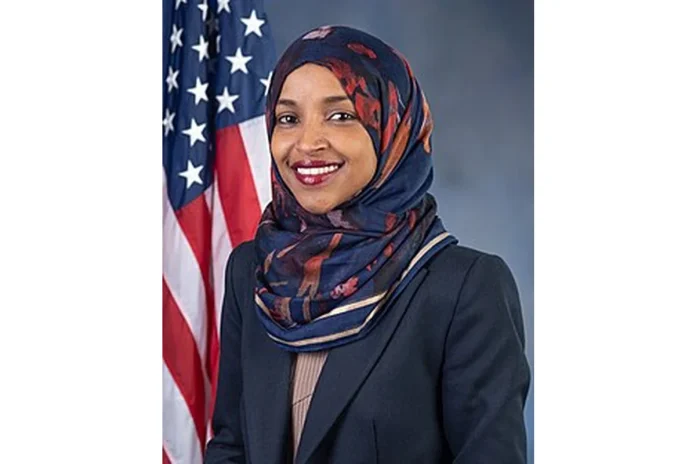
Ilhan Omar Bio
Ilhan Abdullahi Omar (born October 4, 1982) is an American politician serving as the U.S. representative for Minnesota’s 5th congressional district since 2019. A member of the Democratic–Farmer–Labor Party, she previously served in the Minnesota House of Representatives from 2017 to 2019. Omar is the first Somali American in the United States Congress, the first woman of color to represent Minnesota, and one of the first two Muslim women elected to Congress, alongside Rashida Tlaib.
Omar serves as deputy chair of the Congressional Progressive Caucus and has advocated for progressive policies such as Medicare for All, a $15–$17 minimum wage, student loan debt relief, the protection of Deferred Action for Childhood Arrivals, and abolishing U.S. Immigration and Customs Enforcement. She is a frequent critic of U.S. foreign policy and Israel, and she has received both public support and persistent threats because of her outspoken views. In 2020, HarperCollins published her memoir, This Is What America Looks Like.
Early Life and Background
Ilhan Abdullahi Omar was born in Mogadishu, Somalia, on October 4, 1982, and spent her early years in Baidoa, in southern Somalia. She was the youngest of seven siblings. Her father, Nur Omar Mohamed, was a colonel in the Somali Army under Siad Barre, served in the Ogaden War, and later worked as a teacher trainer. Her mother, Fadhuma Abukar Haji Hussein, died when Omar was two, and she was raised by her father and her grandfather, Abukar, who were moderate Sunni Muslims opposed to the rigid Wahhabi interpretation of Islam.
Omar and her family fled the Somali Civil War and spent four years in a Dadaab refugee camp in Garissa County, Kenya, before securing asylum in the United States in 1995. The family arrived in New York, then lived briefly in Arlington, Virginia, before settling in Minneapolis, where her father worked first as a taxi driver and later for the post office. Omar became a U.S. citizen in 2000, at age 17.
Her father and grandfather emphasized the importance of democracy, and at age 14 she accompanied her grandfather to caucus meetings, serving as his interpreter. She has spoken publicly about being bullied in school for her distinctive Somali appearance and for wearing the hijab, recalling her father’s response: “They are doing something to you because they feel threatened in some way by your existence.”
Path to US Politics
Omar attended Thomas Edison High School in Minneapolis, graduating in 2001 and volunteering as a student organizer. She went on to earn a bachelor’s degree in political science and international studies from North Dakota State University in 2011 and later served as a policy fellow at the University of Minnesota’s Humphrey School of Public Affairs.
Her early professional work included serving as a community nutrition educator at the University of Minnesota from 2006 to 2009 and as a child nutrition outreach coordinator at the Minnesota Department of Education in 2012–2013. She managed state and local campaigns, including Kari Dziedzic’s 2012 Minnesota State Senate reelection and Andrew Johnson’s 2013 Minneapolis City Council campaign, after which she served as Johnson’s senior policy aide from 2013 to 2015.
By 2015, Omar had become the Director of Policy Initiatives of the Women Organizing Women Network, encouraging East African women to pursue civic and political leadership. In February 2014, during a DFL caucus in Minneapolis, she was attacked and injured, sustaining a concussion, an experience that would later draw national attention. In September 2018, Roll Call called her a “progressive rising star.”
Ilhan Omar Career
Early Career (2016)
In 2016, Omar ran on the Democratic–Farmer–Labor ticket for the Minnesota House of Representatives in District 60B, which includes part of northeast Minneapolis. On August 9, she defeated Mohamud Noor and incumbent Phyllis Kahn in the DFL primary, then faced Republican nominee Abdimalik Askar in the general election, after Askar withdrew from the race in late August.
She won the general election in November 2016, becoming the first Somali-American state legislator in the United States. Her term began on January 3, 2017, and she served as an assistant minority leader for the DFL caucus, authoring 38 bills during the 2017–2018 legislative session.
Congressional Breakthrough (2018–2019)
On June 5, 2018, Omar filed to run for the United States House of Representatives from Minnesota’s 5th congressional district after six-term incumbent Keith Ellison announced he would not seek reelection. She was endorsed by the Minnesota Democratic–Farmer–Labor Party on June 17 and won the August 14 primary with 48.2% of the vote. She defeated Republican Jennifer Zielinski in the November 6 general election with 78.0% of the vote.
With that victory, Omar became the first Somali American elected to the U.S. Congress, the first woman of color to serve as a U.S. representative from Minnesota, and, alongside Michigan’s Rashida Tlaib, one of the first Muslim women elected to Congress. She received the largest percentage of the vote of any female candidate for U.S. House in Minnesota state history and was sworn in on a copy of the Quran owned by her grandfather. Following her election, the U.S. House modified its ban on head coverings, allowing Omar to become the first woman to wear a hijab on the House floor.
In 2019, she joined the informal congressional group known as “The Squad,” alongside Ayanna Pressley, Rashida Tlaib, and Alexandria Ocasio-Cortez, to push for progressive policies such as the Green New Deal and Medicare for All. The same year, she introduced a House resolution protecting the right to participate in boycotts in pursuit of civil and human rights, and she was one of 17 members of Congress to vote against a House resolution condemning the BDS movement.
Reelection Era (2020–Present)
Omar won the August 11, 2020 Democratic primary with 57.4% of the vote over mediation lawyer Antone Melton-Meaux, who had raised $3.2 million in April–June 2020, much of it from pro-Israel groups. She went on to defeat Republican Lacy Johnson and Legal Marijuana Now Party candidate Michael Moore in the November 3 general election with 64.3% of the vote, securing a second term.
In 2022, she again faced former Minneapolis councilman Don Samuels in the August 9 Democratic primary, winning 50.3% to 48.2%, a margin of fewer than 2,500 votes. In February 2023, the Republican-controlled House voted to remove Omar from her seat on the Foreign Affairs Committee, citing past comments about Israel.
She won the August 13, 2024 Democratic primary with 56% of the vote over Samuels and two other challengers and was reelected to a fourth term with 75.3% of the vote. In September 2025, she introduced a war powers resolution to prevent the Trump administration from conducting future strikes in the Caribbean following a U.S. attack on a Venezuelan boat.
Notable Events and Milestones
In January 2021, Omar led a group of 13 House members introducing articles of impeachment against President Donald Trump on charges of high crimes and misdemeanors related to the 2020 presidential election and the attack on the U.S. Capitol. In July 2022, she was one of 18 members of Congress arrested during a protest for reproductive rights outside the Supreme Court Building after the Court overruled Roe v. Wade in Dobbs v. Jackson Women’s Health Organization. In September 2025, after the assassination of Charlie Kirk, Omar condemned political violence, which led to two Republican efforts to strip her of her committee assignments, one of which failed on September 17, 2025.
Ilhan Omar Career Wins
Ilhan Omar has built a record of electoral firsts since entering public office in 2016, becoming the first Somali-American state legislator in U.S. history, the first Somali American elected to Congress, the first woman of color to represent Minnesota in Congress, and one of the first Muslim women elected to the U.S. House of Representatives.
Minnesota House Highlights
Omar won the 2016 Democratic–Farmer–Labor primary for Minnesota House District 60B, defeating incumbent Phyllis Kahn and Mohamud Noor, before winning the November 2016 general election. As the first Somali-American state legislator, she served one term from 2017 to 2019.
U.S. Congress Highlights
Omar has won four U.S. House elections in Minnesota’s 5th congressional district, taking 78.0% of the vote in 2018, 64.3% in 2020, 75.3% in 2022, and 75.3% in 2024. She is the first Somali American, the first woman of color from Minnesota, and one of the first two Muslim women to serve in the U.S. Congress.
| Position | Wins | Year |
|---|---|---|
| Minnesota House, District 60B | 1 | 2016 |
| U.S. House, Minnesota’s 5th District | 4 | 2018, 2020, 2022, 2024 |
Ilhan Omar Family
Family Background and Political Lineage
Omar is the youngest of seven siblings, raised primarily by her father, Nur Omar Mohamed, a former Somali Army colonel and teacher trainer, and her grandfather, Abukar, who directed Somalia’s National Marine Transport. Her mother, Fadhuma Abukar Haji Hussein, died when Omar was two. Her grandfather introduced her to civic life by bringing her to local caucus meetings as a teenager, where she served as his interpreter.
Personal Life
Omar has been married three times. She entered an unofficial faith-based marriage with Ahmed Abdisalan Hirsi, with whom she had two children, including climate activist Isra Hirsi. In 2009, she married Ahmed Nur Said Elmi; the two legally divorced in 2017. In 2018, she legally married Hirsi, and the couple filed for divorce on October 7, 2019, with the divorce finalized on November 5, 2019. In March 2020, she married Tim Mynett, a political consultant.