
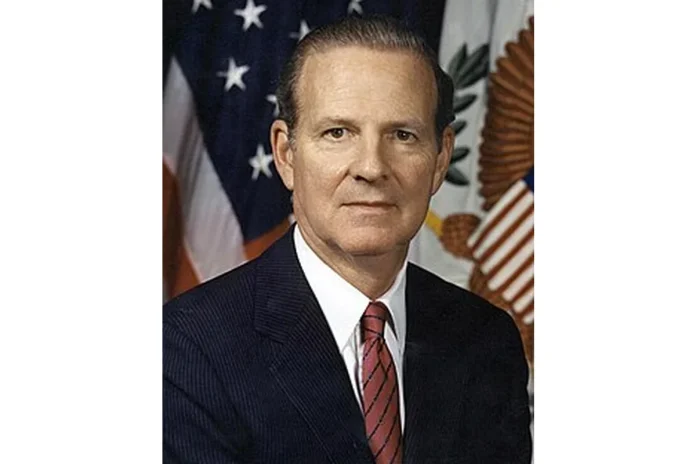
James Baker Bio
James Addison Baker III (born April 28, 1930) is an American statesman, attorney, diplomat, and former United States Marine Corps officer. A member of the Republican Party, he is best known as a top adviser to Presidents Ronald Reagan and George H. W. Bush, holding senior posts including White House Chief of Staff, Secretary of the Treasury, and Secretary of State. Across four decades of public service, Baker shaped tax reform, international monetary policy, and major diplomatic initiatives of the late twentieth century.
After leaving government, Baker returned to the private sector, co-founded a public policy institute, and continued to weigh in on elections and foreign policy through the 2000s. Since the death of Henry Kissinger in 2023, he is recognized as the oldest living former United States Secretary of State.
Early Life and Background
James Addison Baker III was born on April 28, 1930, in Houston, Texas, to James A. Baker Jr. and Bonner Means Baker. His father was a partner at the Houston law firm Baker Botts, which was founded by Baker’s great-grandfather in 1871. Baker grew up in a family that was active in the Democratic Party of one-party Texas, although his father strongly opposed Franklin D. Roosevelt and the New Deal.
Known as “The Warden” to his son and his friends, Baker’s father enforced strict discipline and warned his children away from politics. Baker later named his memoir Work Hard, Study…and Stay Out of Politics after the family maxims, which also included the “Five Ps” of preparation that he said guided him throughout his career. He was raised in Houston alongside his younger sister, Bonner Baker Moffitt.
Baker attended the Kinkaid School and the Hill School in Pennsylvania before enrolling at Princeton University, where he graduated with a Bachelor of Arts. He also played on the Princeton rugby team, the setting in which he met his future first wife. After Princeton, Baker served in the United States Marine Corps, rising to the rank of captain during the Korean War era. He then earned his law degree from the University of Texas School of Austin.
Path to US Politics
Baker’s political career began in Houston law and Republican fundraising, where he became a close friend of George H. W. Bush. He worked on Bush’s unsuccessful 1970 campaign for the United States Senate, his failed 1970 Senate bid, and later served briefly as Under Secretary of Commerce in the Nixon administration. In 1976, Baker ran President Gerald Ford’s re-election campaign after the ouster of original chairman Rogers Morton, gaining national experience in national-level political management.
After losing a 1978 race for Texas Attorney General, Baker shifted to appointed positions and campaign work rather than elected office. In 1979 and 1980, he managed George H. W. Bush’s bid for the Republican presidential nomination. When Bush became Ronald Reagan’s running mate, Baker joined the Reagan campaign as the debate negotiator, helping to shape the schedule that set the final Reagan–Carter debate just days before the election.
Baker’s role in the 1980 Reagan campaign earned him the trust of the incoming president, and Reagan selected him as White House Chief of Staff. That appointment launched Baker’s most influential period in American government and set the stage for the four major posts he would hold in the decade that followed.
James Baker Career
Early Career (1981–1985)
Baker served as the 10th White House Chief of Staff from 1981 to 1985, a tenure that coincided with the early Reagan revolution. Together with Counselor Edwin Meese III and Deputy Chief of Staff Michael Deaver, Baker formed the “Troika,” an informal arrangement that controlled access to the president and the hiring and firing of senior staff. Reporters and historians have credited the Troika with focusing the Reagan White House and giving Baker unusual influence over day-to-day governing.
During his first stint as Chief of Staff, Baker also played a central role in passing the 1981 economic program of tax and budget reform. He later managed Reagan’s 1984 re-election campaign, in which Reagan won 525 electoral votes and 58.8 percent of the popular vote against Walter Mondale. The smooth 1984 operation cemented Baker’s reputation as a top-tier political strategist and positioned him for the Treasury Department.
Tax Reform and the Plaza Accord (1985–1988)
In early 1985, Reagan named Baker the 67th United States Secretary of the Treasury. At Treasury, Baker shepherded the Tax Reform Act of 1986, a major overhaul that lowered top individual rates while simplifying the tax code. He also served on the Economic Policy Council and contributed to the development of the American Silver Eagle and American Gold Eagle bullion coins released in 1986.
On the international side, Baker convened finance ministers from Japan, France, West Germany, and the United Kingdom at the Plaza Hotel in New York in September 1985. The resulting Plaza Accord aimed to weaken an overvalued US dollar by coordinating central bank sales of American currency. A follow-on agreement, the Louvre Accord of early 1987, helped stabilize the dollar after it had fallen by roughly 40 percent.
Secretary of State (1989–1992)
Baker resigned as Treasury Secretary in 1988 to manage George H. W. Bush’s successful presidential campaign. After the election, Bush appointed him the 61st United States Secretary of State. In that role, Baker helped shape American foreign policy during the end of the Cold War, the reunification of Germany, and the 1990–1991 Gulf War.
Baker’s Middle East diplomacy included patient shuttle work that built the international coalition that expelled Iraqi forces from Kuwait. He also worked on frameworks for the Israeli–Palestinian peace process, and his tenure saw the release of Soviet Jewish refuseniks and high-profile hostage negotiations. In 1992, he left the State Department to return to the White House as Chief of Staff for Bush’s unsuccessful re-election bid.
Post-Government Service (1993–Present)
After Bush’s 1992 defeat, Baker rejoined the law firm Baker Botts and the private equity firm The Carlyle Group. He served as a consultant to Enron in the mid-1990s and later served as the United Nations Personal Envoy for Western Sahara from 1997 to 2004, leaving behind the Baker II plan. In 2000, he led the legal team that managed George W. Bush’s Florida recount effort, helping to secure the presidency for the Bush family.
In 2006, Baker co-chaired the Iraq Study Group, a bipartisan panel that recommended a new direction in US Iraq policy. He also co-founded the James A. Baker III Institute for Public Policy at Rice University and later the Climate Leadership Council, which proposed a carbon fee-and-dividend approach to climate change. Through the 2010s and into the 2020s, he has remained an active voice in Republican foreign policy debates.
Notable Events and Milestones
Among Baker’s signature achievements are the 1986 tax reform law, the 1985 Plaza Accord, the diplomatic coalition behind the Gulf War, and the 2000 Florida recount victory for George W. Bush. He was elected a Fellow of the American Academy of Arts and Sciences in 2008, and the Baker Institute at Rice University stands as a long-running contribution to policy research. His memoir, The Politics of Diplomacy, was published in 1995, followed by a second memoir in 2006.
James Baker Career Wins
While James Baker is not a candidate in traditional elections, his “career wins” are the high-stakes political and policy victories he has orchestrated over four decades. From managing presidential campaigns to negotiating international agreements, Baker has played a central role in some of the most consequential political outcomes of the modern Republican Party.
Campaign and Election Highlights
Baker managed George H. W. Bush’s winning 1988 presidential campaign and helped deliver Reagan’s 1984 re-election landslide. He led the Republican legal effort during the 2000 Florida recount that decided the presidency in favor of George W. Bush, and he ran Gerald Ford’s 1976 re-election effort and Reagan’s 1980 debate operation, sharpening Republican strategy at the highest levels.
Other Wins and Achievements
Beyond campaigns, Baker’s most lasting policy wins include the Tax Reform Act of 1986, the Plaza Accord, and the international coalition that won the Gulf War. He also helped shape the orderly German reunification process and contributed to bipartisan reports, including the 2006 Iraq Study Group. His founding of the Baker Institute at Rice University continues to influence public policy research and education.
James Baker Family
Family Background and Political Lineage
Baker is a member of one of Houston’s most prominent legal and political families. His father, James A. Baker Jr., was a partner at the firm Baker Botts, and his great-grandfather founded the firm in 1871. The Baker family was active in Texas Democratic politics through the mid-twentieth century, even as Baker’s father remained a sharp critic of the New Deal.
Though Baker’s father forbade his children from entering politics, Baker eventually became one of the most influential Republican strategists of his generation. His sister, Bonner Baker Moffitt, who struggled with schizophrenia, predeceased him in 2015. Several of Baker’s sons later joined Baker Botts and the family’s global advisory work.
Personal Life
In 1953, Baker married Mary Stuart McHenry of Dayton, Ohio, with whom he had four sons: James Addison Baker IV, Stuart McHenry Baker, John Coalter Baker, and Douglas Bland Baker. Mary Stuart Baker died of breast cancer in 1970, and in 1973, Baker married Susan Garrett Winston, a close friend of his first wife. Together, James and Susan had a daughter, Mary Bonner Baker, born in 1977.
Baker is an avid hunter and has taken safaris in Africa and hunting trips in Wyoming and Scotland. The Bakers own a 1,555-acre property near Boulder, Wyoming, called Silver Creek Ranch. In 2002, Baker’s seven-year-old granddaughter, Virginia Graeme Baker, drowned in a spa due to suction entrapment, an event that led the family to champion the Virginia Graeme Baker Pool and Spa Safety Act.