
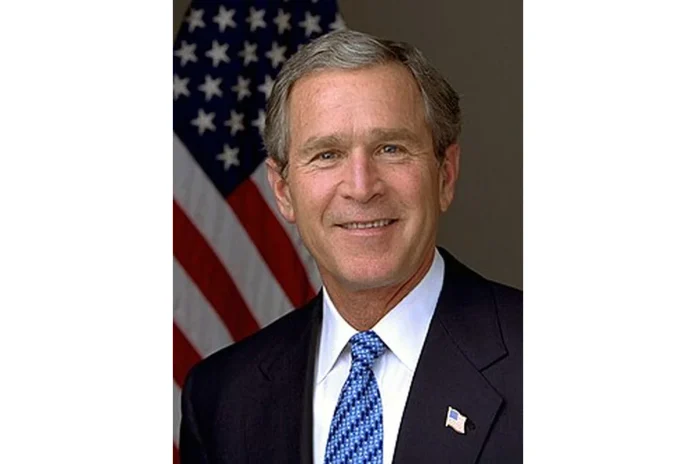
George W. Bush Bio
George Walker Bush is an American politician, businessman, and former military officer who served as the 43rd president of the United States from 2001 to 2009. A member of the Republican Party, he previously served as the 46th governor of Texas from 1995 to 2000. He is the eldest son of the 41st president, George H. W. Bush, and the husband of Laura Welch Bush.
Born into the prominent Bush family in New Haven, Connecticut, Bush built a career in business and politics before reaching the White House. His presidency was shaped by the response to the September 11, 2001 attacks, the wars in Afghanistan and Iraq, and major domestic initiatives including tax cuts and education reform. He is one of the most consequential and debated presidents in modern American history.
Early Life and Background
George Walker Bush was born on 6 July 1946 in New Haven, Connecticut, into one of the most prominent political families in the United States. His father, George H. W. Bush, later became the 41st president, and his mother, Barbara Bush, served as First Lady during that administration. After his early years in New Haven, the family moved to Midland, Texas, where Bush attended public schools through seventh grade before relocating to Houston.
Bush completed his secondary education at The Kinkaid School in Piney Point Village, Texas, and later at Phillips Academy, a boarding school in Andover, Massachusetts, where he played baseball and served as head cheerleader during his senior year. He went on to attend Yale University, graduating in 1968 with a Bachelor of Arts degree in history. During his time at Yale, he was a member of the Delta Kappa Epsilon fraternity and a cheerleader, and he became a member of the Skull and Bones society as a senior.
In the fall of 1973, Bush entered Harvard Business School, where he earned a Master of Business Administration degree in 1975. He remains the only U.S. president to have earned an MBA. He characterized himself as an average student during his academic years and credited his Yale and Harvard experiences with shaping his later career in business and public service.
Path to US Politics
After graduating from Harvard Business School in 1975, Bush entered the oil industry in Texas, where he built a career as a businessman over the following decade. In his twenties, he also served in the Texas Air National Guard, flying warplanes during a period that would later become a topic of public discussion. His early business ventures laid the financial foundation for his later entry into public life.
Bush co-owned the Major League Baseball team the Texas Rangers, an experience that raised his public profile in Texas and gave him direct exposure to media, management, and civic life. The visibility from his role with the team helped position him for a political career in the state. In 1994, he was elected governor of Texas, beginning his formal career in US politics.
As governor from 1995 to 2000, Bush sponsored legislation for tort reform, increased education funding, raised standards for schools, and reformed the criminal justice system. He also helped make Texas the leading producer of wind-generated electricity in the United States, an early signal of his interest in energy policy. His record in Texas established him as a leading figure in the Republican Party and a credible national candidate.
George W. Bush Career
Early Career (1975–1994)
Following his graduation from Harvard Business School, Bush worked in the Texas oil industry, where he developed professional experience in energy and investment. He co-owned the Texas Rangers baseball franchise, an association that brought him public attention and business credentials. During this period, he also continued his military service in the Texas Air National Guard.
By the early 1990s, Bush had built the financial resources and name recognition needed to pursue elected office. His family name, business record, and Texas connections made him a natural candidate within the Republican Party. In 1994, he won the Texas gubernatorial race, launching his career in elected politics.
Texas Governorship (1995–2000)
Bush served as the 46th governor of Texas from 1995 to 2000, winning re-election in 1998 by a wide margin. He pursued a policy agenda that included tort reform, expanded education funding, higher academic standards, and changes to the criminal justice system. His bipartisan approach on some issues allowed him to work with members of both parties in the Texas legislature.
He also championed energy diversification, helping Texas become the leading producer of wind-generated electricity in the United States. His tenure as governor produced a record of executive accomplishments that he would carry into his presidential campaign, signaling his readiness for higher office.
2000 Presidential Election
In the 2000 presidential election, Bush faced Democratic incumbent Vice President Al Gore in a closely contested race. After a narrow and disputed result in Florida, the United States Supreme Court decision in Bush v. Gore halted the recount, securing Bush the Electoral College victory despite losing the national popular vote.
His victory made him the 43rd president of the United States and the eldest son of a former president to reach the White House. The election remains one of the most analyzed in American history, and it set the stage for a presidency that would face extraordinary challenges within its first year.
First Term and September 11 (2001–2005)
Bush’s first term began with a major tax-cut program and the signing of the No Child Left Behind Act, a sweeping education-reform law. He also pursued socially conservative legislation, including the Partial-Birth Abortion Ban Act and faith-based initiatives, while launching the President’s Emergency Plan for AIDS Relief in 2003 to address the global AIDS epidemic.
The September 11, 2001 attacks fundamentally reshaped his presidency. Bush addressed the nation from the Oval Office that evening, visited Ground Zero three days later, and launched the global war on terror. He ordered the invasion of Afghanistan to overthrow the Taliban, dismantle al-Qaeda, and capture Osama bin Laden, and he signed the Patriot Act to expand surveillance authorities. He also created the Department of Homeland Security and, in 2003, ordered the invasion of Iraq to overthrow Saddam Hussein. The Medicare Modernization Act, which created Medicare Part D, was another signature first-term achievement.
2004 Re-election and Second Term (2005–2009)
In 2004, Bush was re-elected president, defeating Democratic challenger John Kerry and winning the popular vote. His second term was marked by judicial appointments, including John Roberts and Samuel Alito to the Supreme Court, and by efforts at Social Security and immigration reform that did not pass Congress.
His second term faced serious challenges, including widespread criticism of the federal response to Hurricane Katrina in 2005, the Abu Ghraib prisoner abuse scandal, and the 2008 financial crisis. In January 2007, he launched a troop surge in Iraq that helped reduce violence there, and his administration worked with Congress on the Troubled Asset Relief Program to stabilize the financial system. The Democrats regained control of Congress in the 2006 midterms, and Bush left office in January 2009 as one of the most unpopular modern presidents.
Notable Events and Milestones
Among the most significant moments of Bush’s presidency were the immediate response to September 11, the launch of the wars in Afghanistan and Iraq, the passage of the No Child Left Behind Act and Medicare Part D, and the troop surge in Iraq. He was named Time Person of the Year in 2000 and again in 2004, reflecting the historic impact of his election and re-election.
George W. Bush Career Wins
George W. Bush achieved significant political victories throughout his career, including the Texas governorship, the 2000 presidential election, and the 2004 re-election. His electoral successes defined an era of Republican leadership in the United States, and his policy wins reshaped tax law, education, and national security.
Political Highlights
Bush won the Texas governorship in 1994 and was re-elected in 1998 by a substantial margin, demonstrating durable voter support in a large and diverse state. He then won the presidency in 2000 after one of the closest and most contested elections in American history, and he won re-election in 2004 with both the popular vote and the Electoral College.
Other Achievements
Bush was named Time Person of the Year in 2000 and 2004, and he later received the Order of the Cross of Terra Mariana in 2012. He remains the only U.S. president to have earned a Master of Business Administration degree from Harvard Business School.
George W. Bush Family
Family Background and Political Lineage
George Walker Bush was born into the Bush family, one of the most prominent political dynasties in the United States. His father, George H. W. Bush, served as the 41st president of the United States, and his mother, Barbara Bush, served as First Lady during that administration. His upbringing in a family with deep ties to public service shaped his path to politics.
Personal Life
Bush married Laura Welch Bush in 1977, and the couple has been together ever since. They have twin daughters, Barbara Bush and Jenna Bush, both born in 1981. After leaving the presidency in 2009, the Bushes settled in Dallas, Texas, in the Preston Hollow neighborhood, and he has generally maintained a low public profile in the years since.