
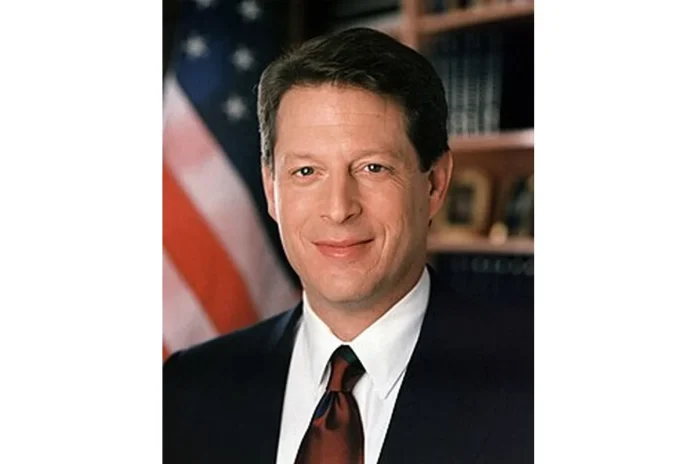
Al Gore Bio
Albert Arnold Gore Jr. (born March 31, 1948) is an American politician, businessman, and environmentalist who served as the 45th vice president of the United States from 1993 to 2001 under President Bill Clinton. A longtime member of the Democratic Party, he represented Tennessee in both chambers of the U.S. Congress, first in the House of Representatives from 1977 to 1985 and then in the U.S. Senate from 1985 to 1993. Gore was the Democratic nominee for president in 2000, winning the national popular vote but losing the Electoral College to George W. Bush.
Since leaving the vice presidency, Gore has built a prominent second career as an author, educator, and climate activist. His work on climate change earned him, jointly with the Intergovernmental Panel on Climate Change, the Nobel Peace Prize in 2007. He is also recognized as a businessman, having co-founded investment firms and venture initiatives focused on sustainability and clean technology.
Early Life and Background
Albert Arnold Gore Jr. was born on March 31, 1948, in Washington, D.C. He is the son of Albert Gore Sr., a Democratic U.S. senator and later representative from Tennessee, and Pauline LaFon Gore. Raised between Washington and the family farm in Smithville, Tennessee, Gore grew up in a household shaped by politics and public service. His father’s career in Congress gave him an early view of national affairs and the rhythms of political life.
Gore attended St. Albans School in Washington, D.C., where he met his future wife, Mary Elizabeth “Tipper” Aitcheson, at the senior prom in 1965. He went on to Harvard College, where he majored in government and graduated with an A.B. cum laude in June 1969. As an undergraduate, he was elected president of the freshman student government council on his second day on campus and roomed with future actor Tommy Lee Jones in Dunster House.
During his senior year, Gore took a class with oceanographer Roger Revelle, a leading global warming theorist whose teaching sparked Gore’s lasting interest in environmental issues. He completed his senior thesis on “The Impact of Television on the Conduct of the Presidency, 1947–1969.” Although he briefly attended Vanderbilt University, his primary degree was earned at Harvard.
Path to US Politics
After graduating from Harvard in 1969, Gore enlisted in the U.S. Army rather than seek a draft deferment. He served as a journalist in Vietnam with the 20th Engineer Brigade at Biên Hòa, working for The Castle Courier, and received an honorable discharge in May 1971. He then enrolled at Vanderbilt University Law School and later attended the University of Tennessee.
In early 1976, U.S. Representative Joe L. Evins of Tennessee’s 4th congressional district announced his retirement, opening the same seat that Gore’s father had once held. Within hours, Gore decided to leave law school to run for the seat, saying he “must become my own man.” He won the 1976 Democratic primary with 32 percent of the vote and easily won the general election, beginning a 16-year career in Congress.
Once in office, Gore quickly became known as an advocate for science, technology, and the environment. He was labeled one of the “Atari Democrats,” a nickname describing politicians passionate about technological issues. In March 1979, he became the first member of Congress to appear on C-SPAN, and he later helped shape legislation that became known as the High Performance Computing Act of 1991, often called “The Gore Bill.”
Al Gore Career
Early Career (1976–1984)
Gore won his 1976 House race with 94 percent of the vote and went on to win re-election three times, in 1978, 1980, and 1982. During his House tenure, he sat on the Energy and Commerce and Science and Technology committees, chairing the Science Committee’s Subcommittee on Oversight and Investigations for four years. He also served on the House Intelligence Committee and, in 1982, introduced the Gore Plan for arms control, which proposed reductions in multiple warheads.
In 1984, Gore ran successfully for the U.S. Senate seat vacated by Republican Senate Majority Leader Howard Baker. He was unopposed in the Democratic primary and won the general election decisively, even as President Ronald Reagan carried Tennessee in his re-election campaign. Gore’s House record on civil rights included support for establishing Martin Luther King Jr. Day as a federal holiday and votes to override President Reagan’s veto of the Civil Rights Restoration Act of 1987.
U.S. Senate Era (1985–1992)
As a senator, Gore sat on the Homeland Security and Governmental Affairs, the Rules and Administration, and the Armed Services Committees. He continued to champion technology and environmental policy, sponsoring hearings on advanced technologies and introducing the Supercomputer Network Study Act of 1986. In 1990, he presided over a three-day conference with legislators from over 42 countries to promote a Global Marshall Plan linking economic growth with environmental protection.
Gore won re-election to the Senate in 1990, a victory that, as of 2025, remains the last time a Democrat won a Senate race in Tennessee. He was one of ten Democrats to vote in favor of the Gulf War in 1991. By the end of his Senate tenure, his work on high-performance computing had earned him a reputation as a forward-thinking lawmaker in the emerging digital economy.
Vice Presidency (1993–2001)
Chosen as Bill Clinton’s running mate in 1992, Gore helped the Democratic ticket defeat the incumbent Republican team of George H. W. Bush and Dan Quayle. He became the first Democrat to serve two full terms as vice president since John Nance Garner, after winning re-election alongside Clinton in 1996 against Bob Dole and Jack Kemp. He was also the first Democrat to serve two full terms as vice president since John Nance Garner.
As vice president, Gore led the administration’s environmental efforts and pushed for U.S. participation in the Kyoto Protocol to reduce greenhouse gas emissions. He continued to engage with technology policy and global sustainability, strengthening the profile that would later define his post-office career.
2000 Presidential Campaign
Gore won the Democratic nomination and faced Republican George W. Bush in the 2000 presidential election. The race came down to Florida, where the initial results were disputed. After a Florida recount was halted by the U.S. Supreme Court in the case of Bush v. Gore on December 12, 2000, Bush won Florida by 537 votes and secured its 25 electoral votes. Gore conceded on December 13, 2000, having won the national popular vote by roughly 543,895 votes while receiving 266 electoral votes to Bush’s 271.
The Supreme Court ruled 7–2 that the recount standards were unconstitutional under the Equal Protection Clause and 5–4 that no valid recount could be completed by the December 12 deadline. Gore accepted the outcome “for the sake of our unity as a people and the strength of our democracy,” though he strongly disagreed with the ruling. He is one of only five presidential candidates in American history to lose the presidency while winning the popular vote.
Post-Vice Presidency and Climate Activism
After leaving office, Gore returned to public life as an author, educator, and environmental advocate. He starred in the 2006 documentary An Inconvenient Truth, which won the Academy Award for Best Documentary in 2007, and wrote the companion book An Inconvenient Truth: The Planetary Emergency of Global Warming and What We Can Do About It, which won a Grammy Award for Best Spoken Word Album in 2009. In 2007, he co-founded The Climate Reality Project, and in 2004 he co-launched Generation Investment Management, where he serves as chair.
Gore has also worked as a partner in the venture capital firm Kleiner Perkins, heading its climate change solutions group, and as a senior adviser to Google. He has served as a visiting professor at Middle Tennessee State University, Columbia University Graduate School of Journalism, Fisk University, and the University of California, Los Angeles. In 2020, he helped launch Climate TRACE to independently monitor global greenhouse gas emissions, and in November 2021 he addressed the 2021 United Nations Climate Change Conference (COP26) in Glasgow, Scotland.
Notable Events and Milestones
Among Gore’s signature achievements are the High Performance Computing Act of 1991, the founding of The Climate Reality Project, and his role in raising global awareness of climate change through An Inconvenient Truth. He holds the rare distinction of being the first Democrat to serve two full terms as vice president since John Nance Garner and the first sitting vice president to appear on C-SPAN. His 2000 election remains one of the closest and most consequential in modern U.S. history, decided by a single Supreme Court ruling.
Al Gore Career Wins
Al Gore has compiled a long record of electoral victories, beginning with his first congressional win in 1976 and continuing through two vice-presidential elections. His 1990 Senate re-election stands out as the most recent Democratic Senate victory in Tennessee. Below is a summary of his key career wins.
U.S. House and Senate Wins
Gore won his U.S. House seat in 1976 and was re-elected three times, in 1978, 1980, and 1982, often facing little or no opposition. He then won his U.S. Senate seat in 1984 in a decisive general election, even as Ronald Reagan carried Tennessee, and secured a second Senate term in 1990. He was unopposed in the 1984 Democratic Senate primary.
Vice Presidential and Related Wins
Gore served as vice president from 1993 to 2001, winning the 1992 and 1996 national elections alongside President Bill Clinton. He became the first Democrat to serve two full terms as vice president since John Nance Garner. In 2000, he won the Democratic presidential nomination and the national popular vote by approximately 543,895 votes, though he lost the Electoral College.
Other Wins & Achievements
Beyond politics, Gore’s climate work has earned him the Nobel Peace Prize in 2007, jointly with the Intergovernmental Panel on Climate Change, a Primetime Emmy Award in 2007, a Webby Award in 2005, the Dan David Prize in 2008, the Prince of Asturias Award for International Cooperation in 2007, a Grammy Award for Best Spoken Word Album in 2009, and the Presidential Medal of Freedom in 2024. He was also elected to the American Philosophical Society in 2008 and named a runner-up for Time’s 2007 Person of the Year.
Al Gore Family
Family Background and Political Lineage
Gore comes from one of Tennessee’s most prominent political families. His father, Albert Gore Sr., served in the U.S. House of Representatives and later in the U.S. Senate, the same Tennessee 4th congressional district seat that his son would eventually hold. His mother, Pauline LaFon Gore, raised the family between Washington, D.C., and the family farm in Smithville, Tennessee. Growing up in this environment shaped Gore’s early ambition to enter public service on his own terms.
Personal Life
Gore married Mary Elizabeth “Tipper” Aitcheson on May 19, 1970, at the Washington National Cathedral. The couple had four children: Karenna Gore (born 1973), Kristin Carlson Gore (born 1977), Sarah LaFon Gore (born 1979), and Albert Arnold Gore III (born 1982). In June 2010, the Gores announced by e-mail to friends that they had made a mutual decision to separate. In May 2012, it was reported that Gore had begun dating Elizabeth Keadle of Rancho Santa Fe, California.