
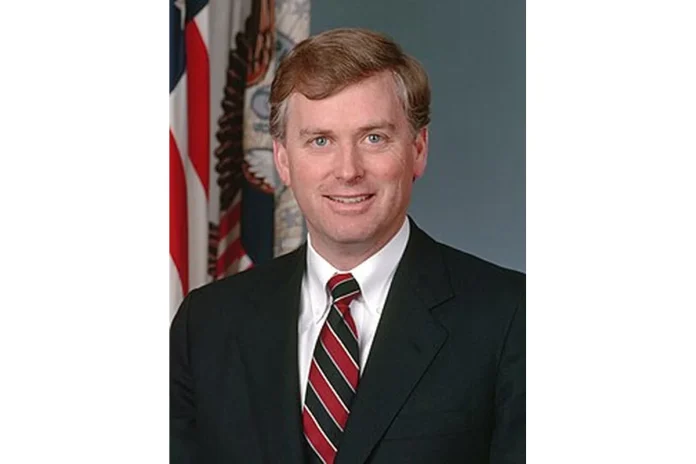
Dan Quayle Bio
James Danforth “Dan” Quayle (born February 4, 1947) is an American retired politician who served as the 44th vice president of the United States from 1989 to 1993 under President George H. W. Bush. A member of the Republican Party, he represented Indiana in the U.S. House of Representatives from 1977 to 1981 and in the U.S. Senate from 1981 to 1989 before joining the national ticket. Since leaving public office, he has worked as a lawyer, author, and investment banker while remaining active in Republican politics.
During his time in office, Quayle was the third-youngest vice president in U.S. history at age 41. He made official visits to 47 countries, chaired the National Space Council, and became widely known for public remarks that drew intense media scrutiny. Today, he lives in Paradise Valley, Arizona, with his wife, Marilyn Quayle.
Early Life and Background
James Danforth Quayle was born on February 4, 1947, in Indianapolis, Indiana, to James C. Quayle and Martha Corinne Quayle, née Pulliam. His maternal grandfather, Eugene C. Pulliam, was a wealthy and influential publishing magnate who founded Central Newspapers, Inc., and owned more than a dozen major newspapers, including The Arizona Republic and The Indianapolis Star. Because of his grandfather’s business, the Quayle family moved to Arizona in 1955, where James C. Quayle took charge of a branch of the publishing empire.
Quayle spent much of his youth in Paradise Valley, a suburb of Phoenix, before returning to his native Indiana for high school. He graduated from Huntington North High School in 1965, then attended DePauw University, where he earned a B.A. in political science in 1969. At DePauw, he captained the university golf team and joined the Delta Kappa Epsilon fraternity. After college, he enlisted in the Indiana National Guard, serving from 1969 to 1975 and reaching the rank of sergeant, which kept him from being drafted during the Vietnam War.
While serving in the National Guard, Quayle enrolled at the Indiana University Robert H. McKinney School of Law. He earned his Juris Doctor degree in 1974, and during law school he met Marilyn Tucker, a fellow night student who would become his wife. Early in his career, he worked as an investigator for the Consumer Protection Division of the Office of the Indiana Attorney General, served as an administrative assistant to Governor Edgar Whitcomb, and later directed the Inheritance Tax Division of the Indiana Department of Revenue.
Path to US Politics
After graduating from law school in 1974, Quayle and his wife, Marilyn, returned to Huntington, Indiana, where he worked briefly as associate publisher of the family newspaper, the Huntington Herald-Press, and the couple began practicing law. His entry into electoral politics came in 1976, when, at age 29, he won a seat in the U.S. House of Representatives from Indiana’s 4th congressional district, defeating eight-term Democratic incumbent J. Edward Roush by a 55%-to-45% margin. He was reelected in 1978 with 64% of the vote against Democrat John D. Walda.
During his time in Congress, Quayle was invited by California Congressman Leo Ryan to join a 1978 delegation to investigate unsafe conditions at the Jonestown settlement in Guyana, but he was unable to attend. The decision likely saved his life, as Ryan and several members of his party were killed at an airstrip during the Jonestown massacre. The experience helped establish Quayle as a rising Republican voice in Indiana, paving the way for his 1980 Senate campaign.
Dan Quayle Career
Early Career (1976–1980)
Quayle’s first notable political victory came in 1976, when he flipped Indiana’s 4th congressional district seat by ousting a long-serving Democratic incumbent. His strong showing in northeastern Indiana earned him a reputation as a young, energetic Republican with appeal in conservative, working-class communities. He was reelected two years later in a landslide.
In November 1978, Quayle was invited to join a congressional delegation to Jonestown, Guyana, but he did not take part in the trip. When the delegation was attacked at a remote airstrip and Congressman Leo Ryan was killed, Quayle’s absence drew national attention and underscored how thin the line was between fate and opportunity in his early political life.
U.S. Senate Breakthrough (1981–1988)
In 1980, at age 33, Dan Quayle became the youngest person ever elected to the U.S. Senate from the state of Indiana. He defeated three-term incumbent Democrat Birch Bayh with 54% of the vote, a stunning upset that immediately put him on the national political map. During his first term, he built a conservative record on economic and foreign policy issues and rose quickly within Republican leadership circles.
Quayle won reelection to the Senate in 1986 with 61% of the vote against Democrat Jill Long, the largest margin ever achieved to that point by a candidate in a statewide Indiana race. That same year, he was criticized for championing the nomination of Daniel Anthony Manion, a former law school classmate, to the U.S. Court of Appeals for the Seventh Circuit. The American Bar Association rated Manion as “qualified/unqualified,” its lowest passing grade, but the Senate confirmed him.
Vice Presidential Era (1989–1993)
On August 16, 1988, Republican presidential nominee George H. W. Bush chose Dan Quayle as his running mate at the Republican National Convention in New Orleans, Louisiana. The pick was controversial from the start, with reporters raising questions about Quayle’s military service, a Florida golf trip with lobbyist Paula Parkinson, and his relatively limited experience. Despite the turbulence, the Bush–Quayle ticket took the lead in the polls in August and never relinquished it, winning the November election in a 53% to 46% landslide and capturing 426 electoral votes.
Quayle was sworn in as the 44th vice president on January 20, 1989, becoming the third-youngest vice president in U.S. history. During his tenure, he made official visits to 47 countries, chaired the National Space Council, and headed the White House Council on Competitiveness. His most memorable moment on the national stage came during the 1988 vice-presidential debate with Democratic Senator Lloyd Bentsen of Texas, when Bentsen delivered the now-famous retort, “Senator, you’re no Jack Kennedy,” after Quayle compared his Senate experience to that of President John F. Kennedy.
Throughout his vice presidency, Quayle was frequently in the news for remarks that critics labeled gaffes, including his 1992 reference to the television character Murphy Brown during a speech on family values and his 1992 correction of a student’s spelling of “potato” at a New Jersey elementary school. In 1992, he survived an internal Republican effort to replace him on the ticket and was renominated, but the Bush–Quayle ticket lost to Bill Clinton and Al Gore in the general election.
Notable Events and Milestones
One of the defining moments of Quayle’s career was the 1988 vice-presidential debate, in which Bentsen’s “Senator, you’re no Jack Kennedy” line became part of the political lexicon. The Murphy Brown speech of 1992 and the widely mocked “potatoe” spelling incident also became defining images of his vice presidency, shaping public perceptions for years to come. He remains the earliest-serving surviving vice president following the death of Walter Mondale in April 2021.
Dan Quayle Career Wins
Dan Quayle compiled a strong record of electoral victories during his career in Indiana and at the national level, though his time on the national ticket ended in defeat. His wins include U.S. House races, U.S. Senate elections, and a vice-presidential election, while his later presidential bids did not result in a nomination.
U.S. Senate and House Highlights
Quayle won his first House race in 1976 against J. Edward Roush and was comfortably reelected in 1978. In 1980, he unseated three-term incumbent Birch Bayh to claim Indiana’s open Senate seat, becoming the youngest person ever elected to the Senate from the state. Six years later, he set a then-record for the largest margin in a statewide Indiana race when he defeated Democrat Jill Long with 61% of the vote.
Vice Presidential Win
As the Republican vice-presidential nominee in 1988, Quayle helped the Bush–Quayle ticket defeat Michael Dukakis and Lloyd Bentsen in a 40-state landslide, capturing 426 electoral votes. He was renominated in 1992 but lost the general election to the Democratic ticket of Bill Clinton and Al Gore.
Dan Quayle Family
Family Background and Political Lineage
Dan Quayle comes from a prominent American family. His maternal grandfather, Eugene C. Pulliam, was a publishing magnate whose newspapers included The Arizona Republic and The Indianapolis Star, giving the family deep ties to Indiana and the American Southwest. His son, Benjamin Quayle, later followed him into politics, serving in the U.S. House of Representatives from 2011 to 2013 and representing Arizona’s 3rd congressional district.
Personal Life
Dan Quayle married Marilyn Tucker in November 1972, and the couple has three children: Tucker, Benjamin, and Corinne. The family has lived in Paradise Valley, Arizona, in recent years. Since leaving the vice presidency, Quayle has pursued careers in business and writing while occasionally engaging in Republican political endorsements, including stints supporting presidential candidates in 2000, 2012, 2016, and 2020.