
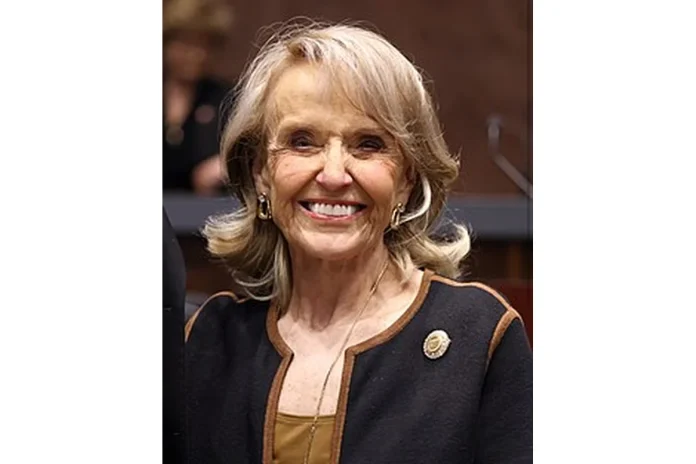
Jan Brewer Bio
Janice Kay Brewer (born September 26, 1944) is an American politician who served as the 22nd governor of Arizona from 2009 to 2015 as a member of the Republican Party. She previously served in the Arizona House of Representatives, the Arizona Senate, the Maricopa County Board of Supervisors, and as Arizona Secretary of State from 2003 to 2009. As governor, Brewer focused on fiscal recovery during the Great Recession, accepted Medicaid expansion despite opposing the Affordable Care Act, and became nationally prominent after signing the strict immigration law SB 1070 in 2010. She also vetoed SB 1062, pursued education and child-welfare reforms, and chose not to seek a third term in 2014.
Early Life and Background
Janice Kay Brewer, née Drinkwine, was born on September 26, 1944, in Hollywood, Los Angeles, California. She is the daughter of Perry Wilford Drinkwine and Edna Clarice Drinkwine, née Bakken. Brewer attended Verdugo Hills High School and later studied at Glendale Community College in California. Her family background was rooted in the working-class communities of the Los Angeles area before she eventually relocated to Arizona.
After completing her studies, Brewer moved to Arizona, where she settled in Glendale and began raising a family. She married John Brewer, with whom she had three sons, Ronald, John, and Michael. Brewer was widowed in 2007 when her husband passed away. Her experience as a mother of school-aged children would later shape her entry into public life, as she became increasingly interested in how local education policy was governed.
Path to US Politics
Brewer’s entry into politics began in 1981, when she started attending school board meetings in the Glendale Union High School District. Concerned about how her children’s education was being administered, she considered running for a local school board seat. When a vacancy arose in the 19th district of the Arizona House of Representatives, Brewer decided that a state-level position would give her a stronger platform to influence education policy. In 1982, she was elected to that seat, becoming one of several women, sometimes called the “Republican wives,” who entered the legislature that year.
She was reelected in 1984 and won a seat in the Arizona Senate in 1986, where she developed a reputation for bipartisanship. Brewer became majority whip of the Arizona Senate in 1993, a position she held until 1996. During this period, she championed causes such as creating a lieutenant governor position so the secretary of state would not automatically be next in line for the governorship, and her battles against a Vietnam War protesters’ monument earned her the nickname Janbo, a reference to the film character John Rambo. She left the Senate in 1996 to chair the Maricopa County Board of Supervisors, a role she won after campaigning against a county tax levy.
Jan Brewer Career
Early Career (1982–1996)
Brewer’s first notable political activity was her 1982 election to the Arizona House of Representatives, where she focused on education policy and school funding. She built a record as a fiscal conservative who supported tax cuts and open enrollment for public schools. Brewer was reelected in 1984, and in 1986 she won election to the Arizona Senate. During her tenure, she took on mental health as a major policy interest, spurred by her son’s hospitalization, and she sponsored the first living will law in the United States.
As majority whip beginning in 1993, Brewer became a leading voice in the Senate on issues ranging from criminal justice reform to election administration. She opposed the impeachment of Republican Governor Evan Mecham in 1988 and gained a reputation for working across the aisle. In 1996, she transitioned from the state legislature to local government, taking the helm of the Maricopa County Board of Supervisors the following year.
Arizona Secretary of State Era (2003–2009)
Elected as Arizona Secretary of State in 2003, Brewer served until she ascended to the governorship in 2009. She campaigned on voting reform and implemented changes including a program allowing deployed military members to vote by internet or fax, touch-screen voting for disabled voters, and the elimination of punch-card ballots to comply with federal law. She also oversaw the implementation of Arizona Proposition 200 in 2004, which required proof of citizenship to register to vote or apply for public benefits, a measure that critics argued was anti-immigrant.
As secretary of state, Brewer negotiated a public-private partnership that allowed advanced medical directives to be filed online, continuing her work on mental health and end-of-life issues. She became governor on January 21, 2009, when Governor Janet Napolitano resigned to become U.S. Secretary of Homeland Security, placing Brewer next in the line of succession.
Arizona Governor Era (2009–2015)
As governor, Brewer inherited a state deep in the Great Recession, with a budget deficit of about $3 billion. She reduced spending by roughly $1 billion, borrowed an additional $1 billion, and pushed through a temporary sales tax to raise a third $1 billion, a move that was deeply unpopular within her own party. The sales tax was approved by voter referendum in February 2010, and Brewer’s relations with the Republican-controlled legislature gradually improved, leading to a series of joint spending cuts, including the closure of state parks and the layoff of hundreds of Arizona Motor Vehicle Division employees.
Brewer became a national figure in April 2010 when she signed SB 1070, the strictest immigration law in the United States, which required police to check the residency status of anyone they suspected of being an undocumented immigrant. The law drew national protests and legal challenges, and a U.S. Supreme Court ruling in June 2012 upheld its core “show me your papers” provision. Brewer also won election to a full term in 2010 and was re-inaugurated in January 2011. In early 2012, an image of her wagging her finger in President Barack Obama’s face on an airport tarmac became an iconic representation of her political style. In 2013, she forced her own party to pass the Medicaid expansion under the Affordable Care Act by vetoing every bill sent to her desk until the legislature relented, and in 2014 she vetoed SB 1062, a religious freedom bill that critics said would have legalized discrimination against gay customers.
Notable Events and Milestones
Beyond SB 1070, Brewer’s tenure featured several high-profile moments, including a widely circulated 2012 tarmac confrontation with President Obama, a 2011 memoir titled Scorpions for Breakfast that became a New York Times Best Seller, and a 2014 decision to veto SB 1062 after intense national pressure. She abolished the troubled Child Protective Services agency in 2014 and replaced it with a cabinet-level Division of Child Safety. In November 2012, she explored the possibility of running for a third term by challenging Arizona’s term-limit law, but on March 12, 2014, she announced she would not seek reelection, paving the way for Republican Doug Ducey to succeed her.
Jan Brewer Family
Family Background and Public Life
Brewer is the daughter of Perry Wilford Drinkwine and Edna Clarice Drinkwine, née Bakken. She was raised in the Los Angeles area before relocating to Glendale, Arizona, where she raised her family. Brewer’s three sons, Ronald, John, and Michael, were a central motivation for her entry into politics, as her concerns about the local school district first drew her into civic engagement in the early 1980s.
Personal Life
Brewer married John Brewer in 1963, and the couple had three sons together. John Brewer passed away in 2007, making her a widow. After leaving the governorship in 2015, Brewer has continued to reside in Glendale, Arizona. She has remained active in conservative causes, endorsing Donald Trump during the 2016 presidential campaign, opposing the American Health Care Act in 2017, and publicly rebuking Trump’s false claims about election fraud in 2022 and 2024, even as she continued to support him on other issues.