
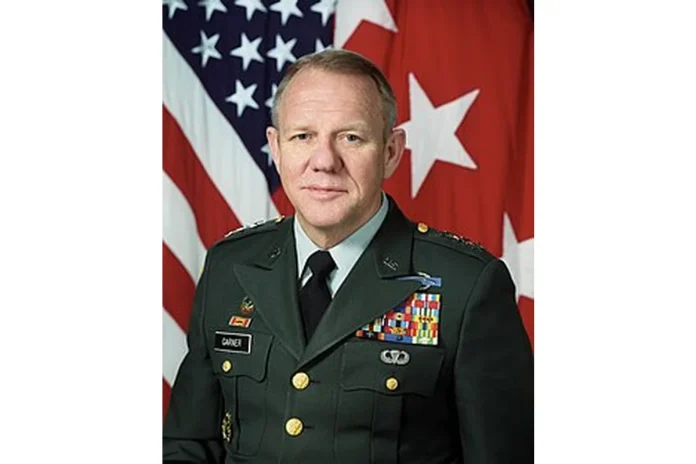
Jay Garner Bio
Jay Montgomery Garner (born April 15, 1938) is a retired United States Army lieutenant general and former American public administrator. In 2003, he was appointed Director of the Office for Reconstruction and Humanitarian Assistance (ORHA) for Iraq, making him the de facto chief civilian administrator of Iraq immediately after the fall of Saddam Hussein. A career military officer, Garner served two tours in Vietnam, helped develop the Patriot missile system, and commanded the United States Army Space and Strategic Defense Command before retiring in 1997.
Beyond his military service, Garner worked in the defense industry and later led short-lived postwar reconstruction efforts in Iraq. A member of the Republican Party in his public profile, he was eventually replaced by Ambassador Paul Bremer in May 2003 and returned to private life. His career spans more than four decades of uniformed service, government leadership, and business executive work.
Early Life and Background
Jay Montgomery Garner was born on April 15, 1938, in Arcadia, Florida, United States. He grew up in the small DeSoto County community during the years surrounding the Second World War, a period that shaped the early ambitions of many young Americans who went on to military careers. Before pursuing higher education, Garner served an enlistment in the United States Marine Corps, an experience that introduced him to military discipline and helped confirm his decision to pursue a long career in the armed forces.
Following his Marine Corps service, Garner transitioned to the United States Army and attended Florida State University, where he earned a Bachelor of Arts degree in History in 1962. He later earned a master’s degree in public administration from Shippensburg State University, expanding his academic preparation for the leadership responsibilities he would later assume. These formative years combined enlistment experience, undergraduate study, and graduate training that prepared him for the operational and administrative demands of a senior military career.
Path to Military Leadership and Public Service
Garner was commissioned as an Army second lieutenant in 1962, beginning a steady rise through the ranks of the United States Army. His early assignments included two tours in Vietnam, where he gained combat experience that would later influence his judgment in command. After returning from Vietnam, he led two air defense units in Germany and served as deputy commanding general at Fort Bliss, Texas, broadening his understanding of both European and domestic defense operations.
As his career progressed, Garner helped develop the Patriot missile system and later commanded missile batteries during the Gulf War. After the Gulf War, he was put in charge of securing Kurdish areas in northern Iraq, a posting that provided him with firsthand experience in the region that would later define his postwar role. These responsibilities positioned him as a natural candidate for the Bush administration’s reconstruction leadership, blending operational command with regional experience and senior-level strategic thinking.
Jay Garner Career
Early Career (1962–1990s)
During the early phase of his career, Garner completed two Vietnam tours and held a series of progressively senior command and staff assignments in the United States Army. He served in Germany leading air defense units and at Fort Bliss, Texas, as deputy commanding general. By the late 1980s and early 1990s, he had become closely associated with missile defense development, including early work on what would become the Patriot missile system.
These assignments prepared him for senior leadership and gave him direct exposure to combined air defense operations, joint staff work, and large-scale troop management. He earned multiple decorations over this period, including awards later summarized in his record of military honors. His reputation as a steady, technically literate officer continued to grow throughout this stretch of his career.
Patriot Missile and Gulf War Breakthrough (1980s–1991)
Garner’s involvement in developing the Patriot missile system marked one of the most significant technical contributions of his career. The system became a central element of American air defense during the Gulf War, where Patriot batteries were used to intercept incoming Iraqi missiles. Garner’s prior development work helped transition the program from concept into operational deployment under combat conditions.
During the Gulf War, Garner commanded Patriot missile batteries in the region, overseeing soldiers and crews responsible for defending allied forces and civilian areas. His performance during this period drew high-level attention and led to additional responsibilities. After the war’s combat phase, he was assigned to secure Kurdish areas in northern Iraq, an experience that later shaped his approach to Iraqi governance and reconstruction.
Senior Command and Strategic Defense Era (1990s–1997)
Following his Gulf War service, Garner was named commander of the United States Army Space and Strategic Defense Command, a position that placed him at the center of President Ronald Reagan’s Strategic Defense Initiative missile shield program. The role required coordination with civilian research agencies, defense contractors, and senior Pentagon leaders working on next-generation missile defense concepts.
He concluded his Army career as Assistant Vice Chief of Staff, one of the most senior staff positions in the service. Garner retired from the United States Army in 1997 at the rank of lieutenant general, bringing to a close a 35-year career that spanned combat, missile defense, and strategic command. His retirement set the stage for his transition to the defense industry and later government advisory work.
Defense Industry and Iraq Reconstruction (1997–2003)
After leaving the Army, Garner became president of SYColeman, a defense contractor that designs missile communications and targeting systems used in the Patriot and Arrow missile systems. The company was later acquired by L3Harris, where Garner remained for two years before retiring from corporate work. During this period he also served on a presidential panel, chaired by Donald Rumsfeld, which specialized in space and missile threats, and worked closely with the Israel Defense Forces.
In 2003, Garner was selected to lead postwar reconstruction efforts in Iraq as Director of the Office for Reconstruction and Humanitarian Assistance. He began reconstruction work in March 2003, with plans that aimed for Iraqis to hold elections within 90 days and for U.S. forces to pull back from cities to a desert base. On April 15, 2003, he convened a conference in Nasiriyah with about 100 Iraqis to discuss the country’s future, followed by a larger April 28 meeting of roughly 250 Iraqis from which five core leaders of a new Iraqi government were selected.
Notable Events and Milestones
One signature moment of Garner’s career came when he was replaced by Ambassador Paul Bremer on May 11, 2003, ending his brief tenure as Iraq’s top civilian administrator. Garner had publicly favored early Iraqi-led elections and an Iraqi government empowered to decide the future of the country’s oil resources, a position that placed him at odds with elements of the Bush administration. He later reflected on the episode in the 2007 documentary No End in Sight, which was highly critical of the handling of the Iraq occupation.
Jay Garner Family
Personal Life
Public records about Jay Montgomery Garner’s private and family life are limited, and detailed information about his parents, spouse, partners, and children has not been confirmed in authoritative sources. He was born and raised in Arcadia, Florida, and his early years included an enlistment in the United States Marine Corps before he transitioned into the Army. Beyond these well-documented facts, the available verified material does not provide further details about his personal relationships or family lineage, and those areas are therefore left unaddressed in this biography.
Jay Garner Military Awards
Throughout his long Army career, Jay Montgomery Garner received numerous decorations recognizing his combat service, senior command, and contributions to missile defense. His verified award count includes two Army Distinguished Service Medals, two Defense Superior Service Medals, and five Legion of Merit awards, along with the Bronze Star. These honors reflect decades of service spanning the Vietnam War, the Gulf War, and senior Pentagon leadership.
Verified Awards and Decorations
Garner’s verified military decorations include two Army Distinguished Service Medals, two Defense Superior Service Medals, five Legion of Merit awards, and the Bronze Star. The Army Distinguished Service Medal and Defense Superior Service Medal reflect exceptional performance in senior command and joint assignments, while the multiple Legion of Merit awards recognize sustained excellence across a long career. The Bronze Star recognizes his service during the Vietnam War era.