
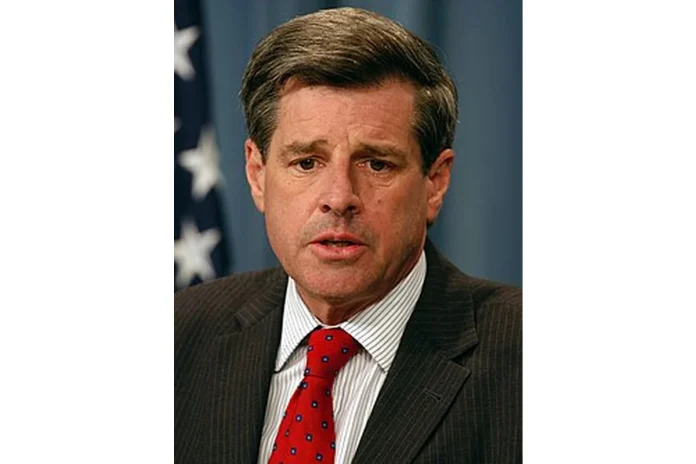
Paul Bremer Bio
Lewis Paul Bremer III, known publicly as Paul Bremer, is a retired American diplomat and civil servant whose career spanned the Cold War, the post-9/11 era, and the toppled government of Iraq. He served as the chief civilian administrator of the Coalition Provisional Authority from May 2003 to June 2004, a position that gave him direct authority over the country’s governance during a pivotal period. A career member of the Senior Foreign Service, Bremer also held senior positions in Washington, including ambassador to the Netherlands and the nation’s first coordinator for counterterrorism.
After leaving public service, Bremer moved into the private sector as a consultant, author, and speaker. He is the author of My Year in Iraq: The Struggle to Build a Future of Hope, a memoir recounting his experience leading Iraq’s postwar transition. He was awarded the Presidential Medal of Freedom in 2004.
Early Life and Background
Lewis Paul Bremer III was born on September 30, 1941, in Hartford, Connecticut. He spent his early years in the surrounding region and was educated at New Canaan Country School, Kent School, and Phillips Academy Andover, where he completed his secondary education. His father served as president of the Christian Dior Perfumes Corporation in New York, while his mother was a lecturer in art history at the University of Bridgeport, providing Bremer with early exposure to both business and the arts.
Bremer went on to earn a Bachelor of Arts degree from Yale University in 1963, followed by a Master of Business Administration from Harvard University in 1966. He later continued his education abroad at the Institut d’études politiques de Paris, where he obtained a Certificate of Political Studies. This academic foundation helped shape his long career in diplomacy and government service.
Path to Government Service
Bremer entered the U.S. Foreign Service in 1966, beginning his diplomatic career with assignments in Kabul, Afghanistan, as a general services officer, followed by a posting in Blantyre, Malawi, where he served as an economic and commercial officer from 1968 to 1971. These early assignments gave him firsthand experience in both developing economies and conflict-affected regions.
During the 1970s, Bremer served in multiple domestic posts at the U.S. State Department, including as an assistant to Henry Kissinger from 1972 to 1976. He accompanied Kissinger on shuttle diplomacy missions to Israel, Syria, and Egypt during the Yom Kippur War in 1973. From 1976 to 1979, he served as Deputy Chief of Mission in Oslo, Norway, before returning to Washington as deputy executive secretary of the State Department.
Paul Bremer Career
Early Career (1981-1989)
In 1981, Bremer was promoted to executive secretary and special assistant to Secretary of State Alexander Haig. President Ronald Reagan appointed him as U.S. Ambassador to the Netherlands in 1983, a position he held until 1986, when he was named the first-ever ambassador-at-large for counterterrorism and coordinator for counterterrorism.
During his diplomatic tenure, Bremer received several honors, including the State Department Superior Honor Award, two Presidential Meritorious Service Awards, and the Distinguished Honor Award from the Secretary of State. He retired from the Foreign Service in 1989, having reached the rank of career minister in the Senior Foreign Service.
Counterterrorism Leadership (1999-2003)
After leaving government, Bremer joined Kissinger and Associates, a consulting firm founded by Henry Kissinger, where he served as managing director. He also became chairman and CEO of Marsh Crisis Consulting, a subsidiary of Marsh & McLennan Companies that specializes in risk and insurance services. He and his wife founded the Lincoln/Douglass Scholarship Foundation, a Washington-based nonprofit that provides high school scholarships to inner-city youths.
In 1999, House Speaker Dennis Hastert appointed Bremer chairman of the National Commission on Terrorism. The resulting report, Countering The Changing Threat of International Terrorism, was published in June 2000. He also served on the National Academy of Sciences’ Committee on Science and Technology for Countering Terrorism, which produced a 2002 report titled Making the Nation Safer.
Coalition Provisional Authority (May 2003 – June 2004)
President George W. Bush appointed Bremer as presidential envoy to Iraq on May 9, 2003. He arrived in Iraq the same month and on May 11 replaced Lieutenant General Jay Garner as Director of the Office for Reconstruction and Humanitarian Assistance. In June, the office was transformed into the Coalition Provisional Authority (CPA), and Bremer became Iraq’s chief executive authority, a post compared in scope to that of General Douglas MacArthur in postwar Japan.
As administrator, Bremer issued several major orders, including CPA Order 1, which banned the Ba’ath Party, and CPA Order 2, which dismantled the Iraqi Army and put roughly 400,000 former soldiers out of work. He also approved the creation of an Iraqi Interim Governing Council in July 2003 and oversaw the development of an interim constitution signed in March 2004. He granted foreign contractors immunity from Iraqi law through CPA Order 17, signed two days before his departure.
On June 28, 2004, the Coalition Provisional Authority formally transferred limited sovereignty to the Iraqi Interim Government, two days ahead of schedule. Bremer departed Iraq on the same day, and John Negroponte replaced him as the highest-ranking American civilian in the country.
Post-Iraq Career (2004-Present)
Following his return from Iraq, Bremer engaged in speaking tours and consulting work. In 2006, he published his memoir, My Year in Iraq: The Struggle to Build a Future of Hope, which offered a day-by-day account of his time leading the CPA. He has also continued to write and publish, including From Sea to Shining Sea: Biking Across America with Wounded Warriors in 2011.
Bremer remains active in nonprofit and advisory work. In November 2010, he joined World T.E.A.M. Sports, a New York-based nonprofit, as CEO and President, serving until March 2012. He has also served on the board of directors of the International Republican Institute and on the board of BlastGard International. He lives in Grafton, Vermont, and continues to engage in consulting and commentary on U.S. foreign policy.
Notable Events and Milestones
Bremer’s most defining moment came with his appointment to lead the Coalition Provisional Authority, where he wielded what was described as the most powerful foreign post held by any American since General MacArthur. His decision to disband the Iraqi Army and pursue de-Ba’athification policies has been widely debated, with critics arguing the moves fueled the insurgency, while Bremer has maintained they were the correct course. He was awarded the Presidential Medal of Freedom by President Bush on December 14, 2004, in recognition of his service.
Paul Bremer Awards
Paul Bremer has received multiple high-level honors from the U.S. government and international organizations in recognition of his diplomatic and public service. His awards reflect decades of work in foreign policy, counterterrorism, and postwar reconstruction.
Major U.S. and International Awards
In 2004, Bremer received the Presidential Medal of Freedom, America’s highest civil award, in recognition of his meritorious contributions to the security and national interests of the United States. The same year, he was presented with the Department of Defense award for Distinguished Public Service and the Nixon Library’s Victory of Freedom Award for his leadership in working toward peace and freedom. In 2013, he received the America Award from the Italy-USA Foundation.
Paul Bremer Family
Family Background
Bremer was raised in Connecticut, where his father served as president of the Christian Dior Perfumes Corporation in New York. His mother was a lecturer in art history at the University of Bridgeport. Together with his wife, Frances Winfield Bremer, he founded the Lincoln/Douglass Scholarship Foundation, a Washington-based nonprofit that provides high school scholarships to inner-city youths.
Personal Life
Paul Bremer has been married to Frances Winfield Bremer since 1966. The couple has made their home in Grafton, Vermont, where Bremer has remained active in local historical and charitable causes. Beyond his public service, Bremer has taken up oil painting, selling works of New England country landscapes through his company Bremer Enterprises, with proceeds supporting historical societies in Vermont. He has also worked as a ski instructor at Okemo Mountain Resort.