
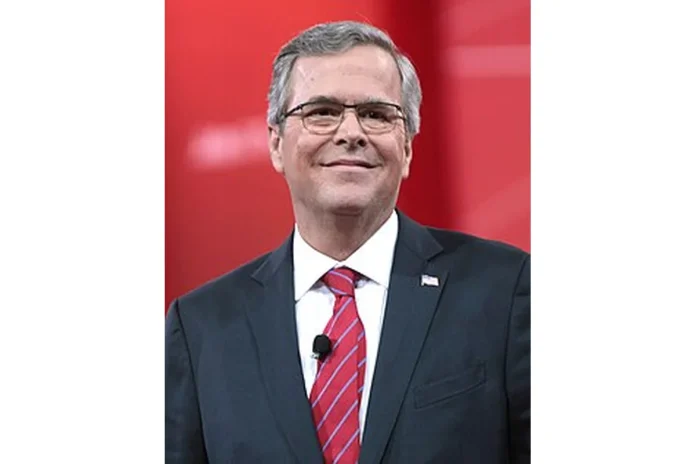
Jeb Bush Bio
John Ellis “Jeb” Bush (born February 11, 1953) is an American politician and businessman who served as the 43rd Governor of Florida from 1999 to 2007. A member of the Republican Party, he is the second son of President George H. W. Bush and First Lady Barbara Bush, and the younger brother of President George W. Bush. As governor, he prioritized education reform, Medicaid privatization, Everglades restoration, and tax cuts.
After leaving the governorship, Bush served on corporate and nonprofit boards before mounting an unsuccessful campaign for the 2016 Republican presidential nomination. He suspended his campaign after the South Carolina primary and finished sixth among a crowded field of contenders. He later endorsed Senator Ted Cruz and was a prominent critic of Donald Trump during the 2016 campaign.
Early Life and Background
Jeb Bush was born on February 11, 1953, in Midland, Texas, where his father was working in the oil industry. When he was six years old, the family relocated to the Tanglewood neighborhood of Houston, Texas. His nickname, “Jeb,” is formed from his initials, J.E.B. (John Ellis Bush). He grew up alongside older brother George, younger brothers Neil and Marvin, and a younger sister, Dorothy.
At the age of 14, Bush enrolled at Phillips Academy in Andover, Massachusetts, following in the footsteps of his father and older brother. He nearly faced expulsion for poor grades but turned his record around, making the honor roll and serving as captain of the tennis team. In 1970, while participating in a student exchange program in León, Mexico, the 17-year-old Bush taught English and met his future wife, Columba Garnica Gallo.
Bush chose to attend the University of Texas at Austin, beginning in September 1971. He played on the Texas Longhorns varsity tennis team in 1973 and graduated Phi Beta Kappa and magna cum laude with a Bachelor of Arts degree in Latin American studies. He completed his coursework in two and a half years and is fluent in Spanish.
Path to US Politics
After graduating, Bush began his professional career in 1974 at Texas Commerce Bank, working in an entry-level international division role. In November 1977, he moved to Caracas, Venezuela, to open a new branch, serving as branch manager and vice president. Following the 1980 presidential election, Bush and his family relocated to Miami-Dade County, Florida.
In Florida, Bush partnered with Cuban-American real estate developer Armando Codina at The Codina Group, a leading South Florida real estate firm. During the 1980s, he pursued various business interests, including work in mobile phones, a minority stake in the Jacksonville Jaguars, and consulting for Norwegian and Panamanian companies. In 1987, Governor Bob Martinez appointed Bush as Florida’s Secretary of Commerce, a role he held until 1988.
That same year, Bush stepped away from the Commerce post to join his father’s successful 1988 presidential campaign. In 1994, he launched his own political career with a gubernatorial bid, losing to incumbent Democrat Lawton Chiles by less than two percentage points. The narrow defeat set the stage for his 1998 rematch, in which Bush defeated Lieutenant Governor Buddy MacKay with 55 percent of the vote to become the 43rd Governor of Florida.
Jeb Bush Career
Early Career (1974–1994)
Jeb Bush’s early career spanned banking, international business, and real estate development. After working in Caracas for Texas Commerce Bank, he transitioned into commercial real estate in South Florida, eventually becoming a partner in Armando Codina’s development firm. His success in business afforded him the financial stability and name recognition needed to enter politics.
His 1988 stint as Florida’s Secretary of Commerce gave him direct experience in state government. Though his 1994 gubernatorial campaign ended in defeat, the race positioned him as a leading voice in the state’s Republican Party and laid the groundwork for his eventual victory four years later.
Governorship Breakthrough (1999–2002)
Taking office in January 1999, Bush quickly moved to consolidate his conservative agenda. He signed major Everglades restoration legislation in 2000 as part of an $8 billion partnership with the federal government. His “A+ Plan” established heightened standards for Florida schools, required statewide student testing, and graded every public school in the state.
Bush expanded school choice through the McKay Scholarship Program for students with disabilities and the A+ Opportunity Scholarship Program, although the latter was later struck down by the Florida Supreme Court in 2006. He also passed a Medicaid reform package that moved recipients into private managed care, reduced the state workforce by 11 percent, and increased state reserves from $1.3 billion to $9.8 billion.
In 2001, Bush eliminated civil service protections for over 16,000 state jobs and signed Florida’s landmark stand-your-ground gun law in 2005, the first such statute in the United States. He also signed “Terri’s Law” in 2003, intervening in the high-profile Terri Schiavo case, although the law was later ruled unconstitutional.
Second Term and Reelection Era (2003–2007)
Bush made history in 2002 by becoming Florida’s first two-term Republican governor, defeating Democrat Bill McBride 56 percent to 43 percent. He used his second term to push medical liability reform, calling the legislature into five special sessions before winning passage of caps on non-economic damages.
During this period, Bush also approved three new medical schools, championed the “One Florida” proposal that ended affirmative action in state university admissions, and signed the Choose Life specialty license plate bill. His administration oversaw the execution of 21 prisoners, though in December 2006 he suspended executions after the botched lethal injection of Ángel Nieves Díaz.
Bush left office in January 2007 with a 58 percent average job approval rating, according to The Miami Herald. He also drew high marks from Republicans (70 percent) and independents (66 percent of whom graded him A or B), though only 32 percent of Democrats approved of his tenure.
Notable Events and Milestones
Among Bush’s signature achievements were the largest tax cuts in Florida history, the groundbreaking Everglades restoration project, and the creation of the first stand-your-ground law in the country. He was also the first Republican governor of Florida to win reelection, cementing his status as a transformative figure in state politics. His successful navigation of the 2004 hurricane season further bolstered his approval ratings, which reached a high of 64 percent in late 2006.
Jeb Bush Career Wins
Jeb Bush’s electoral record includes two hard-fought victories for the Florida governorship and a brief but consequential run for the U.S. presidency. His wins reshaped Florida’s political landscape and cemented his standing as a leading voice in the Republican Party.
Florida Gubernatorial Highlights
Bush first won the governorship in 1998, defeating Democrat Buddy MacKay with 55 percent of the vote and carrying 61 percent of the Hispanic electorate. He followed that victory with a commanding 2002 reelection win over Bill McBride, becoming the first Republican governor of Florida to secure a second term. His 56 percent to 43 percent margin that year was wider than his initial victory.
His 1994 loss to Lawton Chiles, decided by less than two percentage points, served as a valuable learning experience and ultimately propelled him to the governor’s office four years later.
Other Wins and Achievements
Bush’s post-gubernatorial work includes advisory roles at Lehman Brothers, Barclays, and on the boards of Tenet Healthcare, Rayonier, Swisher Hygiene, and InnoVida. He earned nearly half of the $29 million he made between 2007 and 2014 from Wall Street banks and companies. Although his 2016 presidential bid ended in sixth place, he remained an influential voice in Republican policy debates, particularly on education.
Jeb Bush Family
Family Background and Political Lineage
Jeb Bush is the son of President George H. W. Bush and First Lady Barbara Bush. He grew up in a household deeply embedded in American politics, with older brother George W. Bush later becoming the 43rd President of the United States. The Bush family produced two governors serving simultaneously, a feat not seen since Nelson and Winthrop Rockefeller governed New York and Arkansas from 1967 to 1971.
In 1995, Bush converted from Episcopalianism to Catholicism and later became a Fourth Degree Knight of Columbus. In April 2018, he delivered a eulogy at his mother Barbara Bush’s funeral on behalf of the family.
Personal Life
Bush married Columba Garnica Gallo on February 23, 1974, in Austin, Texas, after meeting her in León, Mexico, during a high school exchange program. The couple has three children: George Prescott Bush (born 1976), Noelle Lucila Bush (born 1977), and Jeb Bush Jr. (born 1983). The family resides in Coral Gables, Florida. George Prescott Bush later served as Commissioner of the Texas General Land Office, while Jeb Jr. works in Miami commercial real estate. Bush has four grandchildren.