

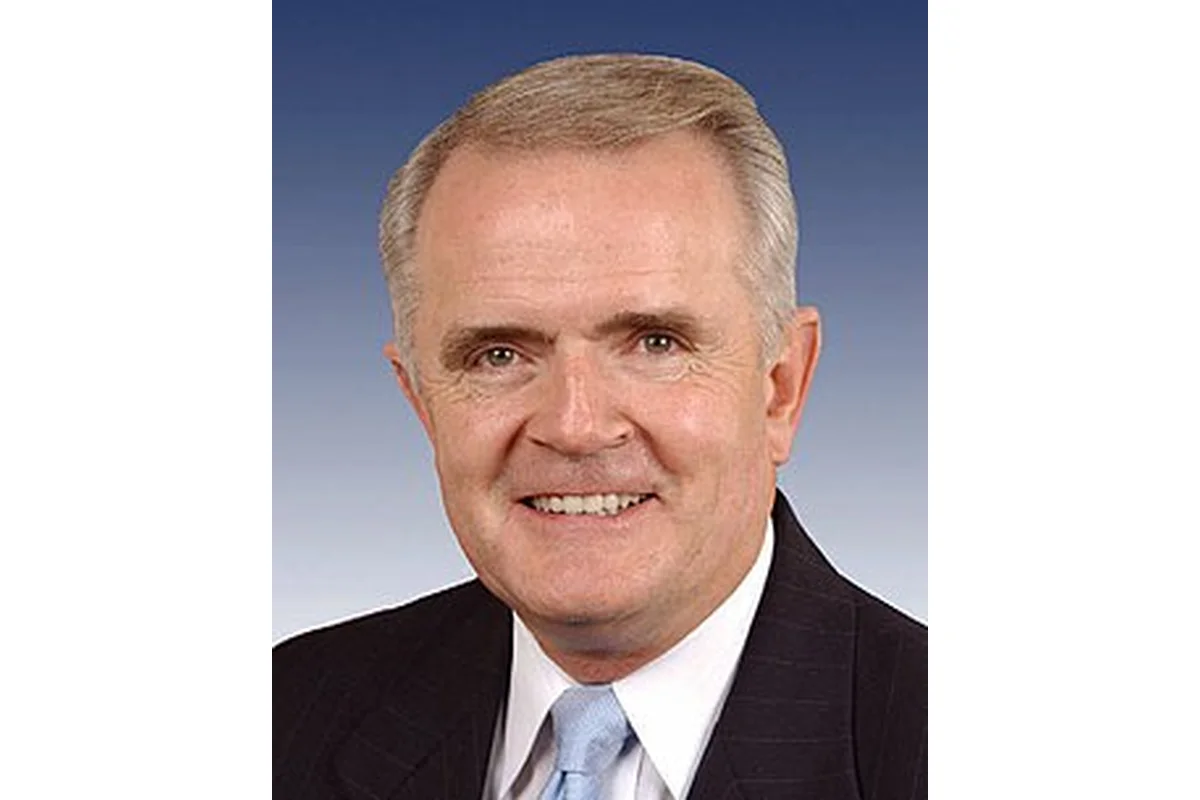
Jim Gibbons Bio
James Arthur Gibbons (born December 16, 1944) is an American attorney, aviator, geologist, hydrologist and Republican politician. He served as the 28th Governor of Nevada from 2007 to 2011 after representing Nevada’s 2nd congressional district in the U.S. House of Representatives from 1997 to 2006. Earlier in his career, Gibbons served in the Nevada State Assembly from 1988 to 1994.
A Vietnam-era U.S. Air Force veteran, Gibbons later joined the Nevada Air National Guard and served as its vice commander. He is a recipient of the Legion of Merit and the Distinguished Flying Cross for his service as a reconnaissance pilot. His term as governor was dominated by the Great Recession, steep budget cuts, and several ethics controversies, and he later ranked among the worst governors in the United States.
Early Life and Background
James Arthur Gibbons was born on December 16, 1944, in Sparks, Nevada. He was raised in The Church of Jesus Christ of Latter-day Saints, a faith that shaped his early years in the Reno–Sparks area of northern Nevada. Growing up in this region placed him near the rural and mining communities that would later inform his interest in geology and water issues.
Gibbons attended the University of Nevada, Reno, where he earned both a Bachelor of Science and a Master of Science degree. During his college years he joined the Sigma Nu fraternity and built the academic foundation that would lead him into law, geology, and public service. He later attended Southwestern Law School in Los Angeles, where he earned a Juris Doctor, and completed post-graduate studies at the University of Southern California.
During the Vietnam War, Gibbons interrupted his studies to serve in the United States Air Force from 1967 to 1971. After returning to civilian life, he joined the Nevada Air National Guard in 1975 and graduated from both the U.S. Air Force Air Command and Staff College and the Air War College. He also worked as a pilot for Delta Air Lines while continuing his political rise in Nevada.
Path to US Politics
Gibbons first entered elected office in 1988 when he won a seat in the Nevada State Assembly representing District 23 in Washoe County, later renumbered as District 25. He won his first race with about 64 percent of the vote and faced no serious opposition afterward because of the district’s strong Republican lean. His assembly tenure was briefly interrupted in 1991 when he and his Nevada Air National Guard unit were called to active service in the U.S. Air Force for the Gulf War.
During the Gulf War, Gibbons served as a pilot and flight leader flying the RF-4C Phantom II reconnaissance aircraft. For extraordinary achievement during a mission in which he flew an unarmed aircraft on reconnaissance over Kuwait, he was awarded the Distinguished Flying Cross. He later received the Legion of Merit for his overall military service. He also served as vice commander of the Nevada Air National Guard from 1990 to 1996.
In 1994, while working as a Delta Air Lines pilot and serving in the Nevada Assembly, Gibbons ran for Governor of Nevada. As the Republican nominee, he lost to Democratic incumbent Bob Miller, receiving 156,875 votes to Miller’s 200,026. The loss did not end his political ambitions, and two years later he successfully ran for the U.S. House of Representatives.
Jim Gibbons Career
Early Career (1988–1994)
Gibbons represented District 23, later renumbered as District 25 in Washoe County, in the Nevada Assembly from 1988 to 1994. His only interruption came in 1991 when he was called to active duty for the Gulf War. During this period, he built a reputation as a reliable conservative voice in northern Nevada while continuing his service in the Air National Guard.
He concluded his assembly career with an unsuccessful 1994 run for governor against Bob Miller. The campaign gave Gibbons statewide exposure and set the stage for his later congressional and gubernatorial bids. He returned to private life and his Delta Air Lines career before launching his next campaign in 1996.
United States Congress (1997–2006)
In 1996, longtime representative Barbara Vucanovich retired from Nevada’s 2nd congressional district. Gibbons won the Republican primary, the real contest in the heavily Republican district, and easily won the general election. He was reelected four times with little substantive opposition, including a 1998 race in which he faced no major-party challenger.
During his time in Congress, Gibbons served as vice chairman of the House Resources Committee and sat on the Armed Services Committee, the Homeland Security Committee, and the Permanent Select Committee on Intelligence. His long-time chief of staff, Michael Dayton, was later replaced by Robert Uithoven, who served as legislative director and eventually as campaign manager for Gibbons’s 2006 gubernatorial run.
Governor of Nevada (2007–2011)
Gibbons announced in late 2004 that he would not seek a sixth House term, choosing instead to run for governor in 2006. He won the Republican primary decisively, defeating state senator Bob Beers and Lieutenant Governor Lorraine Hunt, and went on to defeat Democratic Minority Leader Dina Titus in the general election, 278,984 votes to 255,675. He resigned his House seat on New Year’s Eve and was sworn in as the 28th Governor of Nevada just after midnight on New Year’s Day.
His governorship was dominated by the Great Recession, which hit Nevada harder than most states. In October 2007 he proposed cutting funding for state services by 5 percent, later revising the figure upward to 8 percent, and in 2008 he suggested a 14 percent cut to elementary, secondary, and higher education funding. Nevada experienced an economic slowdown, steep budget cuts, and high taxes during his term. His job approval fell to an all-time low of 10 percent in a June 2008 Las Vegas Review-Journal poll.
Notable Events and Milestones
Gibbons’s tenure was marked by several notable and controversial episodes. These included breaking his no-new-taxes pledge, a land deal near Lamoille, Nevada, that drew ethics questions, and an October 2006 accusation of attempted sexual assault for which criminal charges were never filed. He also faced criticism for spending limited time at his Capitol office, a controversy compounded by a 2009 incident in which he texted during a legislative hearing. In April 2010, Citizens for Responsibility and Ethics in Washington named him one of 11 worst governors in America.
Jim Gibbons Career Wins
Across his political career, Jim Gibbons won a series of elections at the state and federal levels. He captured his first Nevada Assembly seat in 1988 with about 64 percent of the vote, held it for six years, won a U.S. House seat in 1996, and was reelected four times with no serious opposition. In 2006 he won the Republican gubernatorial primary and the general election to become Nevada’s 28th governor.
U.S. Congress Highlights
Gibbons won Nevada’s 2nd congressional district five times between 1996 and 2004, often without a major-party challenger. His most decisive victories came in the heavily Republican district, where he built a reputation as a conservative voice on natural resources, defense, and intelligence matters. He resigned the seat in late 2006 to assume the governorship.
Other Wins and Achievements
Beyond electoral victories, Gibbons earned the Legion of Merit and the Distinguished Flying Cross for his service as an Air Force and Air National Guard reconnaissance pilot. He rose to the rank of vice commander of the Nevada Air National Guard, a position he held from 1990 to 1996. His military decorations remain among the most prominent honors of his public career.
Jim Gibbons Family
Family Background and Personal Life
Jim Gibbons was raised in Sparks, Nevada, in a household shaped by The Church of Jesus Christ of Latter-day Saints. He married Dawn Snelling in 1985, and together they had a son born in 1987. The family made their home in Reno, Nevada, where Dawn preferred to raise their son rather than relocate to Washington during Jim’s years in Congress.
Personal Life
Dawn Gibbons was elected to the Nevada State Assembly in 1998, two years after her husband won his congressional seat. The couple separated publicly when Jim Gibbons filed for divorce on May 2, 2008, citing incompatibility. They finalized an out-of-court divorce agreement in January 2010, and the divorce was completed on July 21, 2010. Following the divorce, Gibbons continued to reside in Reno, Nevada.