
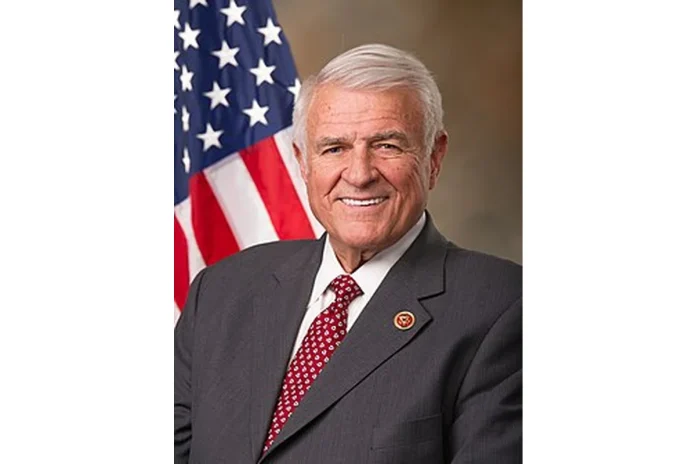
John Carter Bio
John Rice Carter (born November 6, 1941) is an American politician who has served as the United States Representative for Texas’s 31st congressional district since 2003. A member of the Republican Party, he represents a Central Texas district that covers the northern suburbs of Austin and includes Fort Hood. Before entering Congress, Carter built a long career in Texas law and the state judiciary, earning recognition as a conservative legal figure in Williamson County. He lives in Round Rock, Texas, with his wife, Erika, with whom he has four children and six grandchildren.
Over more than two decades in the U.S. House of Representatives, Carter has focused on military, veterans, and homeland security policy through his work on the Appropriations Committee. He is known for sponsoring legislation on identity theft penalties, military family rights, and combat casualty recognition, while also engaging in several high-profile national debates.
Early Life and Background
John Rice Carter was born on November 6, 1941, in Houston, Texas. Although his birthplace is in southeast Texas, he has spent most of his life in central Texas, where he built his legal and political career. Growing up in a region shaped by agriculture, military bases, and steady population growth shaped his later interest in public service and law.
He graduated from Texas Tech University in 1964 with a Bachelor of Arts degree in history. His studies in history gave him a broad understanding of American government and constitutional development, which influenced his later decision to pursue a legal career.
Five years after completing his undergraduate studies, Carter earned a Juris Doctor from the University of Texas School of Law in 1969. His legal training prepared him for a long career in Texas law, the state judiciary, and eventually national politics in Washington.
Path to US Politics
After graduating from law school, Carter served as the first general counsel to the Texas House of Representatives’ Agriculture Committee. This early role introduced him to legislative drafting, committee procedure, and the practical workings of state government. He later opened a private law practice in Round Rock, Texas, where he handled civil and criminal matters for local clients.
In 1981, Carter was appointed judge of the 277th District Court of Williamson County. A year later, he won election to the same bench, becoming the first Republican elected to a countywide office in the county. He was reelected four times and served on the bench for nearly two decades, presiding over a wide range of civil and criminal cases in central Texas.
One of the most notable cases of his judicial career came in 1984, when he presided over the trial of confessed serial killer Genene Jones. Jones was convicted of murdering a fifteen-month-old baby in Kerrville, Texas, and was sentenced to ninety-nine years in prison. Carter remained involved in later efforts to keep Jones incarcerated when questions arose about her potential early release.
John Carter Career
Early Career (1981-2001)
During his two decades on the bench, Carter became a well-known figure in Williamson County legal circles. His rulings and his role as a Republican jurist in a historically Democratic county gave him a reputation for fairness and independence. He retired from the bench in 2001 after serving five terms as judge of the 277th District Court.
That same year, he decided to enter national politics and run for Congress in the newly created 31st congressional district. After finishing second in the Republican primary, he defeated Peter Wareing in the primary runoff. Because the district leaned heavily Republican, the runoff was effectively decisive, paving the way for his first term in Washington.
Congressional Debut and Early Terms (2003-2010)
Carter took office in January 2003 representing a sprawling district that reached from the suburbs of Austin to the western Houston area and included College Station, home of Texas A&M University. Following the 2003 Texas redistricting, his district was redrawn to stretch from the fringes of the Dallas-Fort Worth Metroplex through rural parts of Central Texas. The configuration made him a voice for both suburban growth communities and rural farming areas.
During his early years in Congress, Carter built a legislative record focused on national security and criminal justice. He was the sponsor of the Identity Theft Penalty Enhancement Act, which President George W. Bush signed into law in 2004. He also worked on bills supporting military families, including the Military Spouses Residency Relief Act, and co-sponsored anti-terrorism measures such as the Terrorist Death Penalty Act of 2008.
Redistricting and Reelection Battles (2011-2018)
After redistricting following the 2010 census, Carter’s district was reduced in size to cover Bell and Williamson counties, with Fort Hood becoming a central feature of the constituency. The change brought the issues of active-duty soldiers, military families, and veterans directly into the heart of his legislative work.
In 2016, he was reelected with 166,060 votes, or 58.4 percent of the total, defeating Democratic nominee Mike Clark and Libertarian Scott Ballard. Two years later, in 2018, he faced his toughest race to date, defeating Democratic challenger MJ Hegar with 144,680 votes, or 50.6 percent, to her 136,362 votes, or 47.7 percent. That narrow margin was the smallest of his career and signaled the growing competitiveness of central Texas suburbs.
Senior Committee Work and Recent Years (2019-Present)
In 2018, Carter was named chair of the Military Construction and Veterans Affairs Subcommittee on Appropriations, after previously chairing the Homeland Security Subcommittee on Appropriations. In this leadership role, he has overseen federal spending on military bases, veteran facilities, and the well-being of service members and their families.
Carter has been active on several high-profile national issues in recent years. He voted against both articles of impeachment against President Donald Trump in December 2019 and against certifying the 2020 presidential election results on January 6, 2021. He was one of seventy-one Republicans who voted against final passage of the Fiscal Responsibility Act of 2023 and voted to provide Israel with support following the October 7, 2023 attacks. In 2024, he was reelected to his thirteenth term in Congress.
Notable Events and Milestones
One of the defining moments of Carter’s early career was his 1984 prosecution of Genene Jones, a case that brought national attention to patient safety in healthcare settings. Decades later, his 2018 appointment as chair of the Military Construction and Veterans Affairs Subcommittee cemented his role as a leading voice on military and veterans policy in the House. His narrow 2018 victory over MJ Hegar, his closest race in more than fifteen years in Congress, also stands out as a milestone that reflected changing political winds in central Texas.
John Carter Career Wins
John Carter has compiled a long record of electoral victories since first winning a seat on the Williamson County bench in 1982. His success at the local, state, and federal levels reflects consistent support from voters across central Texas.
Congressional Election Highlights
Since his first victory in the 2002 Republican primary runoff, Carter has won thirteen consecutive terms in the U.S. House of Representatives. His strongest recent performance came in 2016, when he earned 58.4 percent of the vote against a Democratic and a Libertarian challenger. His closest contest was in 2018, when he defeated MJ Hegar by roughly three percentage points in a race that drew national attention.
Other Wins and Achievements
Before entering Congress, Carter won five terms as judge of the 277th District Court of Williamson County, making him one of the longest-serving jurists in the county’s history. His 1982 victory was also historic, as he became the first Republican elected to a countywide office in Williamson County.
John Carter Family
Family Background and Political Lineage
Carter was born in Houston, Texas, and has spent most of his life in central Texas. He married his wife, Erika, in 1968, and the couple has four children and six grandchildren. Since 1971, the family has lived in Round Rock, Texas, where Carter built his law practice and his political career.
Personal Life
Carter and his wife have been residents of Round Rock for more than five decades. Their long-standing ties to central Texas have shaped his focus on issues such as military readiness, veterans’ care, and the growth of suburban communities around Austin.