
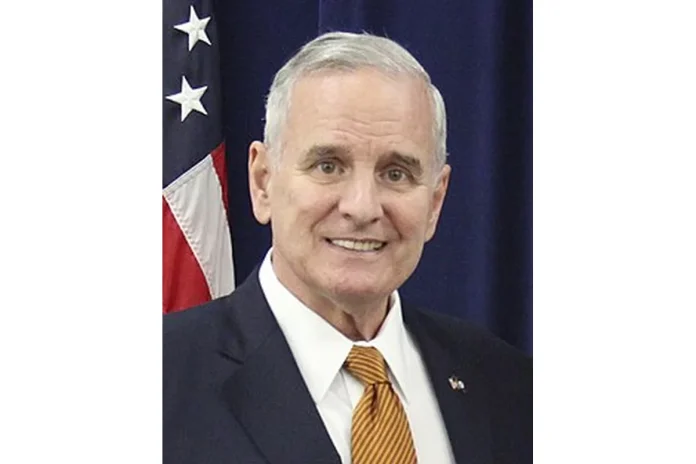
Mark Dayton Bio
Mark Brandt Dayton (born January 26, 1947) is an American politician who served as the 40th governor of Minnesota from 2011 to 2019. A member of the Minnesota Democratic–Farmer–Labor Party (DFL), he is one of the most recognizable figures in modern Minnesota politics, with a career spanning auditing, the U.S. Senate, and the governorship.
Before entering public life, Dayton worked as a teacher in New York City and as a financial officer for a social service agency in Boston. He is the great-grandson of George Dayton, the founder of the Dayton’s department store chain that eventually became the Target Corporation.
Early Life and Background
Mark Brandt Dayton was born on January 26, 1947, in Minneapolis, Minnesota, the eldest of four children of Bruce Bliss Dayton and Gwendolen May (Brandt) Dayton. He was raised in Long Lake, Minnesota, and grew up inside one of the state’s most prominent retail families. His father, Bruce Bliss Dayton, served as chairman and chief executive officer of the Dayton Hudson Corporation, the company that later became Target Corporation, and also founded the B. Dalton bookstore chain in 1966.
Dayton graduated from the Blake School in Minneapolis, where he played ice hockey and was an all-state goaltender as a senior. He attended Yale University, where he played varsity hockey until an injury on the ice cut his playing career short. At Yale he joined the Delta Kappa Epsilon fraternity alongside future President George W. Bush and earned a Bachelor of Arts in psychology in 1969.
Path to US Politics
After college, Dayton taught on the Lower East Side of Manhattan from 1969 to 1971 and then worked as chief financial officer of a social service agency in Boston from 1971 to 1975. He became politically active in the late 1960s, protesting the Vietnam War in April 1970 at a major Minnesota antiwar demonstration against Honeywell, where he was maced by police. The incident created a long-running rift with his father, who sat on the Honeywell board.
From 1975 to 1976, Dayton served as a legislative aide to U.S. Senator Walter Mondale, and from 1977 to 1978 he worked as an aide to Minnesota Governor Rudy Perpich. In 1978, Governor Perpich appointed him to lead the Minnesota Department of Economic Development and later the Department of Energy and Economic Development. These early government posts launched his career in public service and led directly to his first run for the U.S. Senate in 1982.
Mark Dayton Career
Early Career (1982–1995)
Dayton first ran for the U.S. Senate in 1982, challenging Republican incumbent David Durenberger. He won the DFL primary with more than 69% of the vote and campaigned as a populist against Reaganomics, famously promising to close tax loopholes for the rich and corporations and adding, “if you think that includes the Daytons, you’re right.” Durenberger won the general election, 52% to 46%, in one of the most expensive Senate races in Minnesota history to that point.
After the loss, Dayton returned to the Perpich administration and in 1990 won election as Minnesota State Auditor, an office he held from 1991 to 1995. In 1998 he sought the DFL nomination for governor but finished fourth with 18% of the vote, losing the primary to Hubert Humphrey III.
U.S. Senate Breakthrough (2000–2007)
In 2000, Dayton won the DFL nomination for the U.S. Senate in a six-candidate field with 41% of the vote and defeated Republican incumbent Rod Grams 49% to 43%, largely funding the campaign with about $12 million of his own money. As a senator, he voted against the Authorization for Use of Military Force Against Iraq in October 2002 and generally voted with fellow Democrats.
Dayton donated his Senate salary to fund bus trips for Minnesota seniors to buy lower-cost prescription drugs in Canada. On September 22, 2005, he became the first U.S. senator to introduce legislation creating a cabinet-level United States Department of Peace. He announced in February 2005 that he would not seek reelection, citing his dislike of fundraising and his belief that another candidate could hold the seat for the DFL, and he was succeeded in 2007 by Amy Klobuchar.
Governor of Minnesota Era (2011–2019)
After winning the 2010 Democratic primary and defeating Republican Tom Emmer in a narrow contest that required an automatic recount, Dayton was sworn in as the 40th governor of Minnesota on January 3, 2011, becoming the oldest person ever inaugurated as governor in state history. He was the first DFLer to hold the office in 20 years. Early in his term he signed executive orders applying for federal health-care funds and signed a law increasing penalties for those who injure or kill police dogs. A 2011 budget standoff with the Republican-led legislature led to a state government shutdown from July 1 to July 20.
Dayton made the construction of a new Minnesota Vikings stadium a signature effort, and in May 2012 a plan to build the venue on the site of the Metrodome was passed by the legislature and signed into law. In 2013 he pushed through a $2.1 billion tax increase on the wealthy and cigarettes, signed a bill legalizing same-sex marriage in Minnesota, established free statewide all-day kindergarten, and financed expansions of the Mayo Clinic, 3M, and the Mall of America. He won a second term in 2014, defeating Republican Jeff Johnson 50.1% to 44.5%, the first time since 1994 that a Minnesota gubernatorial winner received a majority of the vote.
Notable Events and Milestones
Dayton is remembered for his role in legalizing same-sex marriage in Minnesota, for navigating a 20-day state government shutdown in 2011, and for shepherding the construction of U.S. Bank Stadium, which opened during his tenure. He appointed Lieutenant Governor Tina Smith to the U.S. Senate seat vacated by Al Franken in January 2018 and signed a 2017 executive order requiring state contractors not to boycott Israel. Earlier, in 2012, he commemorated the 150th anniversary of the Dakota War of 1862 with a day of remembrance and reconciliation.
Mark Dayton Career Wins
Mark Dayton built a long record of electoral success at the state and federal level, with his most prominent victories coming in the 2000 U.S. Senate race and the 2010 and 2014 Minnesota gubernatorial elections.
U.S. Senate Highlights
Dayton first captured national attention by winning the 2000 U.S. Senate race in Minnesota, defeating one-term Republican incumbent Rod Grams 49% to 43% in a six-candidate DFL primary and a hard-fought general election. His 1982 Senate bid fell short against David Durenberger, but it established him as a populist voice willing to challenge his own family’s business interests.
Other Wins & Achievements
Beyond his Senate victory, Dayton won election as Minnesota State Auditor in 1990 and served until 1995, and he won the Minnesota governorship twice, in 2010 over Tom Emmer and in 2014 over Jeff Johnson. He is also recognized for landmark legislative achievements as governor, including the legalization of same-sex marriage and the financing of U.S. Bank Stadium.
Mark Dayton Family
Family Background and Political Lineage
Dayton was raised in one of Minnesota’s most prominent families as the great-grandson of George Dayton, founder of the Dayton’s department store chain. His father, Bruce Bliss Dayton, built the family business into a retail empire as chairman and chief executive officer of the Dayton Hudson Corporation, which later became Target Corporation, and also founded the B. Dalton bookstore chain. Dayton’s mother was Gwendolen May (Brandt) Dayton, and he is the eldest of four children.
Personal Life
Dayton has been married three times. In 1978, he married Alida Ferry Rockefeller, the youngest sister of former U.S. Senator Jay Rockefeller, at the Rockefeller home in Tarrytown, New York, and they had two sons, Eric Dayton and Andrew Dayton, before divorcing in 1986. He later married Janice Haarstick in 1996, with that marriage ending in divorce in 1999. In December 2020, he married former congressional intern and campaign staffer Ana Orke, whom he had first met at a 2005 political fundraiser.
Despite his wealth, Dayton has lived modestly and has spoken publicly about his recovery from alcoholism and treatment for mild depression. In 2012 he underwent vertebral fusion surgery at the Mayo Clinic, and in January 2017 he announced that he had been diagnosed with prostate cancer. In October 2019, the University of Minnesota’s Center for Integrative Leadership named him an Executive Leadership Fellow for the 2019–2020 academic year.