

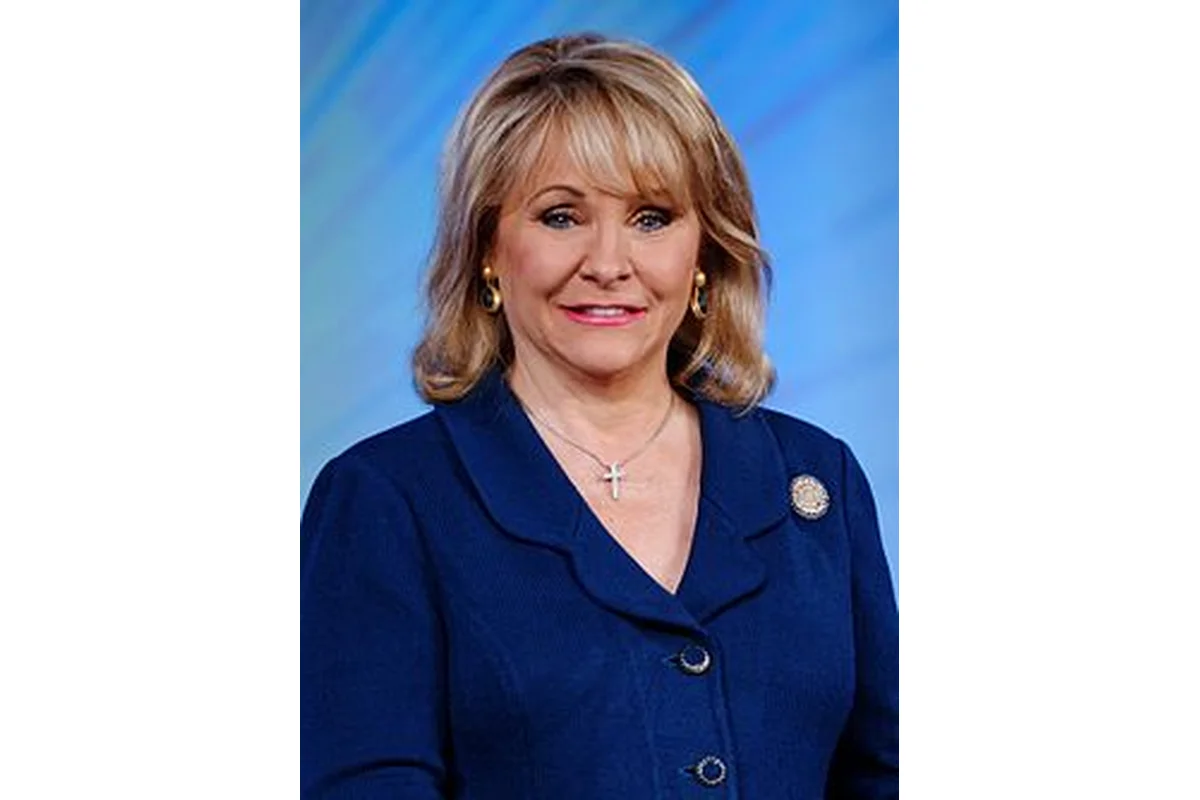
Mary Fallin Bio
Mary Newt Fallin (née Copeland; born December 9, 1954) is an American politician and real estate broker who served as the 27th governor of Oklahoma from 2011 to 2019. A Republican, she previously represented Oklahoma’s 5th congressional district in the U.S. House of Representatives from 2007 to 2011 and served three terms as lieutenant governor of Oklahoma from 1995 to 2007. Fallin began her political career in the Oklahoma House of Representatives, where she served from 1990 to 1995. As of 2025, she remains the only woman to have served as governor of Oklahoma.
Early Life and Background
Mary Newt Fallin was born Mary Copeland in Warrensburg, Missouri, the daughter of Mary Jo (née Duggan) and Joseph Newton Copeland. Her parents later settled in Tecumseh, Oklahoma, where each of them served a term as mayor. Both were members of the Oklahoma Democratic Party, and Fallin identified as a Democrat until the age of 21, when she switched to the Republican Party and became active with the Young Republicans. Growing up in a politically engaged household helped shape her early interest in public service and community leadership.
Fallin graduated from Tecumseh High School and went on to attend Oklahoma Baptist University in Shawnee. She later transferred to Oklahoma State University, where she earned a Bachelor of Science degree in human and environmental sciences, with a focus on family relations and child development, in 1977. While at Oklahoma State, she joined the Kappa Alpha Theta sorority, an experience that broadened her network and deepened her involvement in campus life.
Path to US Politics
After finishing her degree, Fallin gained experience in state government through positions with the Oklahoma Department of Tourism and Recreation, the Oklahoma Employment Security Commission, and the Oklahoma Office of Personnel Management. In 1983, she moved to the private sector as a hotel manager for the Lexington Hotel and Suites in Oklahoma City. She also worked as a marketing director for a ski lodge in Utah and built a career as a commercial real estate broker in Oklahoma, giving her a practical understanding of both public administration and small business.
Fallin entered electoral politics in 1990, winning a seat in the Oklahoma House of Representatives for the 85th district after incumbent Mike Hunter announced his retirement. She won the Republican primary in August 1990 and the general election in November of that year, beginning a steady rise through state government. In 1992, she won re-election unopposed, an early sign of her growing political strength in Oklahoma City. She authored 16 bills that became law and introduced the state’s first anti-stalking legislation, House Bill 2291, in 1992, which helped position her as a rising voice in Oklahoma policy circles.
Mary Fallin Career
Early Career (1990–1994)
Fallin’s early career was defined by her work in the Oklahoma House of Representatives from 1990 to 1995. In addition to her 16 bills that became law, she authored anti-stalking legislation in 1992 that made Oklahoma one of the first five states in the nation to enact such a law. She was active with the American Legislative Exchange Council, which recognized her as Legislator of the Year in 1993, and she was named Guardian of Small Business by the National Federation of Independent Business the same year.
Her reputation as a champion of victims’ rights and health care reform earned her a strong political profile heading into her next campaign. These early accomplishments set the stage for her run for lieutenant governor in 1994, where she ultimately prevailed in a competitive three-way contest against other women candidates. That race marked the beginning of her statewide political career in Oklahoma.
Breakthrough (1994–2006)
In 1994, Fallin ran for lieutenant governor of Oklahoma, defeating two opponents in the Republican primary before winning the run-off against Terry Neese 53% to 47% and then defeating Democrat Nance Diamond 50% to 44% in the general election. In 1995, she was sworn in as the first woman and the first Republican to serve as lieutenant governor in Oklahoma history, beginning a 12-year tenure that made her the third longest-serving lieutenant governor in the state. In 1998, she won re-election against Jack Morgan 68% to 32%, sweeping nearly every county, and in 2002, she won a third term over Democratic State Representative Laura Boyd 57% to 39%.
As lieutenant governor, Fallin served on 10 boards and commissions and took on several high-profile assignments. After the 1995 bombing of the Alfred P. Murrah Federal Building in Oklahoma City, she led a task force to rebuild the childcare center destroyed in the attack. In 1997, she chaired the Fallin Commission on Workers’ Compensation, which produced a comprehensive reform plan, and she promoted the national Project Homesafe initiative to distribute free cable gun locks. She also led the push for a right-to-work law in Oklahoma, which was passed in 2001. Her national profile grew in 1998 when she chaired the National Lieutenant Governors Association, followed by leadership of the Republican Lieutenant Governors Association in 1999 and the Aerospace States Association.
In 2006, after U.S. Representative Ernest Istook launched a gubernatorial bid, Fallin entered the race for Oklahoma’s 5th congressional district. She won the Republican primary with 35% of the vote, then defeated Oklahoma City Mayor Mick Cornett 63% to 37% in the run-off, and went on to win the general election against Democrat Paul David Hunter 60% to 40%. She was sworn into Congress on January 4, 2007, becoming the first woman elected to Congress from Oklahoma since 1920, when Alice Mary Robertson held the same distinction.
Republican Era (2007–Present)
In Congress, Fallin served on the House Small Business Committee and was the top Republican on the Small Business subcommittee overseeing the Small Business Administration from 2007 to 2010. In 2008, she voted for the Emergency Economic Stabilization Act but against the auto industry rescue plan. She passed her first bill in June 2007, revamping federal grants for women’s business centers. She also served as vice chairwoman of the Congressional Women’s Caucus and as Small Business chairwoman on the Republican Policy Committee.
Fallin ran for governor of Oklahoma in 2010, winning the Republican primary with 54% of the vote and defeating Democratic nominee and former Lieutenant Governor Jari Askins 60% to 39% in the general election. She won re-election in 2014 against Oklahoma State Representative Joe Dorman, and term limits prevented her from running again in 2018, when fellow Republican Kevin Stitt succeeded her. As governor, Fallin focused on reducing the state income tax, expanding sales taxes, criminal justice reform, education policy, and pro-business regulatory efforts. She departed office in 2019 with a 23.4% approval rating after starting her tenure with strong public support.
Notable Events and Milestones
Fallin made history as the first woman elected governor of Oklahoma, the first woman elected to Congress from the state since 1920, and the first Republican woman to serve as lieutenant governor of Oklahoma. Her governorship included signature actions such as vetoing permitless carry legislation in 2018, signing 20 anti-abortion measures into law, and issuing a 2015 executive order that made Oklahoma the first state to refuse compliance with the Environmental Protection Agency’s Clean Power Plan. She also received the 2014 Golden Padlock Award from Investigative Reporters and Editors for her commitment to secrecy around execution records.
Mary Fallin Career Wins
Mary Fallin’s electoral record includes three terms as lieutenant governor of Oklahoma, two terms in the U.S. House of Representatives, and two terms as governor of Oklahoma. Her victories span more than two decades of competitive campaigns at the state and federal levels, including wins in both Republican primaries and general elections.
US Politics Highlights
Fallin’s political career began with a 1990 win in the Oklahoma House of Representatives, followed by an unopposed re-election in 1992. She then won three consecutive races for lieutenant governor in 1994, 1998, and 2002, becoming the longest-serving Republican lieutenant governor in Oklahoma history. In Congress, she won the 5th district in 2006 and was re-elected in 2008 with 66% of the vote. Her two gubernatorial victories, in 2010 and 2014, were among the most decisive in recent Oklahoma history.
Other Wins and Achievements
In addition to her electoral wins, Fallin was named 1993 Legislator of the Year by the American Legislative Exchange Council and 1998 Woman of the Year in Government. She received the Clarence E. Page Award, the Women in Communications’ Woman in the News Award, and was inducted into both the Oklahoma Women’s Hall of Fame and the Oklahoma Aviation Hall of Fame. In 1998, she served as chairwoman of the National Lieutenant Governors Association.
Mary Fallin Family
Family Background and Political Lineage
Mary Fallin was raised in Tecumseh, Oklahoma, by her parents, Joseph Newton Copeland and Mary Jo Copeland (née Duggan), both of whom served terms as mayor of Tecumseh and were members of the Oklahoma Democratic Party. Her parents’ deep involvement in local politics gave Fallin an early appreciation for public service, even though she would later switch to the Republican Party at age 21.
Personal Life
Fallin married her first husband, Joseph Fallin, a dentist, in November 1984, and the couple divorced in December 1998. In November 2009, she married Wade Christensen, an Oklahoma City lawyer. Together, they have a blended family of six children, including Fallin’s daughter, Christina Fallin, a model, makeup artist, and musician who was described in a 2014 Washington Post article as “the most interesting governor’s daughter in the country.” As of 2025, Fallin and Christensen remain married.