
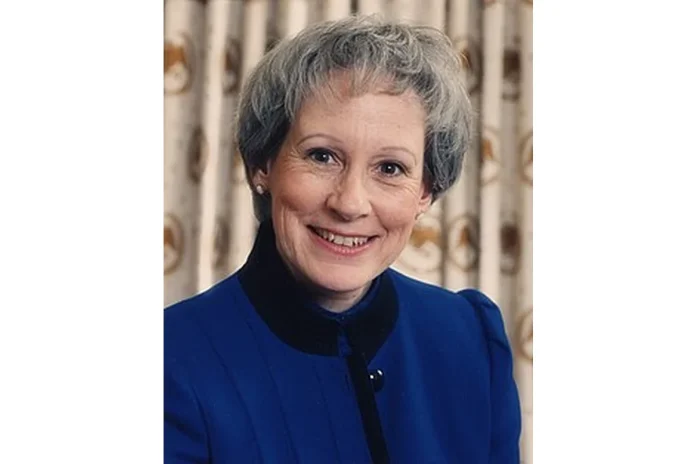
Nancy Kassebaum Bio
Nancy Josephine Kassebaum Baker, born July 29, 1932, in Topeka, Kansas, is an American retired politician who represented Kansas in the United States Senate from 1978 to 1997. A Republican known for her political independence, Kassebaum built bipartisan coalitions on foreign policy and domestic issues across three Senate terms. She was the daughter of Alf Landon, the 1936 Republican presidential nominee and former Governor of Kansas, and the first woman elected to a full Senate term without a husband who had previously served in Congress.
Early Life and Background
Nancy Josephine Landon was born in Topeka, Kansas, on July 29, 1932, the daughter of Kansas First Lady Theo Cobb Landon and Governor Alf Landon. She grew up in a political household shaped by her father’s career as a governor and presidential nominee, which gave her early exposure to public service. She attended Topeka High School and graduated in 1950 before enrolling at the University of Kansas in Lawrence.
At the University of Kansas, she was a member of Kappa Alpha Theta sorority and met John Philip Kassebaum, whom she married in 1955. She graduated with a bachelor’s degree in 1954 and went on to earn a master’s degree in diplomatic history from the University of Michigan in 1956. The couple settled in Maize, Kansas, where they raised four children while she worked as vice president of Kassebaum Communications, a family-owned company that operated several radio stations. Kassebaum also served on the Maize School Board, continuing her early engagement in civic life.
Path to US Politics
Kassebaum’s path into national politics accelerated in 1975 when she worked in Washington, D.C., as a caseworker for Republican Senator James B. Pearson of Kansas. She returned to Kansas the following year, but had already gained firsthand experience of Senate work. In late 1977, when Senator Pearson announced he would not seek another term, the rare open seat drew a crowded field of Republican candidates.
Legally separated from her husband at the time, Kassebaum entered the 1978 Republican primary under the name Nancy Landon Kassebaum, drawing on her father’s political reputation. She defeated eight other Republicans in the primary and then defeated former Democratic Representative William R. Roy in the general election. With that victory, she became the only woman serving in the Senate and the first woman to represent Kansas in the upper chamber.
Nancy Kassebaum Career
Early Career (1978–1984)
Kassebaum’s first term in the Senate quickly established her as a centrist voice. From the start of her tenure, she voted moderate to liberal on most social issues while remaining conservative on federal spending and government mandates. She helped lead an unsuccessful bipartisan effort to curb soaring federal deficits in the early years of the Reagan administration, building a reputation as a broker across party lines.
She became chair of the Senate Subcommittee on African Affairs in 1981, marking her rise in foreign policy. She also served as Temporary Chairman of the 1980 Republican National Convention, presiding over the first two days in a role widely seen as a nod from the Reagan campaign to the moderate and liberal wings of the party.
Foreign Policy and Anti-Apartheid Work (1981–1986)
As chair of the Senate Subcommittee on African Affairs, Kassebaum entered the growing controversy over apartheid in South Africa. She issued a public call for President Reagan and fellow Republicans to toughen United States policy toward the white minority government in Pretoria. Working with Senator Richard Lugar of Indiana, she helped craft targeted sanctions against the South African government, including a demand for the release of African National Congress leader Nelson Mandela.
The bipartisan Comprehensive Anti-Apartheid Act of 1986 passed both chambers by overwhelming margins. After President Reagan vetoed the bill, Kassebaum and Lugar led the fight to override the veto. On October 2, 1986, the Senate voted 78 to 21 to enact the sanctions into law. In March 1982, Kassebaum also headed a United States delegation to observe national elections in El Salvador, where she subsequently championed bipartisan support for the Salvadoran government while pressing it on human rights and land reform.
Health Care Reform and Senate Leadership (1994–1997)
When Republicans won control of Congress in the 1994 elections, Kassebaum became chair of the Senate Labor Committee, with broad jurisdiction over federal domestic policy. One of her first actions was to introduce health insurance reform legislation co-sponsored by the committee’s senior Democrat, Senator Ted Kennedy of Massachusetts. The bill focused on helping roughly 25 million workers obtain and keep health insurance coverage regardless of preexisting conditions, even when changing or losing a job.
During a year of heated debate, Kassebaum often opposed amendments from fellow Republicans, including Kansas colleague and Senate Majority Leader Bob Dole, while pressuring Kennedy and Democrats to reach compromises. House and Senate conferees ultimately settled on a final version of the legislation, known as the Kennedy-Kassebaum Health Insurance Portability and Accountability Act. The bill passed overwhelmingly in both chambers and was signed into law by President Clinton on August 21, 1996.
Conservation and Final Years in the Senate (1996–1997)
In her final months in the Senate, Kassebaum secured passage of a new law preserving a Kansas tallgrass prairie in the national park system. The Tallgrass Prairie National Preserve, covering 10,876 acres in the heart of the Flint Hills, became a reality just two months before she left office. The preserve is the only National Park Service unit dedicated to preserving public access to untamed tallgrass prairie that once covered more than 400,000 square miles of the American heartland.
Kassebaum chose not to seek reelection in 1996 and left the Senate after three terms. Her independent voting record and her work across the aisle made her one of the most respected figures of her era in the chamber.
Notable Events and Milestones
Kassebaum’s career was defined by signature legislative achievements, including the 1986 override of President Reagan’s veto of anti-apartheid sanctions and the 1996 passage of the Kennedy-Kassebaum Health Insurance Portability and Accountability Act. She also helped create the Tallgrass Prairie National Preserve in her home state. In 1991, Time magazine mentioned her as a possible running mate for President George H. W. Bush in the event that Vice President Dan Quayle was not the Republican vice-presidential candidate in 1992.
Nancy Kassebaum Family
Family Background and Political Lineage
Nancy Kassebaum was the daughter of Alf Landon, Governor of Kansas from 1933 to 1937 and the 1936 Republican nominee for president, and First Lady Theo Cobb Landon. Her father’s political legacy shaped her early understanding of public service and gave her a recognizable name when she first ran for the Senate in 1978. Four of her children also attended Kansas State University, continuing the family’s ties to Kansas higher education.
Personal Life
In 1955, Kassebaum married John Philip Kassebaum, and the couple had four children before separating in 1975 and divorcing in March 1979. On December 7, 1996, she married former United States Senator and diplomat Howard Baker of Tennessee, who had served as both Senate majority and minority leader. From 2001 to 2005, Kassebaum accompanied Baker to Tokyo while he served as United States Ambassador to Japan, after which they split time between his home in Huntsville, Tennessee, and her home in Burdick, Kansas, until Baker’s death on June 26, 2014.
Her son William Kassebaum is a former member of the Kansas House of Representatives. Her son, filmmaker Richard Kassebaum, died of a brain tumor on August 27, 2008, at the age of 47. Her daughter, Dr. Linda Johnson, died of supranuclear palsy in 2020 at the age of 61. Kassebaum is also a widow and lives in Burdick, Kansas.