
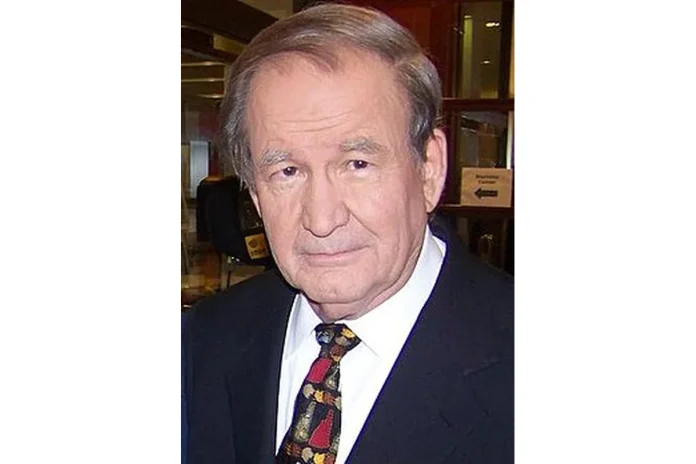
Pat Buchanan Bio
Patrick Joseph Buchanan (born November 2, 1938) is an American author, political commentator, and conservative politician. Over a career spanning more than five decades, he served as an aide and speechwriter to Presidents Richard Nixon, Gerald Ford, and Ronald Reagan, and was White House Communications Director under Reagan from 1985 to 1987. Buchanan is a leading figure in the modern paleoconservative movement, advocating economic nationalism, restrictions on immigration, and a non-interventionist foreign policy.
He twice sought the Republican presidential nomination, in 1992 and 1996, and was the Reform Party’s nominee for president in 2000. In 2002, he co-founded The American Conservative magazine. He is also a longtime syndicated columnist and television commentator, recognized for his appearances on CNN’s Crossfire, MSNBC’s Buchanan & Press, and The McLaughlin Group.
Early Life and Background
Patrick Joseph Buchanan was born in Washington, D.C., on November 2, 1938. He is the son of William Baldwin Buchanan, a partner in an accounting firm, and Catherine Elizabeth Crum, a nurse and homemaker. Buchanan had six brothers and two sisters. His younger sister, Angela Buchanan, later served as U.S. Treasurer during the Reagan administration. His father was of Irish, English, and Scottish ancestry, and his mother was of German descent. A great-grandfather, Cyrus Baldwin, fought and died for the Confederacy at Vicksburg, which inspired Buchanan’s later membership in the Sons of Confederate Veterans.
He was raised in a Catholic family and attended Catholic schools, including the Jesuit-run Gonzaga College High School in Washington, D.C. He then enrolled at Georgetown University, where he participated in the Reserve Officers’ Training Corps program without completing it. In 1960, he earned a bachelor’s degree in English. After receiving his draft notice, the District of Columbia Draft Board exempted him from military service because of reactive arthritis, classifying him as 4-F. He went on to attend the Graduate School of Journalism at Columbia University, writing his master’s thesis on expanding trade between Canada and Cuba and earning a journalism degree in 1962.
Path to US Politics
Buchanan’s first major step into national politics came in 1966, when he was hired as an opposition researcher for Richard Nixon’s presidential campaign. He traveled with Nixon through Western Europe, Africa, and the Middle East in the lead-up to the 1968 election. After Nixon’s victory, Buchanan was appointed a White House assistant and speechwriter for both the president and Vice President Spiro Agnew. He coined the phrase “Silent Majority” and helped shape the political strategy that drew millions of former Democrats to the Republican ticket.
During the Nixon years, he accompanied the president to China in 1972 and to summit meetings in Moscow, Yalta, and Minsk in 1974. He remained at the White House through the final days of the Watergate scandal and was never accused of wrongdoing. When Nixon resigned in 1974, Buchanan briefly continued under President Gerald Ford. Ford initially approved his appointment as ambassador to South Africa, but later rescinded it after the news leaked and drew controversy. Buchanan then transitioned into broadcasting, co-hosting the three-hour daily radio program the Buchanan-Braden Show and writing columns syndicated nationwide.
Pat Buchanan Career
Early Career (1966–1984)
Buchanan built his early career inside the Nixon White House, working on press relations, policy positions, and political strategy. He helped craft the polarizing speeches that earned him the nickname “Mr. Inside” among colleagues. In a 1972 memo, he urged the White House to “re-capture the anti-Establishment tradition” of American politics, foreshadowing his later populist campaigns.
Following his departure from the Ford White House, Buchanan returned to journalism. He co-hosted the Buchanan-Braden Show and delivered daily commentaries on NBC Radio from 1978 to 1984. He also began regular television appearances on The McLaughlin Group and CNN’s Crossfire, programs that made him a nationally recognizable conservative voice.
Reagan White House Breakthrough (1985–1987)
In February 1985, Buchanan was named White House Communications Director, serving under President Ronald Reagan until March 1987. In that role, he shaped the administration’s messaging on cultural and religious issues, telling the National Religious Broadcasters in 1986 that Reagan’s legacy would depend on whether he had “charted a new course that will set our compass for decades.”
While serving in the Reagan administration, Buchanan drew public attention for his defense of John Demjanjuk, a Cleveland auto-worker accused of being “Ivan the Terrible” of the Treblinka death camp, and for supporting Reagan’s plan to visit a German military cemetery at Bitburg in 1985. He also began publicly criticizing the Justice Department’s Office of Special Investigations, accusing it of pursuing suspected Eastern European Nazi war criminals through mistaken identity. After leaving the White House, he returned to his column and to Crossfire.
1992 and 1996 Presidential Campaigns Era (1991–1999)
Buchanan challenged President George H. W. Bush for the 1992 Republican nomination, campaigning against Bush’s broken “Read my lips: no new taxes” pledge and his foreign, trade, and immigration policies. Although he failed to win a primary, he captured about 38 percent of the New Hampshire vote and roughly 23 percent of the total primary ballots, three million votes. At the 1992 Republican National Convention, he delivered his famous “culture war” speech, declaring a “religious war going on in our country for the soul of America.”
He ran again for the Republican nomination in 1996, defeating front-runner Bob Dole in the New Hampshire primary by about 3,000 votes and winning primaries in Alaska, Missouri, and Louisiana. He ultimately withdrew after collecting roughly 21 percent of the primary vote. In October 1999, he left the Republican Party, calling it and the Democrats a “beltway party,” and joined the Reform Party founded by Ross Perot.
Reform Party and Later Media Era (2000–Present)
Buchanan secured the Reform Party’s 2000 presidential nomination at a divided convention in Long Beach, choosing conservative activist Ezola B. Foster as his running mate. The Buchanan-Foster ticket received the fourth-most popular votes in the 2000 election, about 449,895 votes, or 0.4 percent of the national total. The famous Palm Beach County “butterfly ballot” is credited with misdirecting over 2,000 votes intended for Al Gore to Buchanan.
In 2002, Buchanan co-founded The American Conservative magazine and the educational foundation The American Cause. He hosted MSNBC’s Buchanan & Press with Bill Press from 2002 until its cancellation in November 2003, and remained an MSNBC contributor until February 2012, when the network ended its relationship with him following controversies tied to his book Suicide of a Superpower. From 2006 until his retirement in 2023, he was a frequent contributor to VDARE. He continues to write a nationally syndicated column and is recognized as one of the most influential paleoconservative voices in American political life.
Notable Events and Milestones
Among Buchanan’s most defining moments are his coinage of the phrase “Silent Majority” during the Nixon administration, his nationally televised “culture war” speech at the 1992 Republican National Convention, his historic win in the 1996 New Hampshire primary over Bob Dole, and his third-party run as the Reform Party nominee in 2000. He is also remembered for his public defense of suspected Nazi war criminal John Demjanjuk and his central role in the Reagan administration’s controversial Bitburg cemetery visit.
Pat Buchanan Career Wins
Buchanan never held elected office, but his career features several significant victories in American political contests. He captured roughly 23 percent of the 1992 Republican primary vote and forced President Bush to the right on economic policy. He then won the 1996 New Hampshire primary against Bob Dole and added victories in Alaska, Missouri, and Louisiana. As the Reform Party nominee in 2000, he won the party’s nomination and the Right to Life Party nomination in New York.
Presidential Primary Highlights
In the 1992 Republican primaries, Buchanan finished a strong second in New Hampshire and accumulated about three million total primary votes, or 23 percent of the total. Four years later, he stunned the Republican establishment by defeating front-runner Bob Dole in the New Hampshire primary and winning three additional state contests. His insurgent campaigns are widely credited with pushing the Republican Party toward more confrontational stands on trade, immigration, and cultural issues.
Other Wins & Achievements
Buchanan won the Reform Party’s presidential nomination in 2000 and received the endorsement of the New York Right to Life Party, which nominated him with 90 percent of its districts. He also secured about $12.6 million in federal campaign funds for his Reform Party run, thanks to Ross Perot’s 1996 showing, and founded The American Conservative and The American Cause, two influential institutions in American paleoconservative thought.
Pat Buchanan Family
Family Background and Political Lineage
Buchanan was raised in a large Catholic family of nine children in Washington, D.C. His father’s accounting career and his mother’s work as a nurse provided a stable middle-class upbringing. His sister Angela “Bay” Buchanan later became a prominent conservative activist and served as U.S. Treasurer under President Reagan, and she also chaired her brother’s political advocacy efforts. Buchanan’s identification with his Southern roots and his admiration for Robert E. Lee, Douglas MacArthur, and Senator Joseph McCarthy shaped his political outlook from an early age.
Personal Life
Buchanan married White House staffer Shelley Ann Scarney in 1971. The couple have no children. A traditionalist Catholic, Buchanan attends Mass in the extraordinary form of the Roman Rite and has been a strong public defender of Summorum Pontificum. He and his wife once owned a tabby cat named Gipper, who reportedly sat on Buchanan’s lap during staff meetings.