
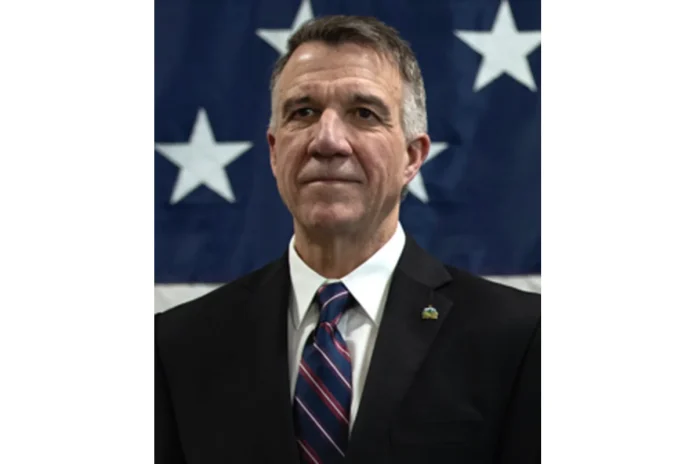
Phil Scott Bio
Philip Brian Scott (born 4 August 1958) is an American politician, businessman, and champion stock car racer who has served as the 82nd governor of Vermont since 2017. A member of the Republican Party, he is widely described as a moderate or liberal Republican, known for combining fiscal conservatism with socially moderate positions. He represented the Washington County district in the Vermont Senate from 2001 to 2011 and served as the 81st lieutenant governor of Vermont from 2011 to 2017.
Scott was first elected governor in 2016 and was reelected in 2018, 2020, 2022, and 2024. His 2024 margin of victory is the largest in any Vermont gubernatorial election since 1946, and as of 2025 he ranks as the second-longest serving incumbent governor in the United States. Throughout his career, he has focused on economic development, government modernization, environmental protection, and public health while maintaining high approval ratings among many Vermonters.
Early Life and Background
Philip B. Scott was born on 4 August 1958 in Barre, Vermont, the son of Marian (Beckley) Scott and Howard Roy Scott (1914–1969). His father was disabled after being wounded while serving in World War II and later worked as a vehicle permit supervisor for the state highway department. In 1973, Scott’s mother married Robert F. Dubois (1919–1983), a connection that would later shape his early professional life.
Scott grew up in Barre and graduated from Spaulding High School in 1976. He went on to attend the University of Vermont, where he earned a Bachelor of Science degree in industrial education in 1980. His upbringing in a working-class Vermont family and his early exposure to construction through family connections laid the foundation for both his business and political careers.
Path to US Politics
After graduating from high school, Scott began working at DuBois Construction, a Middlesex business founded by the brother of his mother’s second husband. Following college, he owned a motorcycle sales and repair shop in Morrisville and later worked as a construction manager for H. A. Manosh Corporation in Morrisville. He also held interests in other ventures, including ownership of a restaurant and a nightclub, gaining broad experience in small business management.
Scott became a co-owner of DuBois Construction in 1986 and went on to serve as a past president of the Associated General Contractors of Vermont. His growing reputation in the business community and his civic involvement paved the way for his entry into public service. In 2000, he was elected to the Vermont Senate as one of three at-large senators representing the Washington County district, beginning a political career that would eventually lead to the governor’s office.
Phil Scott Career
Early Career (2001–2010)
During his ten years in the Vermont Senate, Scott built a reputation as a practical and bipartisan legislator. He served as vice chair of the Transportation Committee and chaired the Institutions Committee, while also serving on the Natural Resources and Energy Committee. As chair of the Institutions Committee, he redesigned the Vermont State House cafeteria to increase efficiency.
Scott was also active on several special committees, including the Judicial Nominating Board, the Legislative Advisory Committee on the State House, the Joint Oversight Corrections Committee, and the Legislative Council Committee. In 2005, he founded the Wheels for Warmth program, which buys used car tires and resells safe ones, with the profits going to heating fuel assistance programs in Vermont. His senate work laid the groundwork for his later statewide campaigns.
Lieutenant Governor Breakthrough (2011–2016)
On 2 November 2010, Scott was elected the 81st lieutenant governor of Vermont, defeating Steven Howard, and he took office on 6 January 2011. He was reelected in 2012, defeating Cassandra Gekas, and again in 2014, defeating Dean Corren. As lieutenant governor, he presided over the Vermont Senate during its sessions and served on the Committee on Committees, the three-member panel that determines Senate committee assignments and appoints committee chairs and vice chairs.
Scott also served as acting governor when the governor was out of state and was an active member of the National Lieutenant Governors Association (NLGA), where he sat on the executive committee and finance committee. By September 2015, the Castleton University Polling Institute found that more than three-quarters of Vermonters knew who he was, and of those who could identify him, 70 percent viewed him favorably. The same poll found that 59 percent of self-identified Democrats held a favorable view of him, while only 15 percent held an unfavorable view.
Governorship (2017–Present)
Scott was first elected governor of Vermont in the 2016 general election, winning the Republican primary by 21 percentage points before defeating Democratic nominee Sue Minter in November by 8.7 percentage points. He took office in January 2017 and has since been reelected in 2018, 2020, 2022, and 2024. His 2024 margin of victory is the largest in any Vermont gubernatorial election since 1946, and as of 2025 he is the second-longest serving incumbent governor in the United States.
During his tenure, Scott has pursued policies focused on economic development, government modernization, environmental protection, and public health. He approved $48 million for clean water funding in 2017, signed an executive order creating the Vermont Climate Action Commission, and led Vermont to join the United States Climate Alliance. He has also worked to address the opioid crisis through the creation of an Opioid Coordination Council and a director of drug policy and prevention. In August 2025, he declined a federal request to deploy Vermont’s National Guard to Washington, D.C., and in October 2025 he called the Trump administration’s decision to dispatch the National Guard to other U.S. cities unconstitutional.
Notable Events and Milestones
Scott’s signature political moments include signing a sweeping abortion rights bill in 2019, signing a constitutional amendment in 2022 to further protect abortion rights in Vermont, and allowing a bill to legalize recreational marijuana to become law without his signature in 2020 after previously vetoing similar legislation. He supported the impeachment inquiry into Donald Trump in 2019 and called for Trump to resign or be removed from office after the 2021 storming of the U.S. Capitol building. In the 2020 and 2024 presidential elections, Scott announced he voted for Democratic nominees Joe Biden and Kamala Harris, respectively.
Phil Scott Racing Career
Beyond politics, Scott is a champion stock car racer with a long career at Thunder Road and other tracks. He won the 1996 and 1998 Thunder Road Late Model Series championships and the 1997 and 1999 Thunder Road Milk Bowls, the track’s annual season finale. In 2002, he became a three-time champion, winning both the Thunder Road and Airborne Late Model Series track championships and the American Canadian Tour championship.
Thunder Road Highlights
Scott also competed in the 2005 British Stock Car Association Formula One Championship of the World, though he did not finish. On 6 July 2017, he won the Thunder Road Late Model Series feature race, starting from the pole and securing his first victory since 2013. He participated in a limited number of Thunder Road events in 2019, winning the 27 June 2019 LMS feature race, and in July 2022 he competed in the Governor’s Cup 150, finishing 23rd. As of July 2019, he had 31 career wins, the most in Late Model division history.
Phil Scott Family
Family Background and Racing Lineage
Scott was born to Howard Roy Scott and Marian (Beckley) Scott, and his family ties to the construction industry through his mother’s second husband shaped his early professional life. He became a co-owner of DuBois Construction in 1986 and served as a past president of the Associated General Contractors of Vermont, building a legacy in the state’s business community that complemented his political career.
Personal Life
Scott has been married three times, first to Jane Manosh in 1982, later to Angela Wright in 1999, and to Diana McTeague in 2011. He lives in Berlin, Vermont, with his wife Diana McTeague Scott. He has two adult daughters. After being elected governor, Scott sold his 50 percent share of DuBois Construction for $2.5 million plus 3 percent interest, payable over 15 years, to avoid possible conflicts of interest with the State of Vermont.