

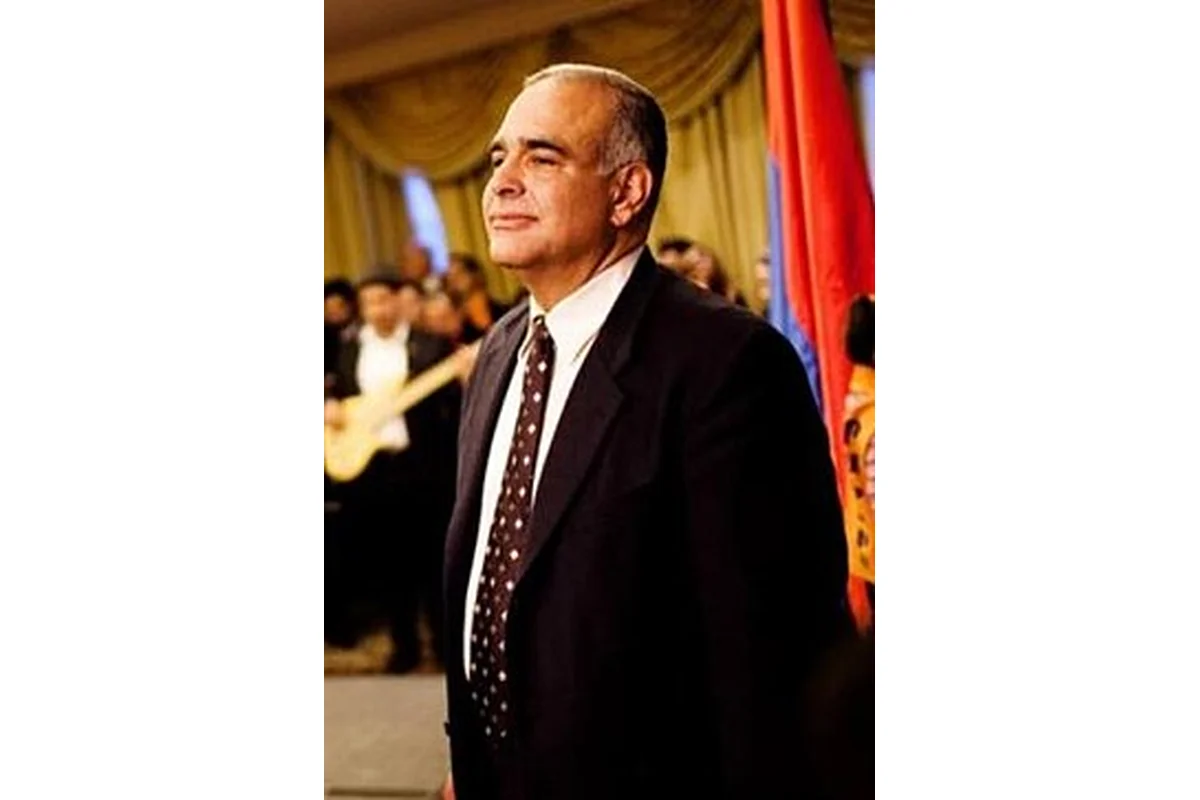
Raffi Hovannisian Bio
Raffi K. Richardi Hovannisian, born on 20 November 1959, is an Armenian politician, lawyer, diplomat, and academic who became the first Foreign Minister of independent Armenia. He is the founding leader of the national liberal Heritage party and the founder of the Armenian Center for National and International Studies, the country’s first independent research center. Over a career spanning more than three decades, Hovannisian has campaigned for international recognition of the Armenian Genocide, supported the Nagorno-Karabakh cause, and shaped the political debate inside Armenia through electoral campaigns and street protests.
After decades of activism and public service, Hovannisian remains a recognizable figure in Armenian civic life, living in Yerevan with his family. He has also worked as an international lawyer in the United States and as a university lecturer on Armenian history and international affairs.
Early Life and Background
Raffi K. Richardi Hovannisian was born on 20 November 1959 in Fresno, California, to Richard Hovannisian and Vartiter Hovannisian, whose maiden name was Kotcholosian. Both of his parents were the children of Armenian genocide survivors, and the family home in California was shaped by a strong scholarly and diasporan identity. His father, Richard Hovannisian, became a noted historian of the Armenian people, and the household encouraged rigorous study of history, law, and public service.
Hovannisian attended Palisades Charter High School in Los Angeles, graduating in 1977. In his youth he joined the California chapter of the Armenian Youth Federation, the youth wing of the Armenian Revolutionary Federation, eventually rising to lead the chapter. These early experiences helped connect his generation of diaspora Armenians to the political and cultural questions facing Soviet Armenia in the late twentieth century.
After high school, Hovannisian pursued higher education at several major American institutions. He studied political science at the University of California, Berkeley, attended the University of California, Los Angeles for Armenian history, and in 1982 received a Master of Arts in international law and diplomacy from the Fletcher School of Law and Diplomacy at Tufts University. He completed his legal education with a Juris Doctor from Georgetown University Law Center in 1985.
Path to US Politics and Armenian Public Service
Before moving to Armenia, Hovannisian built a professional foundation in the United States. From 1981 to 1982 he served as a lecturer in Armenian history at Tufts University. Between 1985 and 1989 he worked as an international lawyer and civil litigator at several prominent firms, including Hill, Farrer and Burrill, Whitman and Ransom, Stroock and Stroock and Lavan, and Coudert Brothers. This legal training gave him a background in negotiation and international disputes that would later shape his diplomatic work.
In October 1988, Hovannisian wrote an article for the Los Angeles Times supporting the Karabakh movement, signaling his growing engagement with the Armenian national question. In December 1988 he was in Soviet Armenia during a devastating earthquake in the northwestern part of the country. In February 1990 he settled in a one-bedroom apartment off what is now Sakharov Square in Yerevan, and his family followed later that fall. He also served as the Yerevan office director of the Armenian Assembly of America, deepening his links to both diaspora and homeland institutions.
On 7 November 1991, Hovannisian was appointed as the first Foreign Minister of Armenia by then-President Levon Ter-Petrosyan. On 2 March 1992 he raised the Armenian tricolor at the United Nations headquarters in New York, a defining moment for the young republic. He held the position until 16 October 1992, when he was forced to resign because of policy disagreements with Ter-Petrosyan, particularly over how to handle relations with Turkey and the question of Armenian Genocide recognition.
Raffi Hovannisian Career
Early Career (1985–1990)
During the mid-1980s, Hovannisian worked in major American law firms in Los Angeles, focusing on international law and civil litigation. He also taught Armenian history at Tufts University, building a scholarly profile alongside his legal practice. These years gave him early exposure to international affairs and Armenian diaspora networks.
By the late 1980s, his attention turned toward the political changes sweeping Soviet Armenia. His 1988 Los Angeles Times article on the Karabakh movement marked a public step into Armenian political life. His relocation to Yerevan in early 1990 turned that engagement into full-time public service.
Foreign Minister Era (1991–1992)
As Armenia’s first Foreign Minister, Hovannisian worked to place the newly independent republic on the global stage. The symbolic highlight of his tenure was raising the Armenian tricolor at the United Nations in New York, an event watched by Armenians across the diaspora. By September 1992, a Los Angeles Times report noted that Hovannisian enjoyed a 96 percent approval rating in the Armenian newspaper Epokha, higher than President Ter-Petrosyan himself.
His tenure ended in late 1992 after a policy split with President Ter-Petrosyan over relations with Turkey. Hovannisian insisted on raising the Armenian Genocide issue during a state visit to Istanbul, a step Ter-Petrosyan opposed. The disagreement led to Hovannisian’s dismissal and pushed him into opposition politics.
Heritage Party and Parliamentary Campaigns (2002–2012)
In 2002, Hovannisian founded the Heritage party, a national liberal force. The party first crossed the electoral threshold in 2007, winning 6 percent of the vote and 7 seats in the National Assembly. It was the only opposition party to pass the 5 percent barrier in that election. Hovannisian personally led the campaign to secure Armenian recognition of the Nagorno-Karabakh Republic, introducing a formal recognition bill in the National Assembly on 28 August 2007.
In the 2012 parliamentary election, Heritage again won representation, taking 5 seats with 86,998 votes. Hovannisian also organized a public hunger strike in March 2011 at Freedom Square in Yerevan to press for a more assertive Armenian foreign policy, including restitution of territories from Azerbaijan and Turkey and protections for the Armenian minority in Georgia.
2013 Presidential Bid and the Barevolution
Hovannisian announced his candidacy for the Armenian presidency in early November 2012, running on a nationalist platform that emphasized recognition of the Armenian Genocide and a firm stance on the Nagorno-Karabakh conflict. The official campaign ran from 21 January to 16 February 2013. In the February 2013 election, he finished second with roughly 37 percent of the vote against incumbent Serzh Sargsyan, and he alleged fraud.
Following the election, Hovannisian led large protests in Yerevan’s Freedom Square and other Armenian cities, demanding that Sargsyan concede what Hovannisian called the people’s victory. He branded the movement the Barevolution, a combination of the Armenian word barev, meaning hello, and revolution, capturing his habit of greeting voters on the street. The protests gradually faded by April 2013, but the campaign cemented Heritage’s role as a leading opposition force.
Heritage in Later Elections (2017)
In the 2017 parliamentary election, Heritage joined the ORO Alliance and sought to return to the National Assembly. The party ultimately won only 2.07 percent of the popular vote, losing all of its parliamentary representation. The result marked a difficult period for Hovannisian’s political movement, even as he continued to speak on national issues.
Notable Events and Milestones
Key moments in Hovannisian’s career include raising the Armenian tricolor at the United Nations in 1992, founding the Heritage party in 2002, leading the only opposition faction into parliament in 2007, his 15 March 2011 hunger strike in Freedom Square, and his 2013 presidential run that produced the Barevolution protests. Together, these events shaped his image as a nationalist opposition leader.
Raffi Hovannisian Family
Family Background and Heritage
Hovannisian was raised in a scholarly Armenian American household in Fresno, California. His parents, Richard Hovannisian and Vartiter Hovannisian, were both children of Armenian genocide survivors, and his father became a noted historian of Armenia. The family’s deep engagement with Armenian history, language, and political life influenced Hovannisian’s decision to move to Yerevan in 1990 and to devote his career to Armenian national causes.
Personal Life
Raffi Hovannisian married Armenouhi Hovannisian in 1985. They have five children, four sons and a daughter, including the journalist and filmmaker Garin K. Hovannisian. The family resides in Yerevan. Armenouhi Hovannisian is the executive director of Junior Achievement of Armenia, an affiliate of Junior Achievement Worldwide. Raffi Hovannisian is fluent in Armenian, English, Russian, and French, and he renounced his United States citizenship in 2001 in order to be eligible to run for office in Armenia.