
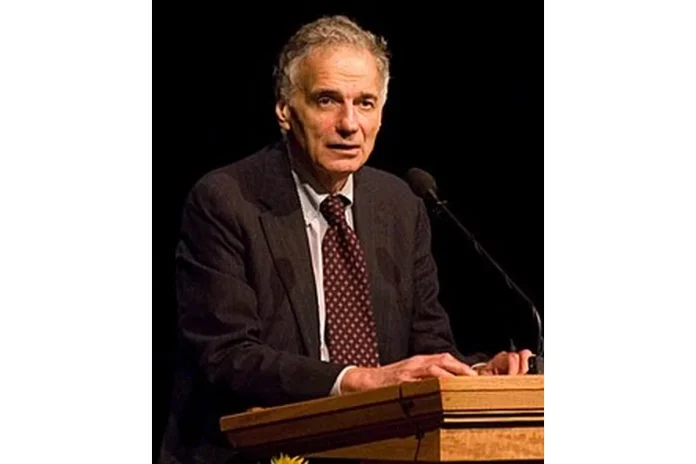
Ralph Nader Bio
Ralph Nader is an American lawyer, political activist, and author whose six decades of public-interest work have reshaped consumer protection, environmental policy, and government accountability in the United States. He first gained national attention in 1965 with his bestselling book Unsafe at Any Speed, a critical examination of the U.S. auto industry that helped lead to the National Traffic and Motor Vehicle Safety Act of 1966. Beyond consumer advocacy, Nader has run for President of the United States four times and remains a leading voice for electoral reform, corporate accountability, and civic engagement.
Born in Winsted, Connecticut, to Lebanese immigrant parents, Nader built his career by founding influential watchdog organizations, including Public Citizen and the Center for Auto Safety, and by leading teams of volunteer researchers known as “Nader’s Raiders.” His long-standing role in American public life has made him both a celebrated reformer and a sometimes controversial figure in national politics.
Early Life and Background
Ralph Nader was born on February 27, 1934, in Winsted, Connecticut, to Rose and Nathra Nader, both Antiochian Greek Christian immigrants from Mount Lebanon and the Beqaa Valley in southeastern Lebanon. After settling in Connecticut, his father worked in a textile mill before opening a bakery and restaurant, where Ralph occasionally helped as a young man. He also worked as a newspaper delivery boy for the local paper, the Winsted Register Citizen.
Nader’s family was deeply involved in their community, and he grew up in a household shaped by immigrant values of hard work, education, and public service. He attended Sunday school at a local Methodist church, an experience he later described as warmly embraced by his family. These early surroundings nurtured his lifelong curiosity about civic issues and the role ordinary citizens could play in shaping public policy.
Nader graduated from The Gilbert School in 1951 and went on to attend Princeton University. He completed a Bachelor of Arts at Princeton’s Woodrow Wilson School of Public and International Affairs in 1955, graduating magna cum laude and Phi Beta Kappa, with a senior thesis titled “Lebanese Agriculture.” He then enrolled at Harvard Law School, earning a Bachelor of Laws (LL.B.) in 1958, though he often skipped classes to travel and conduct field research on Native American issues and migrant worker rights.
Path to US Politics
After being admitted to the bar in 1959, Ralph Nader began practicing law in Hartford, Connecticut, while lecturing at the University of Hartford and writing dispatches for publications such as The Christian Science Monitor and The Nation during trips to the Soviet Union, Chile, and Cuba. He served briefly in the U.S. Army as a cook at Fort Dix before moving to Washington, D.C., in 1964 to serve as a consultant to Assistant Secretary of Labor Daniel Patrick Moynihan.
His early work in Washington introduced him to the world of federal policy, and he soon focused his attention on the safety flaws of American automobiles. Drawing on his legal training and the field research he had conducted on labor and consumer issues, Nader set out to document the dangers posed by certain car models. That research would become the foundation of his career as a public-interest advocate.
The publication of Unsafe at Any Speed in 1965 turned Nader into a household name and transformed the consumer movement. A year later, Congress unanimously passed the National Traffic and Motor Vehicle Safety Act. The Speaker of the House at the time credited the “crusading spirit of one individual who believed he could do something,” solidifying Nader’s reputation as a singular force in American reform politics.
Ralph Nader Career
Early Career (1959–1968)
Ralph Nader began his professional career in 1959, working as a lawyer in Hartford, Connecticut, while teaching at the University of Hartford. His international reporting and early legal practice helped him develop the analytical approach that would define his later advocacy. By 1964, he had moved to Washington, D.C., to consult for the federal government, where he observed firsthand how industry interests influenced regulatory decisions.
His groundbreaking work came in 1965, when he published Unsafe at Any Speed, a book that exposed unsafe design practices in the U.S. auto industry, with particular focus on the Chevrolet Corvair. When General Motors attempted to discredit him through surveillance and a deliberate campaign to entrap him, Nader sued for invasion of privacy and settled for $425,000. He used the proceeds to found the Center for the Study of Responsive Law, marking the start of his career as an institutional reformer.
Advocacy and Public Citizen Breakthrough (1968–1995)
Following the success of Unsafe at Any Speed, Nader recruited seven volunteer law students in 1968 to evaluate the Federal Trade Commission, earning the nickname “Nader’s Raiders” from the Washington press corps. Their critical report led to a major American Bar Association investigation and prompted President Richard Nixon to revitalize the agency as a stronger consumer-protection and antitrust enforcer.
In 1971, Nader founded Public Citizen, a watchdog organization dedicated to public-interest lobbying and activism on consumer rights, where he served on the board of directors until 1980. He also established the Center for Auto Safety, which for forty years published an annual guide called “The Car Book,” evaluating new car safety ratings, fuel economy, and repair costs. His work in the 1970s and 1980s contributed to the passage of major laws, including the Freedom of Information Act, the Foreign Corrupt Practices Act, the Clean Water Act, the Consumer Product Safety Act, and the Whistleblower Protection Act.
By the early 1970s, Nader had become a household name. A 1971 memo by Lewis Powell to the U.S. Chamber of Commerce warned that Nader “has become a legend in his own time and an idol of millions of Americans.” He also turned his attention to environmental activism, founding the Critical Mass Energy Project in 1974 to coordinate antinuclear power efforts across the United States.
Presidential Campaigns Era (1996–2008)
Ralph Nader’s most public phase of political activity came through four presidential bids. In 1996, he ran as the Green Party candidate, qualifying for the ballot in 22 states and receiving 685,297 votes, or 0.71 percent of the popular vote. He returned as the Green Party nominee in 2000, this time with Winona LaDuke as his running mate, earning 2,883,105 votes, or 2.74 percent, in a race that proved enormously consequential.
The 2000 campaign was the most controversial of Nader’s career. He and LaDuke received nearly three million votes, and critics argued that his presence on the ballot in Florida helped tip that state, and the overall election, to George W. Bush. Nader rejected the idea that he had run a deliberate spoiler strategy, although academic studies disagreed about the extent of his impact. In 2004, he ran as an independent and received 463,655 votes, and in 2008, he again ran as an independent with Matt Gonzalez, earning 738,475 votes and a third-place finish.
Throughout these campaigns, Nader positioned himself as a critic of both major parties, which he described as too influenced by corporate interests. He used the platforms to press for electoral reform, consumer rights, and environmental protection, helping to expand ballot access for third parties and to keep under-reported issues in the national conversation.
Notable Events and Milestones
One of the defining milestones of Nader’s career was the unanimous passage of the National Traffic and Motor Vehicle Safety Act in 1966, which he is widely credited with inspiring. His founding of Public Citizen, the Center for Auto Safety, and the Congressional Accountability Project helped create a permanent infrastructure for consumer advocacy in Washington. His placement on multiple “100 Most Influential Americans” lists by Life, Time, and The Atlantic underscored the lasting reach of his work.
Ralph Nader Career Wins
Ralph Nader’s career is measured less in electoral victories than in lasting policy achievements and institutional reforms. His efforts contributed to the passage of landmark legislation, including the National Traffic and Motor Vehicle Safety Act, the Freedom of Information Act, the Foreign Corrupt Practices Act, the Clean Water Act, the Consumer Product Safety Act, and the Whistleblower Protection Act.
Advocacy Highlights
Nader’s first major public win came in 1966, when Congress passed the National Traffic and Motor Vehicle Safety Act in direct response to Unsafe at Any Speed. The settlement of his invasion-of-privacy lawsuit against General Motors for $425,000 allowed him to create the Center for the Study of Responsive Law, the foundation of his later advocacy network.
His most recent recognized achievements include founding the American Museum of Tort Law in Winsted, Connecticut, in 2015, with Nader personally donating $150,000 to the project. In 1974, he received the S. Roger Horchow Award for Greatest Public Service by a Private Citizen, and he has also been honored with the Gandhi Peace Award and induction into the Automotive Hall of Fame.
Other Wins & Achievements
Beyond his headline legislation, Nader expanded the reach of public-interest advocacy by building a network of organizations, including Public Citizen, the Center for Auto Safety, and the Public Interest Research Group. His antinuclear organizing through the Critical Mass Energy Project helped grow what became the largest national anti-nuclear coalition in the United States, with an estimated 200,000 supporters.
Ralph Nader Family
Family Background and Civic Lineage
Ralph Nader was raised in Winsted, Connecticut, in a close-knit family headed by Lebanese immigrant parents, Rose and Nathra Nader. His father worked in a textile mill and later opened a bakery and restaurant, instilling in his children a strong work ethic and a commitment to community engagement. Nader has credited his family’s immigrant experience and his father’s insistence on self-reliance as formative influences on his later advocacy for ordinary Americans.
His siblings include Laura, a professor of social and cultural anthropology at the University of California, Berkeley, his sister Claire, and his late brother Shafeek, who died of prostate cancer in 1986. Nader’s grandniece, Samya Stumo, was among the 157 people killed in the crash of Ethiopian Airlines Flight 302 in March 2019, an event that prompted Nader to publicly call for the grounding of the Boeing 737 Max and for accountability from the company’s leadership.
Personal Life
Ralph Nader has never married. In a conversation with writer Karen Croft, who worked with him at the Center for the Study of Responsive Law in the late 1970s, Nader explained that he had chosen to dedicate his life to his career rather than to starting a family. He has lived in a modest apartment in Washington, D.C., since the 1960s and is a registered voter in Connecticut.
Described by The Independent‘s Rupert Cornwell as “ascetic … bordering on self-righteous,” Nader has long been known for his frugal lifestyle, including reportedly spending about $25,000 a year on personal expenses and not owning a car or television. He is a lifelong fan of the New York Yankees, speaks several languages in addition to English, and continues to host the weekly Ralph Nader Radio Hour, which has been produced and distributed through the Pacifica Radio Network since March 2014.