
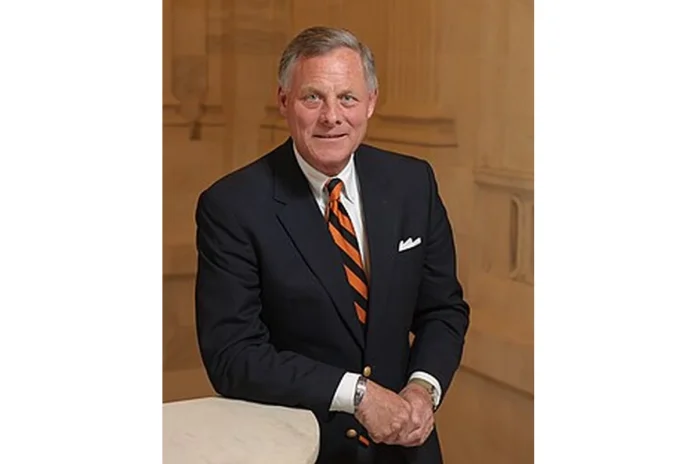
Richard Burr Bio
Richard Mauze Burr (born November 30, 1955) is an American businessman and politician who served as a United States senator from North Carolina from 2005 to 2023. A member of the Republican Party, he represented North Carolina in the U.S. House of Representatives from 1995 to 2005 before his election to the Senate. Richard Burr chaired the Senate Intelligence Committee from 2015 to 2020 and was involved in oversight of national security matters. A Wake Forest University graduate, he worked in sales management prior to entering politics.
Early Life and Background
Richard Mauze Burr was born on November 30, 1955, in Charlottesville, Virginia, the son of Martha (Gillum) and Rev. David Horace White Burr. In 1963, his family moved to Winston-Salem, North Carolina, where he spent most of his upbringing. He graduated from Richard J. Reynolds High School in Winston-Salem in 1974 and went on to earn a Bachelor of Arts degree in communications from Wake Forest University in 1978. While at Wake Forest, Burr played defensive back for the Demon Deacons football team and was a member of the Kappa Sigma fraternity.
Before running for Congress, Burr worked for 17 years as a sales manager for Carswell Distributing Company, a distributor of lawn equipment. His long career in private business gave him experience in management and sales that he later drew upon as a legislator. He is a member of the United Methodist Church.
Path to Politics
Richard Burr’s entry into elective politics began in 1992, when he challenged incumbent Representative Stephen L. Neal for the seat in the Winston-Salem-based 5th Congressional District and lost. He ran again in 1994, after Neal chose not to seek reelection, and won in a landslide year for Republicans known as the Republican Revolution. This victory launched his career in the U.S. House of Representatives and gave him a platform to develop policy expertise.
During his time in the House, Burr authored the FDA Modernization Act of 1997 and helped create the National Institute for Biomedical Imaging and Bioengineering. In the aftermath of the September 11, 2001 attacks, he successfully sponsored amendments to improve defenses against bioterrorism. He was reelected four times with no substantial opposition, building a reputation on health, science, and national security issues that would shape his Senate career.
Richard Burr Career
Early Career (1995-2004)
Richard Burr served in the U.S. House of Representatives for North Carolina’s 5th congressional district from 1995 to 2005. In the House, he focused on health, energy, and national security policy, including co-sponsoring an amendment to the Energy Policy Act of 2003 that relaxed restrictions on the export of specific types of enriched uranium for medical isotope production. His work on bioterrorism defense in the wake of 9/11 helped establish him as a national security-focused lawmaker.
Burr built strong relationships across the Republican caucus and became a reliable voice on regulatory and trade issues. After ten years in the House, he set his sights on the U.S. Senate seat being vacated by John Edwards, who had been the Democratic vice presidential nominee in 2004.
Senate Election and Tenure (2005-2015)
Richard Burr won the Republican primary for the U.S. Senate seat in July 2004 and went on to face Democratic nominee Erskine Bowles and Libertarian Tom Bailey in the general election. He won the election with 52% of the vote and was sworn in to the Senate on January 4, 2005. In his first reelection bid in 2010, he defeated North Carolina Secretary of State Elaine Marshall, 55% to 43%, becoming the first Republican since Jesse Helms to be reelected to the U.S. Senate from North Carolina.
In 2007, Burr ran for chair of the Senate Republican Conference but lost to Senator Lamar Alexander. In 2009, Senator Jon Kyl appointed him Chief Deputy Whip in the 111th Congress, and he later announced a bid for minority whip in 2011 before dropping out of the race in 2012. He served on the boards of Brenner Children’s Hospital and the West Point Board of Visitors.
Intelligence Committee Leadership and Reelection (2015-2020)
From 2015 to 2020, Richard Burr chaired the Senate Intelligence Committee, leading that chamber’s investigation into Russian interference in the 2016 United States elections. He also served as a national security adviser to the Trump campaign and was an advisor for Donald Trump’s successful 2016 presidential bid. In his 2016 reelection, he defeated Democratic nominee Deborah K. Ross, 51% to 45%, with the National Rifle Association spending nearly $7 million to support his campaign.
On July 20, 2016, while campaigning for a third Senate term, Burr announced that he would not seek a fourth term in 2022. In early February 2020, just before the COVID-19 market crash, he sold more than $1.6 million of stock in 33 transactions during a period when, as head of the Senate Intelligence Committee, he was being briefed daily regarding potential health threats from COVID-19. On May 13, 2020, the FBI served a search warrant on Burr at his Washington residence and seized his cellphone, and he temporarily stepped down as chair of the Intelligence Committee on May 15, 2020. On January 19, 2021, the Department of Justice informed him that it would not pursue charges against him.
Final Term and Post-Senate Era (2021-2023)
In February 2021, Richard Burr was one of seven Republican senators to vote to convict Donald Trump of incitement of insurrection in his second impeachment trial. On February 16, 2021, the North Carolina Republican Party censured him for the vote. He delivered a farewell address on the Senate floor on December 14, 2022, and his final term expired on January 3, 2023, when he was succeeded by Ted Budd. Upon leaving Congress, Burr took a job at law firm DLA Piper as a principal policy advisor and chair of the Health Policy Strategic Consulting Practice. In 2025, he introduced Tulsi Gabbard at her confirmation hearing to be Director of National Intelligence, his first visit to the Capitol since his term ended.
Notable Events and Milestones
Richard Burr is one of only three senators to oppose the STOCK Act of 2012, which prohibits members of Congress and congressional staff from using nonpublic information in securities trading. He was the only Southern Republican senator to vote for the Don’t Ask, Don’t Tell Repeal Act of 2010, and in 2022 he was one of 12 Republican senators to support the Respect for Marriage Act. He is a distant relative of 19th century Vice President Aaron Burr, as a descendant of one of Aaron Burr’s brothers.
Richard Burr Career Wins
Richard Burr compiled a long record of electoral success in North Carolina, winning his U.S. House seat in 1994 and holding it through four subsequent reelection victories with no substantial opposition. He then won three U.S. Senate elections in 2004, 2010, and 2016, making him one of the longest-serving North Carolina federal lawmakers of his era.
Senate Election Highlights
Richard Burr first won his U.S. Senate seat in 2004 with 52% of the vote, defeating Democrat Erskine Bowles and Libertarian Tom Bailey. He won reelection in 2010 with 55% of the vote against Elaine Marshall, becoming the first Republican since Jesse Helms to be reelected to the U.S. Senate from North Carolina. He won his third and final Senate election in 2016 with 51% of the vote against Deborah K. Ross.
Other Wins and Achievements
Burr authored the FDA Modernization Act of 1997 and helped create the National Institute for Biomedical Imaging and Bioengineering during his time in the House. He chaired the Senate Intelligence Committee from 2015 to 2020, leading investigations into Russian interference in the 2016 elections, and served as Chief Deputy Whip in the 111th Congress. The American Conservative Union’s Center for Legislative Accountability gave him a lifetime rating of 84.22.
Richard Burr Family
Family Background and Personal Life
Richard Mauze Burr was born to Rev. David Horace White Burr and Martha (Gillum) Burr, and the family moved from Charlottesville, Virginia, to Winston-Salem, North Carolina, in 1963. He is a distant relative of 19th century Vice President Aaron Burr, descending from one of Aaron Burr’s brothers. He is a member of the United Methodist Church.
Richard Burr has been married to Brooke Fauth Burr, a real estate agent, since 1984, and they have two sons, Tyler and William, both of whom work for tobacco companies. Burr is known for driving a 1973 Volkswagen Thing, which became something of a local celebrity on Capitol Hill, and he has a known aversion to reporters.