

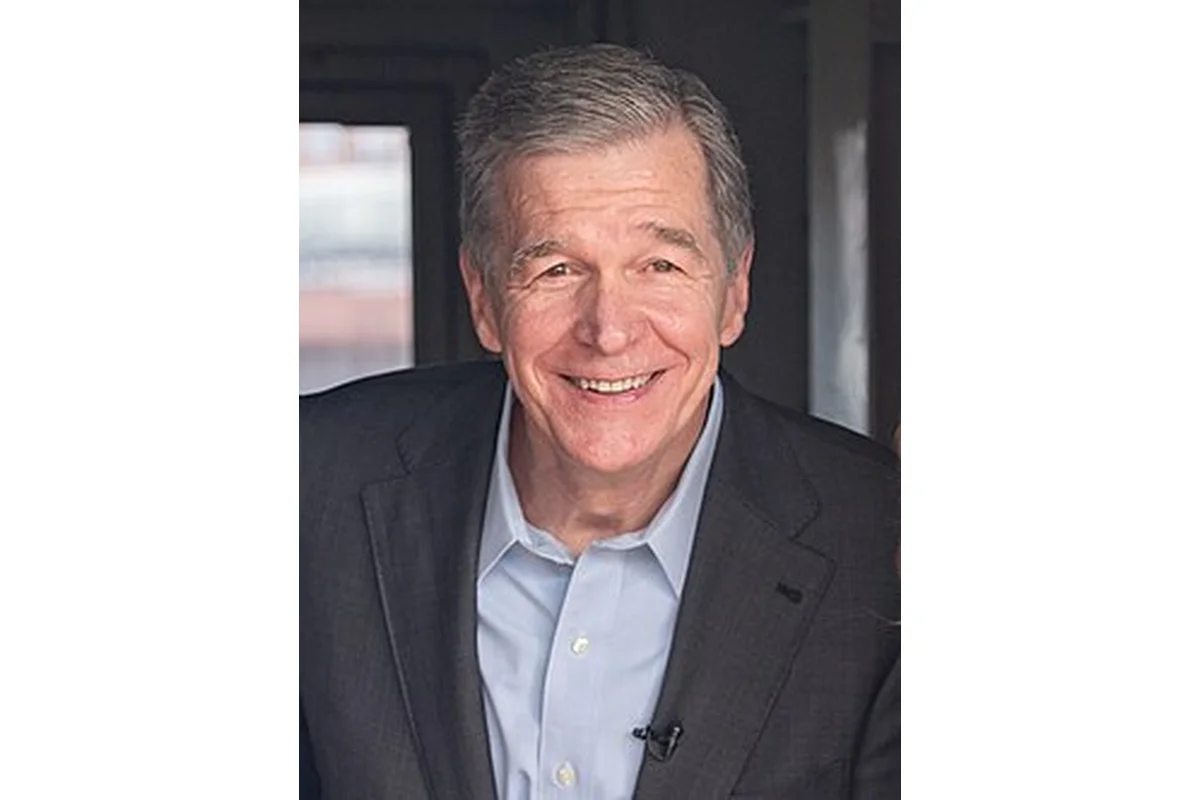
Roy Cooper Bio
Roy Asberry Cooper III, born on June 13, 1957, is an American politician and lawyer who served as the 75th governor of North Carolina from 2017 to 2025. A member of the Democratic Party, he built a long career in state government, including a record-setting tenure as North Carolina’s attorney general before winning the governorship.
Throughout his career, Cooper focused on education, healthcare, and consumer protection. He is the Democratic nominee for the United States Senate in North Carolina in 2026, seeking to succeed retiring Republican incumbent Thom Tillis.
Early Life and Background
Roy Asberry Cooper III was born in Nashville, North Carolina, to Roy Asberry Cooper II, a lawyer and Democratic Party operative, and Beverly Thorne Cooper, a teacher. His father was a close advisor to Governor Jim Hunt and later co-chaired Hunt’s successful 1976 gubernatorial campaign. Cooper is a descendant of Marcom Cooper, who served as a juror during the American Revolutionary War, and he is the brother of district court judge Pell Cooper.
Cooper attended public schools in Nash County and worked on his parents’ tobacco farm during summers. He was an athlete and student government member at Northern Nash High School, participated in Boys State, and represented Nash County in the Youth Legislative Assembly during his senior year, graduating in 1975. He received the Morehead Scholarship to attend the University of North Carolina at Chapel Hill, where he joined the Chi Psi fraternity, was elected president of the university’s Young Democrats, and earned a Bachelor of Arts in Political Science in 1979. He went on to receive his Juris Doctor from the University of North Carolina School of Law in 1982.
Path to US Politics
While still in law school, Cooper was appointed by Governor Jim Hunt to the State Goals and Policy Board, becoming the youngest person ever to serve on it. Hunt also named him to the Interim Balance Growth Board and the North Carolina 2000 Commission, giving Cooper early exposure to statewide policy work.
After law school, Cooper joined the firm Fields, Cooper & Henderson in Nashville, the same firm his father had helped found, and became a partner in 1985. In 1984, he served as the Rocky Mount and Nash County chairman of Lauch Faircloth’s unsuccessful gubernatorial campaign. These roles established his reputation in Eastern North Carolina and laid the groundwork for his entry into elected office.
Roy Cooper Career
Early Career (1985-2000)
Cooper filed in 1985 to run for the North Carolina House of Representatives in the 72nd district and defeated 12-term incumbent Allen Barbee in the Democratic primary before winning the general election unopposed. The nonpartisan North Carolina Center for Public Policy Research ranked him the most effective freshman representative. In 1989, he joined a bipartisan coalition that helped unseat longtime Speaker Liston B. Ramsey, and the new speaker appointed Cooper chair of the House Judiciary Committee.
In February 1991, Cooper was appointed to the North Carolina Senate to fill the seat of State Senator Jim Ezzell, who had died in a car crash. He later negotiated a 1995 compromise that placed a constitutional amendment granting veto power to the governor on the ballot, and in 1997 he was elected Senate Majority Leader. His legislative record included penalties for minors who brought guns to school, expanded public records access, and a stronger open meetings law.
Attorney General Era (2001-2017)
Cooper won election as North Carolina’s attorney general in 2000 and took office on January 6, 2001, beginning what would become the longest tenure for an attorney general in state history. He was reelected in 2004, 2008, and 2012, running unopposed in his final two races and setting a record for votes received. As attorney general, he created mentoring and tutoring programs for suspended students and pushed for a major overhaul of the state’s response to campus safety issues after the 2007 Virginia Tech shooting.
Cooper also handled high-profile cases, including the 2007 dismissal of charges against the Duke University lacrosse team, declaring the players innocent and victims of a rushed accusation in a decision that drew bipartisan praise. He argued his first case before the United States Supreme Court in 2011, J. D. B. v. North Carolina, a juvenile Miranda rights case. His office later audited the North Carolina State Bureau of Investigation forensic lab after revelations that agents had withheld evidence for two decades, a review that identified roughly 230 tainted cases.
Governorship (2017-2025)
Cooper defeated Republican incumbent Pat McCrory in 2016, becoming the first challenger to defeat a sitting governor in North Carolina history. He was sworn in on January 1, 2017, in a small ceremony after a snowstorm forced the cancellation of his public inauguration. The Republican-controlled General Assembly passed special legislation stripping powers from the governor’s office just before he took office, and in his first two years Cooper vetoed 28 bills, 23 of which were overridden by the legislature. The 2018 elections ended the GOP supermajority, strengthening Cooper’s leverage in subsequent budget and policy fights.
Cooper was reelected in 2020, defeating Lieutenant Governor Dan Forest 51.52 percent to 47.01 percent. His governorship was shaped by major public health and policy events, including the COVID-19 pandemic, where he created a Novel Coronavirus Task Force in February 2020, declared a state of emergency, banned large gatherings, closed K-12 schools, and imposed a statewide face mask requirement. After nearly a decade of Republican opposition, he signed landmark legislation in March 2023 expanding Medicaid to more than 600,000 low-income North Carolinians. He also appointed a Campus Safety Task Force after Virginia Tech, signed the STOP Act to address the opioid crisis, and led negotiations that ultimately repealed the controversial 2016 Public Facilities Privacy & Security Act.
Notable Events and Milestones
Cooper’s career-defining moments include his 2016 gubernatorial victory by just 10,227 votes out of 4.7 million ballots after a prolonged recount, his successful push for Medicaid expansion in 2023, and his leadership during the COVID-19 pandemic. On his final day in office, December 31, 2024, he commuted the sentences of 15 inmates on North Carolina’s death row before being succeeded by Democrat Josh Stein.
Roy Cooper Career Wins
Roy Cooper compiled one of the most successful electoral records in modern North Carolina politics, winning statewide office four times as attorney general and twice as governor. He is the longest-serving attorney general in the state’s history and the first challenger ever to defeat a sitting North Carolina governor.
Statewide Election Highlights
Cooper first won the office of attorney general in 2000, defeating Republican Dan Boyce and Reform Party candidate Margaret Palms. He went on to win reelection in 2004 against Joseph Thomas Knott, in 2008 against Bob Crumley, and ran unopposed in 2012, receiving more than 2.8 million votes. He also ran unopposed in the 2016 Democratic primary for governor before his narrow general election victory over McCrory and his 2020 landslide over Forest.
Other Wins and Achievements
Cooper was elected North Carolina Senate Majority Leader in 1997 and chaired the House Judiciary Committee earlier in his career. Fellow Appalachian governors chose him as co-chair of the Appalachian Regional Commission in 2019, making him the first North Carolina governor to hold that role since Jim Hunt in 1978. President Donald Trump also appointed him in 2017 to a federal commission on opioid addiction.
Roy Cooper Family
Family Background and Public Service Lineage
Cooper comes from a family with deep roots in North Carolina law, education, and Democratic politics. His father, Roy Asberry Cooper II, was a lawyer and Democratic Party operative who advised Governor Jim Hunt, while his mother, Beverly Thorne Cooper, was a teacher. His brother, Pell Cooper, is a district court judge, and the family has historical ties to the American Revolutionary War through ancestor Marcom Cooper.
Personal Life
Roy Cooper married Kristin Bernhardt in 1992, and she has worked as a guardian ad litem for foster children in Wake County. The couple has three daughters, all of whom graduated from the University of North Carolina at Chapel Hill. Cooper has taught Sunday school and served as a deacon and elder at White Memorial Presbyterian Church, and he is a well-known fan of the NHL’s Carolina Hurricanes. After leaving the governorship, he accepted a teaching position at Harvard University.