
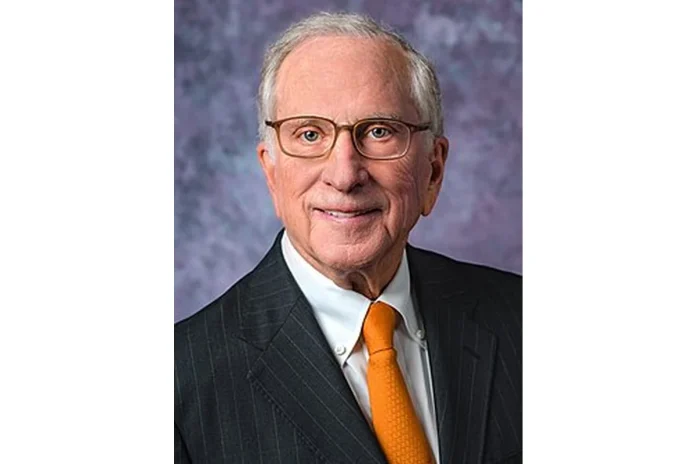
Sam Nunn Bio
Samuel Augustus Nunn Jr. (born 8 September 1938) is an American politician and lawyer who served as a United States senator from Georgia from 1972 to 1997 as a member of the Democratic Party. During his time in the Senate, he chaired the Senate Armed Services Committee and helped shape major national security legislation, including the Goldwater–Nichols Department of Defense Reorganization Act and the Nunn–Lugar Cooperative Threat Reduction program. After leaving Congress, he co-founded the Nuclear Threat Initiative and has remained a leading voice on global security and nonproliferation through teaching and nonprofit leadership.
Early Life and Background
Samuel Augustus Nunn Jr. was born on 8 September 1938 in Macon, Georgia, and was raised in nearby Perry. He is the son of Mary Elizabeth Cannon and Samuel Augustus Nunn, an attorney who also served as mayor of Perry. Through his family, he is a grandnephew of longtime Congressman Carl Vinson, giving him an early connection to public service.
Nunn was a standout athlete in high school, where he captained the basketball team to a state championship. He is also an Eagle Scout and was recognized with the Distinguished Eagle Scout Award from the Boy Scouts of America, an honor that reflects his lifelong record of leadership and service.
He began his higher education at the Georgia Institute of Technology in 1956, where he joined Phi Delta Theta, before transferring to Emory University in 1959. At Emory he earned his undergraduate degree in 1961 and went on to receive his law degree from the Emory University School of Law in 1962, setting the stage for a career that would combine legal training with public policy.
Path to US Politics
After completing law school, Nunn served on active duty in the United States Coast Guard and then spent six years in the Coast Guard Reserve, reaching the rank of petty officer. He also worked as a member of a congressional staff, an experience that gave him a firsthand look at the legislative process and the demands of public office.
He returned to Perry, Georgia, where he practiced law and managed his family’s farm while taking on local civic roles, including serving as president of the Perry Chamber of Commerce. These activities helped him build the relationships and reputation that would carry him into state-level politics.
In 1968, Nunn took his first step into elected office by winning a seat in the Georgia House of Representatives. The move marked the start of a steady rise that, within four years, would take him to the United States Senate.
Sam Nunn Career
Early Career (1968–1972)
Nunn’s early political career was rooted in his home state of Georgia, where he served in the state House of Representatives beginning in 1968. His mix of military service, legal experience, and local leadership positioned him as a serious candidate for federal office.
In 1972 he won the Democratic primary against appointed U.S. Senator David H. Gambrell and went on to defeat U.S. Representative Fletcher Thompson in the general election, earning his first term in the United States Senate. The victory launched a Senate career that would last nearly a quarter of a century.
Senate Career and Armed Services Leadership (1972–1997)
During his tenure in the U.S. Senate, Sam Nunn served as chairman of the Senate Committee on Armed Services and of the Permanent Subcommittee on Investigations. He also served on the Intelligence and Small Business Committees, giving him influence over a wide range of national security and oversight issues.
His most enduring legislative achievement was the Department of Defense Reorganization Act, drafted with Senator Barry Goldwater and commonly known as the Goldwater–Nichols Act, which restructured the Pentagon and strengthened civilian control of the military. Working with Senator Richard Lugar, Nunn also created the Nunn–Lugar Cooperative Threat Reduction Program, which provided assistance to Russia and the former Soviet republics for securing and destroying excess nuclear, biological, and chemical weapons. The program is credited with deactivating more than 7,600 nuclear warheads.
Often described as a moderate-to-conservative Democrat, Nunn frequently broke with his party on social and economic issues, voting in favor of school prayer, caps on punitive damage awards, a balanced budget amendment, and limits on death penalty appeals, while taking more liberal positions on abortion, the environment, gun control, and affirmative action. He consistently supported increased immigration and was the rare Democrat to vote against authorizing the Gulf War in 1991.
Reelection Campaigns and Major Diplomatic Missions (1978–1996)
Nunn won reelection to the Senate three more times, in 1978, 1984, and 1990, building a reputation as one of the chamber’s most respected voices on defense policy. In 1994, President Bill Clinton asked Nunn, former President Jimmy Carter, and former Chairman of the Joint Chiefs of Staff Colin Powell to travel to Haiti to press for the departure of military dictator Lieutenant General Raoul Cédras. The delegation helped persuade Cédras to step down, averting a U.S. military invasion and allowing the return of elected President Jean-Bertrand Aristide.
Announcing in 1996 that he would not seek a fifth term, Nunn cited a lack of “zest and enthusiasm” and retired from the Senate in January 1997. On his departure, he received bipartisan praise, with Republican Senator John Warner of Virginia calling him a global thinker whose contributions would continue well beyond his time in office.
Post-Congressional Work and the Nuclear Threat Initiative (2001–Present)
After leaving the Senate, Nunn founded the Nuclear Threat Initiative in 2001, serving as its co-chair and chief executive until June 2017, when he stepped down as CEO while remaining co-chair alongside Ted Turner and Ernest J. Moniz. The nonprofit works to reduce nuclear, biological, and emerging technology threats around the world.
He also serves as a distinguished professor in the Sam Nunn School of International Affairs at Georgia Tech, where he has hosted the biennial Sam Nunn Policy Forum bringing together leaders from government, academia, and the private sector. Nunn is Chairman Emeritus of the board of trustees of the Center for Strategic and International Studies in Washington, D.C., and a retired partner in the law firm of King & Spalding. He has also served on the board of The Coca-Cola Company and was an advisory board member of the Partnership for a Secure America.
Notable Events and Milestones
Among Sam Nunn’s defining moments were his co-authorship of the Goldwater–Nichols Act, the creation of the Nunn–Lugar Cooperative Threat Reduction Program, and his 1994 diplomatic mission to Haiti with Carter and Powell. In 2019, the U.S. Navy announced that an Arleigh Burke-class missile destroyer would be named the USS Sam Nunn in his honor.
Sam Nunn Career Wins
Sam Nunn’s career wins include four U.S. Senate victories, a leading role in shaping modern U.S. defense policy, and a lasting influence on global nonproliferation efforts through the Nuclear Threat Initiative. His legislative and diplomatic successes have been recognized across party lines and continue to shape American national security.
U.S. Senate Highlights
Nunn first won his Senate seat in 1972 by defeating appointed Senator David H. Gambrell in the Democratic primary and U.S. Representative Fletcher Thompson in the general election. He went on to win reelection in 1978, 1984, and 1990, serving a total of 24 years in the chamber before retiring in 1997.
His most recent Senate win came in 1990, and his decision not to seek a fifth term in 1996 opened the way for his transition to a broader role in global security policy.
Other Achievements
Beyond the Senate, Nunn co-founded the Nuclear Threat Initiative in 2001 and has helped lead international efforts to secure and dismantle weapons of mass destruction, including the 2010 documentary Nuclear Tipping Point produced with William Perry, Henry Kissinger, and George Shultz. He has also received the Distinguished Eagle Scout Award and has been honored through the naming of the Sam Nunn School of International Affairs at Georgia Tech and a U.S. Navy destroyer.
Sam Nunn Family
Family Background and Public Service Lineage
Sam Nunn was born into a family with deep roots in Georgia law and politics. His father, Samuel Augustus Nunn, was an attorney and mayor of Perry, Georgia, while his mother was Mary Elizabeth Cannon. He is also a grandnephew of Carl Vinson, the long-serving Georgia congressman after whom the USS Carl Vinson aircraft carrier is named, reflecting a family tradition of public service.
Personal Life
Sam Nunn married Colleen O’Brien in 1965 after meeting her at the U.S. Embassy in Paris, where she was working for the Central Intelligence Agency. The couple has two children, Mary Michelle Nunn and Samuel Brian Nunn. Michelle Nunn later became chief executive officer of Points of Light and CARE and was the 2014 Democratic nominee for the U.S. Senate in Georgia.