
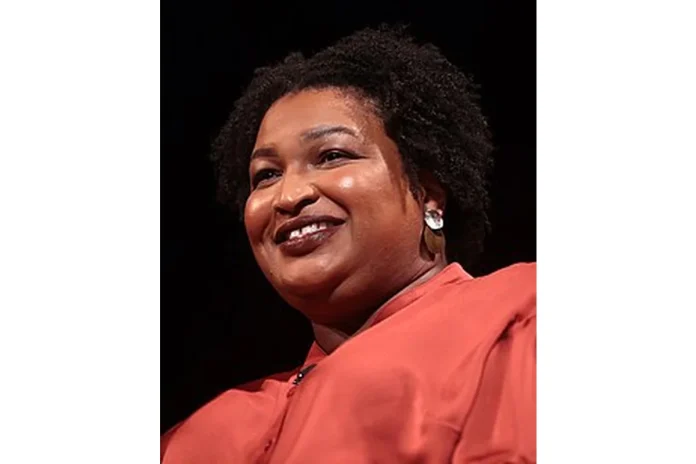
Stacey Abrams Bio
Stacey Yvonne Abrams (born December 9, 1973) is an American politician, lawyer, voting rights activist, and author. She served in the Georgia House of Representatives from 2007 to 2017 and held the position of minority leader from 2011 to 2017. A member of the Democratic Party, Abrams gained national recognition as the Democratic nominee for governor of Georgia in 2018 and 2022, losing both races to Republican Brian Kemp. She is also a New York Times bestselling author who has written both nonfiction and romance novels under the pen name Selena Montgomery.
Beyond elected office, Abrams founded Fair Fight Action in 2018 and the New Georgia Project in 2013, two organizations dedicated to expanding voter access and fighting voter suppression. Her organizing work has been widely credited with increasing voter turnout in Georgia, contributing to Democratic victories in the 2020 presidential and U.S. Senate elections. Abrams continues to influence American politics through her writing, advocacy, and public service.
Early Life and Background
Stacey Yvonne Abrams was born in Madison, Wisconsin, the second of six children of Reverend Robert Abrams and Reverend Carolyn Abrams. Her parents, originally from Mississippi, raised the family in Gulfport, Mississippi, where her father worked in a shipyard and her mother worked as a librarian. In 1989, when Abrams was a junior in high school, the family moved to Atlanta, Georgia, so her parents could pursue graduate divinity degrees at Emory University. Both later became Methodist ministers, eventually returning to Mississippi with the youngest children while Abrams and two siblings remained in Atlanta.
Abrams attended Avondale High School in DeKalb County, Georgia, graduating as valedictorian in 1991. During high school, she was selected for the Telluride Association Summer Program and, at age 17, was hired first as a typist and then as a speechwriter for a congressional campaign. As a college freshman in 1992, she took part in a protest at the Georgia Capitol in which the state flag incorporating the Confederate battle flag was burned, an event that shaped her early political awareness.
She earned a Bachelor of Arts in interdisciplinary studies, focusing on political science, economics, and sociology, from Spelman College in 1995, graduating magna cum laude and serving as student-government president. She then earned a Master of Public Affairs from the University of Texas at Austin’s LBJ School of Public Affairs in 1998 and a Juris Doctor from Yale Law School. As a 1994 Harry S. Truman Scholar, she developed a strong foundation in public policy that would later inform her political career.
Path to US Politics
Abrams’s path to US politics began with public service at the local level. While attending Spelman College, she worked in the youth services department in the office of Atlanta mayor Maynard Jackson and later interned at the U.S. Environmental Protection Agency. After earning her law degree from Yale University, she joined the Atlanta law firm Sutherland Asbill & Brennan as a tax attorney, focusing on tax-exempt organizations, health care, and public finance. In 2002, at age 29, she was appointed deputy city attorney for the City of Atlanta.
Her interest in elected office grew during the 1990s and early 2000s, as she watched Georgia politics shift under Republican leadership. Encouraged by mentors including Spelman president Johnnetta Cole, Abrams decided to run for the Georgia House of Representatives in 2006 after incumbent JoAnn McClinton announced she would not seek reelection. She outraised her primary opponents, former state legislator George Maddox and political operative Dexter Porter, and won the Democratic primary with 51 percent of the vote.
Her election to the Georgia House of Representatives marked the beginning of a legislative career that would span more than a decade. Representing House District 84, and later District 89 after reapportionment, Abrams quickly established herself as a sharp policy analyst, focusing on fiscal responsibility, education, and ethics reform. Her early success laid the foundation for her elevation to minority leader in 2010.
Stacey Abrams Career
Early Career (2002-2010)
Before her time in the Georgia legislature, Abrams built a career in law and public service. She served as a deputy city attorney for the City of Atlanta beginning in 2002, while also practicing as a tax attorney at Sutherland Asbill & Brennan. Her legal work focused on public finance, health care, and tax-exempt organizations, giving her a strong grounding in the policy issues she would later address in the Georgia General Assembly.
After winning her 2006 primary and entering the General Assembly in 2007, Abrams served on the Appropriations, Ethics, Judiciary Non-Civil, Rules, and Ways and Means committees. She also pursued entrepreneurial work, co-founding NOW Corp. in 2010, a financial services firm that later pivoted to invoicing solutions for small businesses. These early experiences allowed her to develop a reputation as a thoughtful lawmaker with practical business experience.
Georgia General Assembly Breakthrough (2010-2017)
In November 2010, the Democratic caucus elected Abrams to succeed DuBose Porter as minority leader, defeating Virgil Fludd. As minority leader, she worked across the aisle with Republican Governor Nathan Deal to reform the HOPE Scholarship program, helping preserve financial aid for Georgia students by reducing scholarship amounts and funding a low-interest loan alternative. She also cooperated with Republicans on criminal-justice reforms and the state’s largest-ever public transportation funding package.
One of her most celebrated moments in the legislature came in 2011, when she analyzed a Republican-backed tax proposal and demonstrated that 82 percent of Georgians would see a net tax increase. She placed a copy of her analysis on every legislator’s desk, and the bill subsequently failed, an achievement that led Time magazine to note that Abrams had single-handedly stopped the largest tax increase in Georgia history.
Throughout her tenure as minority leader, she earned recognition as one of the most influential state legislators in the country, appearing on Georgia Trend’s 100 Most Influential Georgians list every year between 2012 and 2017 and being named a Public Official of the Year by Governing Magazine in 2014. On August 25, 2017, Abrams resigned from the General Assembly to focus on her gubernatorial campaign.
2018 Gubernatorial Campaign and Voting Rights Era (2018-Present)
Abrams’s campaign for governor of Georgia in 2018 made national history. On May 22, 2018, she won the Democratic nomination, becoming the first African-American woman in the United States to be a major party’s nominee for governor. She faced Republican Brian Kemp, who served as Georgia’s secretary of state while running for governor. Abrams lost the November 6, 2018 election by 54,723 votes but refused to concede, citing concerns about voter suppression and conflicts of interest.
Following the 2018 race, she founded Fair Fight Action, a voting rights organization that filed a federal lawsuit against the state for voter suppression. She also led the New Georgia Project, founded in 2013, which focused on registering and engaging underrepresented voters. Her organizing work is widely credited with helping Joe Biden win Georgia in the 2020 presidential election and Democrats win both Georgia U.S. Senate runoffs, giving the party control of the Senate.
In February 2019, Abrams became the first African-American woman to deliver a response to the State of the Union address. She ran for governor again in 2022, winning the Democratic primary unopposed before losing to Kemp by a wider margin in November. She conceded the 2022 race on election night. Since then, she has continued her work as a voting rights advocate, author, and policy commentator, and in 2023 was appointed the inaugural Ronald W. Walters Endowed Chair for Race and Black Politics at Howard University.
Notable Events and Milestones
Abrams’s signature moment in public life was her 2018 gubernatorial run, which made her the first African-American woman to be a major-party nominee for governor in U.S. history. Her refusal to concede the 2018 race and her founding of Fair Fight Action reshaped national conversations about voter access, and her organizing is credited with helping flip Georgia in the 2020 election cycle. In 2019, she became the first African-American woman to deliver the State of the Union response, and in 2021 she was named to the Time 100 list of the most influential people in the world.
Stacey Abrams Career Wins
Although Stacey Abrams has not won a gubernatorial election, she has built a record of legislative and civic accomplishments. Her ten years in the Georgia House of Representatives, including seven as minority leader, established her as a leading voice in state politics. She is widely recognized for stopping a major tax increase in 2011, reforming the HOPE Scholarship program, and helping pass the state’s largest public transportation funding package.
Georgia House of Representatives Highlights
Abrams won her first election to the Georgia House of Representatives in 2006, taking 51 percent of the vote in the Democratic primary. She served continuously from 2007 until her resignation in 2017, representing portions of Atlanta and unincorporated DeKalb County. In 2010, she won the caucus election to become minority leader, a position she held through 2017. Her legislative tenure included major wins on criminal-justice reform, education funding, and ethics.
Other Wins and Achievements
Beyond her legislative record, Abrams has received numerous honors, including the 2012 John F. Kennedy New Frontier Award, the inaugural 2014 Gabrielle Giffords Rising Star Award from EMILY’s List, the 2019 Distinguished Public Service Award from the University of Texas LBJ School, and inclusion in the 2021 Time 100. She was also nominated for a Nobel Peace Prize for her get-out-the-vote work and elected to the American Academy of Arts and Sciences in 2025.
Stacey Abrams Family
Family Background and Public Service Lineage
Stacey Yvonne Abrams was raised in a family with deep roots in public service and the African-American church. Her parents, Robert and Carolyn Abrams, both became Methodist ministers after pursuing graduate divinity degrees at Emory University. The second of six siblings, she grew up alongside Andrea Abrams, U.S. District Judge Leslie Abrams Gardner, Richard Abrams, Walter Abrams, and Jeanine Abrams McLean, several of whom have also pursued careers in law and public policy.
Personal Life
Abrams has long been recognized for her openness about financial challenges, including writing a 2018 op-ed in which she disclosed federal back taxes and student loan debt. She completed repayment of those obligations by 2019. While her marital status and personal relationships are not widely discussed in public sources, she resides in Atlanta, Georgia, where she continues her work as an author, activist, and policy leader.