
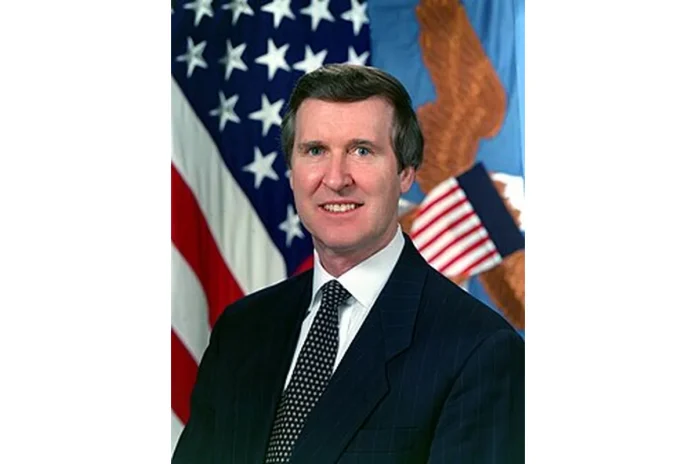
William Cohen Bio
William Sebastian Cohen (born August 28, 1940) is an American lawyer, author, and politician from the U.S. state of Maine. A Republican, Cohen served as both a member of the United States House of Representatives (1973–1979) and the United States Senate (1979–1997), and as Secretary of Defense (1997–2001) under Democratic President Bill Clinton. Throughout his career, he developed a reputation as a moderate Republican with a willingness to work across party lines on defense, intelligence, and social policy questions.
After leaving public office, William Sebastian Cohen founded The Cohen Group, a business consulting firm, and has written several books, including works of fiction, poetry, and non-fiction. He has remained active in public life as a commentator on international affairs and as a member of advisory councils on U.S. foreign policy, defense, and U.S.-China relations.
Early Life and Background
William Sebastian Cohen was born in Bangor, Maine, on August 28, 1940. His mother, Clara (née Hartley), was of Protestant Irish ancestry, and his father, Reuben Cohen, was born in New York and was the son of a Russian Jewish immigrant. The couple owned the Bangor Rye Bread Co. in Maine. Pursuant to his father’s wishes, Cohen was raised Jewish, attended a synagogue, and attended Hebrew School in preparation for his bar mitzvah. He later decided not to complete the ceremony when he was told he would have to convert formally to Judaism, and he began to practice Christianity.
After graduating from Bangor High School in 1958, William Sebastian Cohen attended Bowdoin College, graduating cum laude with a Bachelor of Arts degree in Latin in 1962. While a student at Bowdoin, he was a member of the Kappa chapter of the Psi Upsilon fraternity. He was a basketball player in high school and college, was named to the Maine all-state high school and college basketball teams, and was inducted into the New England All-Star Hall of Fame at Bowdoin. He went on to attend Boston University School of Law, earning a Bachelor of Laws degree cum laude in 1965.
Path to US Politics
Following law school, William Sebastian Cohen built a foundation in legal practice, local government, and public service in Maine. He served as an assistant county attorney for Penobscot County from 1968 to 1970 and was an instructor at Husson College in Bangor starting in 1968, and later at the University of Maine (1968–1972). He became vice president of the Maine Trial Lawyers Association (1970–1972) and served on the Bangor School Board from 1971 to 1972.
His local political career advanced quickly. William Sebastian Cohen was elected to the Bangor City Council (1969–1972) and served as Mayor of Bangor in 1971–1972. In 1972, he became a fellow at Harvard Kennedy School, and in 1975 was named one of the U.S. Jaycees’ “Ten Outstanding Young Men.” These early leadership roles prepared him for his move to federal office.
William Cohen Career
Early Career (1968–1972)
Before winning a seat in Congress, William Sebastian Cohen worked as an attorney, teacher, and local officeholder in Maine. As assistant county attorney for Penobscot County (1968–1970) and an instructor at Husson College and the University of Maine (1968–1972), he developed a public profile rooted in law, education, and civic affairs. He also served as vice president of the Maine Trial Lawyers Association (1970–1972) and on the Bangor School Board (1971–1972).
In 1969, he was elected to the Bangor City Council, and from 1971 to 1972 he served as Mayor of Bangor. His growing reputation in state affairs and a Harvard Kennedy School fellowship in 1972 helped set the stage for his 1972 run for the U.S. House of Representatives.
House of Representatives and Senate (1973–1997)
In the 1972 election, William Sebastian Cohen won a seat in the U.S. House of Representatives, representing Maine’s 2nd congressional district. He succeeded Democrat William Hathaway, who had been elected to the U.S. Senate, and defeated Democratic State Senator Elmer H. Violette of Van Buren. During his first term, Cohen was assigned to the House Judiciary Committee, where he participated in the 1974 impeachment hearings against President Richard Nixon. He was one of the first Republicans on the committee to support impeaching Nixon, and Time magazine named him one of “America’s 200 Future Leaders.”
After three terms in the House, William Sebastian Cohen was elected to the U.S. Senate in 1978, defeating incumbent William Hathaway. He was reelected in 1984 and 1990, serving 18 years in the Senate. In the Senate, he served on the Armed Services Committee and the Governmental Affairs Committee (1979–1997) and was a member of the Senate Intelligence Committee (1983–1991 and 1995–1997), serving as vice chairman from 1987 to 1991. He helped draft the Competition in Contracting Act (1984), the Montgomery G.I. Bill Act (1984), the Goldwater–Nichols Act (1986), the Intelligence Oversight Reform Act (1991), the Federal Acquisition Reform Act (1996), the Nunn–Cohen Act creating U.S. Special Operations Command, and the Clinger–Cohen Act (1996).
Secretary of Defense (1997–2001)
On December 5, 1996, President Bill Clinton announced his selection of William Sebastian Cohen as Secretary of Defense, calling him the “right person” to build on the work of retiring Secretary William Perry. After a unanimous Senate confirmation, Cohen was sworn in as the 20th Secretary of Defense on January 24, 1997. He maintained a heavy schedule, routinely arriving at the Pentagon before 7 a.m. for intelligence briefings, policy meetings, and regular “ABC” sessions at the White House with Secretary of State Madeleine Albright and National Security Adviser Sandy Berger.
As Secretary of Defense, William Sebastian Cohen directed U.S. military actions in Iraq and Kosovo, including the dismissal of Wesley Clark as NATO Supreme Allied Commander. Both Operation Desert Fox in Iraq and Operation Allied Force in Kosovo were launched in 1998, months after the U.S. embassy bombings in Africa. He presented a $250.7 billion fiscal year 1998 defense budget to Congress, led the Quadrennial Defense Review, and supported NATO expansion. He also addressed the controversial “don’t ask, don’t tell” policy in late 1999, ordering an immediate review of the policy after President Clinton publicly said it was not working.
Notable Events and Milestones
One of the defining moments of William Sebastian Cohen’s career came in 1974, when he became one of the first Republicans on the House Judiciary Committee to support the impeachment of President Richard Nixon. Decades later, in June 2009, he and his wife Janet Langhart were present at the U.S. Holocaust Museum when a gunman fatally shot security guard Stephen Tyrone Johns; the couple appeared on CNN that afternoon to recount the experience. In January 2021, Cohen joined all living former secretaries of defense in a Washington Post op-ed telling President Donald Trump not to involve the military in determining the outcome of the 2020 elections.
William Cohen Career Highlights
House, Senate, and Cabinet Achievements
William Sebastian Cohen’s federal career included three terms in the U.S. House of Representatives (1973–1979), three terms in the U.S. Senate (1979–1997), and a four-year tenure as Secretary of Defense (1997–2001). He helped shape major defense, intelligence, and procurement laws and was widely described as a moderate Republican and a “career-long maverick with a reputation for fashioning compromise out of discord.”
Other Achievements and Recent Years
After leaving the Pentagon in 2001, William Sebastian Cohen founded The Cohen Group, a business consulting firm, with three former Pentagon officials. In 2002, he received the Woodrow Wilson Award for Public Service. He has served as a BBC world affairs analyst since 2016, and in 2022 he helped found a group of U.S. business and policy leaders focused on constructive engagement with China.
William Cohen Family
Family Background and Heritage
William Sebastian Cohen was raised in Bangor, Maine, by his mother, Clara (née Hartley), of Protestant Irish ancestry, and his father, Reuben Cohen, who was born in New York and was the son of a Russian Jewish immigrant. The family owned the Bangor Rye Bread Co. and were part of a small but tight-knit business and civic community in mid-20th-century Maine.
Personal Life
In 1987, William Sebastian Cohen filed for divorce from his first wife, Diana Dunn, with whom he has two sons, Kevin and Christopher. On February 14, 1996, he married Janet Langhart, a former model, Boston television personality, and BET correspondent who became known as the “First Lady of the Pentagon” during his tenure as Secretary of Defense. Cohen has served as an advisory board member for the Partnership for a Secure America and is a member of the ReFormers Caucus of Issue One.