
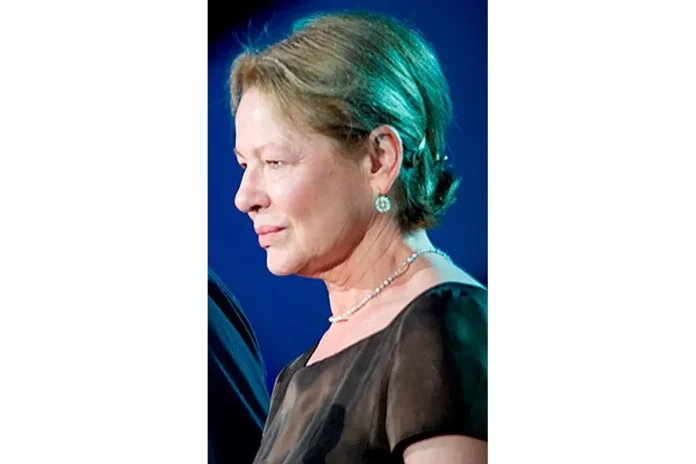
Dianne Wiest Bio
Dianne Evelyn Wiest (born March 28, 1948) is an American actress whose work spans stage, film, and television. Over a career that began in the early 1970s, she has become known for thoughtful, nuanced performances in projects ranging from Woody Allen’s New York comedies to popular network television series.
Wiest has won two Academy Awards for Best Supporting Actress for Hannah and Her Sisters (1986) and Bullets Over Broadway (1994), along with a Golden Globe and two Primetime Emmy Awards. Her film credits also include Footloose, Edward Scissorhands, The Birdcage, and I Care a Lot, while her television work has ranged from Law & Order to In Treatment and, more recently, Only Murders in the Building.
Early Life and Background
Dianne Evelyn Wiest was born on March 28, 1948, in Kansas City, Missouri. Her mother, Anne Stewart (née Keddie), was a nurse, and her father, Bernard John Wiest, was a college dean and a former psychiatric social worker for the United States Army. Wiest has two brothers, Greg and Don, and her parents first met in Algiers.
Because of her father’s military and academic work, Wiest spent part of her youth abroad and attended Nurnberg American High School in Germany. She has said that her original ambition was to become a ballet dancer, but she shifted her focus to acting during her senior year of high school. After returning to the United States, she enrolled at the University of Maryland.
Wiest graduated from the University of Maryland in 1969 with a degree in Arts and Sciences. While there, she became active in campus theater, and she left her studies after the third term to tour with a Shakespearean troupe. This early experience on the road cemented her decision to pursue acting as a profession.
Path to Celebrity
Wiest’s path to a career in acting began in regional and off-Broadway theater. After touring with a Shakespearean company, she earned a supporting role in a New York Shakespeare Festival production of Ashes and worked at the Yale Repertory Theatre in New Haven, Connecticut, where she played the title role in Henrik Ibsen’s Hedda Gabler. She also served as an understudy off-Broadway and on Broadway in Kurt Vonnegut’s Happy Birthday, Wanda June in 1970.
She made her Broadway debut in Robert Anderson’s Solitaire/Double Solitaire in 1971, taking over the role of the daughter. Wiest then spent four years as a member of the Arena Stage in Washington, D.C., where she played Emily in Our Town, Honey in Who’s Afraid of Virginia Woolf?, and leading roles in The Dybbuk, The Lower Depths, and Heartbreak House. She toured the USSR with the Arena Stage and, in 1976, attended the Eugene O’Neill National Playwrights Conference.
By the end of the 1970s, Wiest had built a strong reputation in New York theater. In 1979, she originated the role of Agnes in John Pielmeier’s Agnes of God in Waterford, Connecticut, and her off-Broadway performance in Tina Howe’s The Art of Dining earned her an Obie Award (1980), a Theatre World Award (1979–1980), and the Clarence Derwent Award (1980). She also performed at the Public Theater and in works including Frankenstein (1981) and Othello (1982) opposite James Earl Jones and Christopher Plummer.
Dianne Wiest Career
Early Career (1970s–1983)
Wiest’s early career was rooted almost entirely in the theater. During the 1970s, she took on a steady stream of supporting and leading roles at the Arena Stage, the Yale Repertory Theatre, and Joe Papp’s Public Theater, working with directors including Andrei Șerban and Lloyd Richards. Her three off-Broadway awards for The Art of Dining in 1979 and 1980 marked her as one of the most promising actresses in New York.
Her first screen appearances were small roles in the early 1980s in films starring Jill Clayburgh, including It’s My Turn and I’m Dancing as Fast as I Can. In 1984, she landed her first widely seen movie role as the reverend’s wife and mother of Ariel in the popular dance drama Footloose, which introduced her work to a much broader audience.
Breakthrough (1984–1995)
Wiest’s breakthrough came through her long collaboration with Woody Allen. She first appeared under his direction in The Purple Rose of Cairo (1985) and then won the Academy Award for Best Supporting Actress for her role in Hannah and Her Sisters (1986). She went on to appear in his Radio Days and September in 1987, as well as The Purple Rose of Cairo, establishing a recurring presence in his filmography.
Following her first Oscar win, Wiest starred in a series of high-profile films, including The Lost Boys (1987), Bright Lights, Big City (1988), and Ron Howard’s Parenthood (1989), the latter earning her a second Academy Award nomination for Best Supporting Actress. She also gave a memorable performance as Peg Boggs in Tim Burton’s Edward Scissorhands (1990) and appeared in Jodie Foster’s Little Man Tate (1991).
Her second Academy Award for Best Supporting Actress came for her turn as a character actress in Woody Allen’s Bullets Over Broadway (1994). The role also brought her a Golden Globe Award for Best Supporting Actress – Motion Picture. By the mid-1990s, Wiest was widely regarded as one of the most accomplished character actresses in American film.
Later Career (1996–2025)
In the second half of the 1990s, Wiest continued to balance film and stage work. She appeared in the Mike Nichols remake The Birdcage (1996) and the fantasy Practical Magic (1998), while also returning frequently to theater. Her guest performance in the television series Road to Avonlea in 1996 earned her the 1997 Primetime Emmy Award for Outstanding Guest Actress in a Drama Series.
On television, Wiest portrayed interim District Attorney Nora Lewin in NBC’s Law & Order from 2000 to 2002, and she later reprised the character in episodes of Law & Order: Special Victims Unit and the pilot of Law & Order: Criminal Intent. In 2007, she co-starred with Steve Carell in Dan in Real Life and appeared in Charlie Kaufman’s Synecdoche, New York in 2008.
Her portrayal of the therapist Gina Toll on the HBO series In Treatment brought her the 2008 Primetime Emmy Award for Outstanding Supporting Actress in a Drama Series, followed by a further nomination in 2009. She continued to take on varied film roles, including Rabbit Hole (2010) with Nicole Kidman, Darling Companion (2012), and, in 2020, Steven Soderbergh’s Let Them All Talk alongside Meryl Streep and I Care a Lot opposite Rosamund Pike.
More recently, Wiest has starred in the Paramount+ crime thriller Mayor of Kingstown beginning in 2021, and in 2025 it was announced that she would be joining the cast of Only Murders in the Building as Lorraine, the grieving widow of doorman Lester.
Notable Works and Milestones
Wiest’s signature works include her two Oscar-winning performances in Woody Allen’s Hannah and Her Sisters and Bullets Over Broadway, her Golden Globe-winning turn in the latter film, and her long stage partnership with the Yale Repertory Theatre and Arena Stage. Her Emmy wins for Road to Avonlea and In Treatment further cemented her reputation across stage, film, and television.
Dianne Wiest Award Nominations
Dianne Wiest has received multiple major award nominations throughout her career, spanning the Academy Awards, the Golden Globes, and the Primetime Emmys. She earned an Academy Award nomination for Best Supporting Actress for Parenthood in 1990, a Golden Globe nomination for Bullets Over Broadway in 1995, and Primetime Emmy nominations for The Simple Life of Noah Dearborn in 1999 and the second season of In Treatment in 2009.
Dianne Wiest Awards Won
Wiest has won two Academy Awards for Best Supporting Actress, a Golden Globe Award, and two Primetime Emmy Awards. Her Oscar wins came for Hannah and Her Sisters in 1987 and Bullets Over Broadway in 1995, her Golden Globe win came for Bullets Over Broadway in 1995, and her Emmy wins were for Road to Avonlea in 1997 and In Treatment in 2008.
| Award | Wins | Year |
|---|---|---|
| Academy Award for Best Supporting Actress (Hannah and Her Sisters) | 1 | 1987 |
| Academy Award for Best Supporting Actress (Bullets Over Broadway) | 1 | 1995 |
| Golden Globe Award for Best Supporting Actress – Motion Picture (Bullets Over Broadway) | 1 | 1995 |
| Primetime Emmy Award for Outstanding Guest Actress in a Drama Series (Road to Avonlea) | 1 | 1997 |
| Primetime Emmy Award for Outstanding Supporting Actress in a Drama Series (In Treatment) | 1 | 2008 |
Dianne Wiest Family
Wiest was born to Bernard John Wiest, a college dean and former psychiatric social worker for the United States Army, and Anne Stewart (née Keddie), a nurse. She has two brothers, Greg and Don, and the family spent time in Germany during her father’s military service.
Personal Life
Wiest was in a relationship with her talent agent Sam Cohn for three years during the mid-1980s. She is the mother of two daughters, Emily and Lily, both of whom she adopted.