
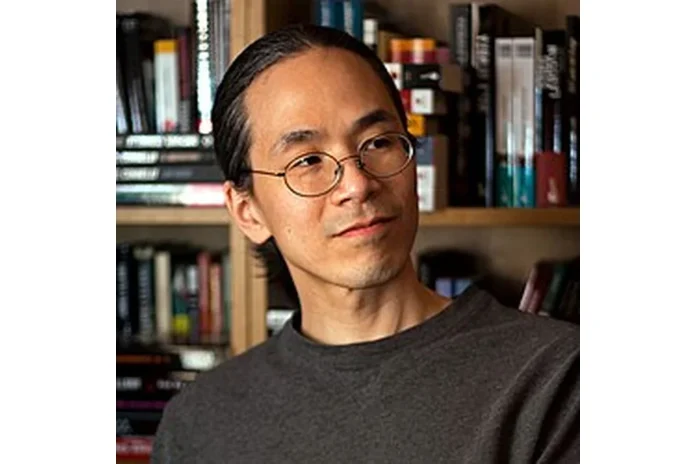
Ted Chiang Bio
Ted Chiang, born in 1967, is an American science fiction writer whose philosophy-driven short fiction has earned him a reputation as one of the most respected voices in contemporary speculative literature. His stories often explore language, time, computation, and moral choice with rigorous logic and humane empathy. Over the course of his career, he has won four Nebula awards, four Hugo awards, six Locus awards, and the John W. Campbell Award for Best New Writer.
Chiang is the author of the short story collections Stories of Your Life and Others (2002) and Exhalation: Stories (2019). His novella “Story of Your Life” was adapted into the 2016 film Arrival, directed by Denis Villeneuve and starring Amy Adams and Jeremy Renner. In addition to his fiction, he works as a technical writer in the software industry and contributes non-fiction essays on computing and artificial intelligence to the New Yorker.
Early Life and Background
Ted Chiang was born in 1967 in Port Jefferson, New York, to a Taiwanese American family. His Chinese name is Chiang Feng-nan. Both of his parents are Taiwanese waishengren who were born in mainland China, migrated to Taiwan with their families during the Great Retreat, and later immigrated to the United States. His father, Fu-pen Chiang, is a distinguished professor of mechanical engineering at Stony Brook University. His mother, who passed away in 2019, worked as a librarian, and he also has a sister who is a physician.
Chiang grew up on Long Island. He began submitting science fiction stories to magazines at the age of 15. In a later interview, he recalled that as a child he intended to become a physicist, a choice that felt perfectly respectable for the son of an engineer, with fiction writing planned as a side pursuit. In 1989, he graduated from Brown University with a Bachelor of Science after choosing to study computer science over physics. He continued writing science fiction as an undergraduate, though those early stories were ultimately unpublished.
Path to Writing
After attending and graduating from the Clarion Workshop in 1989, Chiang sold his first story, “Tower of Babylon,” to Omni magazine. The story was awarded a Nebula Award in 1990, an early signal of the recognition his work would continue to receive. He also counts Isaac Asimov and Arthur C. Clarke among the writers who inspired him when he first started, while the works of Gene Wolfe, John Crowley, and Edward Bryant became his primary creative influences during college.
Chiang has said that one of the reasons science fiction interests him is that it allows him to make philosophical questions “storyable.” He enjoys reading explanatory story notes by other authors and includes them in his own collections as a way to answer the best question a reader might ask about a story. This balance of scientific curiosity and narrative clarity would become a defining feature of his published work.
Ted Chiang Career
Early Career (1989–2001)
Following his Nebula-winning debut with “Tower of Babylon” in 1990, Chiang published a steady stream of short fiction that earned him a reputation for both intellectual rigor and emotional depth. His novella “Story of Your Life” appeared in 1998, and his short story “Hell is the Absence of God” was published in 2001. These early stories established him as one of the most honored writers in contemporary science fiction, with multiple Nebula, Hugo, and Locus honors accumulating across the decade.
Throughout this period, Chiang worked as a technical writer in the software industry while continuing to write fiction. By July 2002, he was residing in Bellevue, Washington, near Seattle. He later served as an instructor at the Clarion Workshop at UC San Diego in both 2012 and 2016, helping to train the next generation of speculative fiction writers.
Breakthrough (2002–2019)
Chiang’s first short story collection, Stories of Your Life and Others, was published in 2002 by Tor Books and brought together his first eight stories. The collection was reprinted in 2016 under the title Arrival to coincide with the release of the film adaptation. In 2007, he published “The Merchant and the Alchemist’s Gate,” a novella that further cemented his standing in the field.
His second collection, Exhalation: Stories, was published in May 2019 by Alfred A. Knopf and was named to former US president Barack Obama’s 2019 reading list, where Obama praised it as the “best kind of science fiction.” As of 2019, Chiang had published eighteen short stories, novelettes, and novellas. In 2020, he was inducted into the Science Fiction and Fantasy Hall of Fame.
Notable Works and Milestones
Chiang’s signature work is the novella “Story of Your Life,” adapted by screenwriter Eric Heisserer into the 2016 film Arrival, which brought his writing to a wide mainstream audience. The film was directed by Denis Villeneuve and starred Amy Adams and Jeremy Renner. In 2022, he became a Miller Scholar at the Santa Fe Institute, and in 2023, Time named him one of the 100 most influential people in AI.
Ted Chiang Award Nominations
Chiang has received numerous award nominations across his career for his short fiction and collections, spanning the Nebula, Hugo, and Locus awards. He has also been recognized for his contributions to the genre through nominations tied to works such as “Liking What You See: A Documentary,” a 2003 short story for which he personally declined the Hugo nomination because he felt the piece had been rushed by editorial pressure.
Ted Chiang Awards Won
Chiang has won four Nebula awards, four Hugo awards, the John W. Campbell Award for Best New Writer, and six Locus awards. In 2020, he was inducted into the Science Fiction and Fantasy Hall of Fame. In 2024, he received the PEN/Malamud Award for excellence in the art of the short story, as well as the American Humanist Association’s Inquiry and Innovation Award.
| Award | Wins | Year |
|---|---|---|
| John W. Campbell Award for Best New Writer | 1 | 1989 |
| Science Fiction and Fantasy Hall of Fame | 1 | 2020 |
| PEN/Malamud Award | 1 | 2024 |
| American Humanist Association Inquiry and Innovation Award | 1 | 2024 |
Ted Chiang Family
Chiang’s father, Fu-pen Chiang, is a distinguished professor of mechanical engineering at Stony Brook University. His mother, who passed away in 2019, worked as a librarian. He also has a sister who is a physician. Both of his parents are Taiwanese waishengren who were born in mainland China, migrated to Taiwan with their families during the Great Retreat, and later immigrated to the United States.
Personal Life
As of 2016, Chiang lives in Bellevue, Washington, with his long-time partner, Marcia Glover, whom he met while they both were working at Microsoft. Glover has worked as an interface designer and later as a photographer. In 2020, Chiang was an artist in residence at the University of Notre Dame from 2020 to 2021.