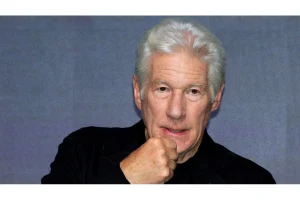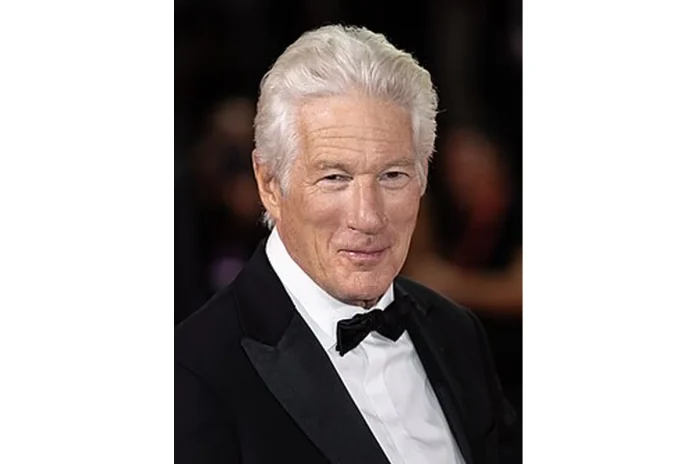
Richard Gere Bio
Richard Tiffany Gere (born August 31, 1949) is an American actor whose career has spanned more than five decades across film, stage, and humanitarian work. He first appeared in motion pictures during the 1970s and rose to international fame with the crime drama American Gigolo (1980) and the romantic drama An Officer and a Gentleman (1982). Over the years, Gere has become one of Hollywood’s most recognizable leading men, known for both his dramatic performances and his lifelong activism on behalf of Tibet and other human rights causes.
Early Life and Background
Richard Tiffany Gere was born on August 31, 1949, in Philadelphia, Pennsylvania. He is the eldest son of homemaker Doris Ann Gere and insurance agent Homer George Gere. His father originally intended to become a minister, and Gere was raised Methodist in Syracuse, New York, where the family settled during his childhood. Both of his parents were descendants of Mayflower passengers, and one of his ancestors, also named George, came from Heavitree, England, and settled in the Connecticut Colony in 1638.
Gere graduated from North Syracuse Central High School in 1967, where he excelled at gymnastics, played the trumpet, and developed a strong interest in music. He then enrolled at the University of Massachusetts Amherst on a gymnastics scholarship and studied philosophy, although he left after two years without completing his degree. During these formative years, his interest in acting and performance gradually began to take shape.
Path to Acting
Gere began his professional acting career at the Seattle Repertory Theatre and the Provincetown Playhouse on Cape Cod in 1969, starring in the play Rosencrantz and Guildenstern Are Dead. His first major role came in the 1971 rock opera Soon, which opened on Broadway at the Ritz Theatre. Shortly afterward, he appeared in the original London stage version of Grease in 1973, gaining additional stage experience.
He earned early recognition on Broadway by playing a gay Holocaust victim in the 1979 production of Bent, a role that won him a Theatre World Award and made him one of the first notable Hollywood actors to portray a homosexual character. During this period, he also began transitioning to screen work, with a small but significant part in the film Looking for Mr. Goodbar (1977) and a starring role in Terrence Malick’s well-reviewed drama Days of Heaven (1978). These performances laid the foundation for his breakthrough as a film star.
Richard Gere Career
Early Career (1974–1979)
Gere first entered the film industry in the mid-1970s, originally being cast in a starring role in The Lords of Flatbush (1974) before being replaced after a disagreement with co-star Sylvester Stallone. He rebounded with a small but significant part in Looking for Mr. Goodbar (1977) and a starring role in Terrence Malick’s highly praised drama Days of Heaven (1978). On stage, he was one of the first notable Hollywood actors to play a homosexual character in the 1979 Broadway production of Bent, which earned him a Theatre World Award.
Breakthrough (1980–1989)
The crime drama American Gigolo (1980) significantly boosted Gere’s profile and established him as a leading man and a sex symbol. He cemented his ascent to stardom with the romantic drama An Officer and a Gentleman (1982), co-starring Debra Winger, which grossed nearly $130 million and won two Academy Awards out of six nominations. For this performance, Gere received his first Golden Globe Award nomination. For the remainder of the decade, he appeared in films of varying critical and commercial reception.
Career Expansion (1990–2004)
Gere’s career rebounded with the releases of Internal Affairs (1990) and Pretty Woman (1990), the latter of which earned him his second Golden Globe Award nomination. He continued to star in successful films throughout the 1990s, including Sommersby (1993) opposite Jodie Foster, Primal Fear (1996), the action thriller The Jackal (1997), and Runaway Bride (1999), which reunited him with his Pretty Woman co-star Julia Roberts. In 1999, People magazine named him Sexiest Man Alive.
In 2002, Gere appeared in three major films: The Mothman Prophecies, Unfaithful, and the Academy Award-winning musical adaptation Chicago. For portraying the silver-tongued lawyer Billy Flynn in Chicago, he won his first Golden Globe Award. His ballroom dancing drama Shall We Dance? (2004) was also a solid commercial performer, grossing $170 million worldwide. He composed and performed the Pretty Woman piano theme and a guitar solo in Runaway Bride, and studied tap dance for his role in Chicago.
Independent Work and Later Films (2005–2016)
After the commercial failure of Bee Season (2005), Gere went on to co-star in The Hunting Party (2007) and Todd Haynes’ semi-biographical Bob Dylan film I’m Not There (2007), in which he was one of six actors to portray a variation of the musician. He later co-starred with Diane Lane in the romantic drama Nights in Rodanthe (2008).
Gere has said his political views regarding China have made him unwelcome in big-budget Hollywood productions, leading him to focus on independent films that garnered some of the best reviews of his career. He was notably singled out for portraying businessman Robert Miller in Arbitrage (2012), earning his fourth Golden Globe Award nomination. In 2016, he made a notable departure from his traditional screen persona with Joseph Cedar’s political drama Norman, in which he played a small-time Jewish fixer. His portrayal of Norman Oppenheimer was called consistently, completely fascinating by critics and was singled out as a worthy Academy Award contender by Variety.
Notable Works and Milestones
Across his career, Richard Gere has built a body of signature films including American Gigolo (1980), An Officer and a Gentleman (1982), Pretty Woman (1990), Chicago (2002), and Norman (2016). He has received multiple Golden Globe Award nominations and won the Golden Globe for Best Actor for Chicago. Multiple film critics and media outlets have called him one of the best actors never to have received an Academy Award nomination.
Richard Gere Award Nominations
Richard Gere has received several Golden Globe Award nominations throughout his career. His first Golden Globe nomination came for his role in the romantic drama An Officer and a Gentleman (1982), followed by another nomination for Pretty Woman (1990). He earned additional Golden Globe nominations for Arbitrage (2012), demonstrating his continued critical respect across decades.
Richard Gere Awards Won
Richard Gere won the Golden Globe Award for Best Actor in a Motion Picture – Musical or Comedy for his portrayal of Billy Flynn in the musical film Chicago (2002). He also received a Theatre World Award for his Broadway performance in Bent (1979), the George Eastman Award for distinguished contribution to the art of film in 2012, the Golden Starfish Award for Lifetime Achievement from the Hamptons International Film Festival in 2012, and the Career Achievement Award from the Hollywood Film Awards in 2012.
Richard Gere Family
Richard Gere was born to Homer George Gere, an insurance agent, and Doris Ann Gere, a homemaker. He is the eldest son in the family and was raised in Syracuse, New York. He is the father of four sons, including Homer James Jigme Gere, born in 2000, who was named for his grandfathers as well as the Tibetan name Jigme. He has two additional sons, born in 2019 and 2020, with his wife Alejandra Silva.
Personal Life
Richard Gere has had several high-profile relationships. He was married to model Cindy Crawford from 1991 to 1995. In 2002, he married model and actress Carey Lowell, with whom he had a son, Homer James Jigme Gere, in 2000. They separated in 2013 and finalized their divorce in October 2016 after a highly contested court process. In April 2018, Gere married Spanish activist Alejandra Silva, and the couple have since welcomed two sons, born in 2019 and 2020.
Gere first developed an interest in Buddhism in his 20s, initially studying Zen Buddhism before traveling to Nepal in 1978, where he met Tibetan monks and lamas. He later met the 14th Dalai Lama in India and became a practicing Tibetan Buddhist of the Gelugpa school. He is a co-founder of Tibet House US, creator of the Gere Foundation, and Chairman of the Board of Directors for the International Campaign for Tibet, and he is permanently banned from entering China due to his advocacy for Tibetan independence.