

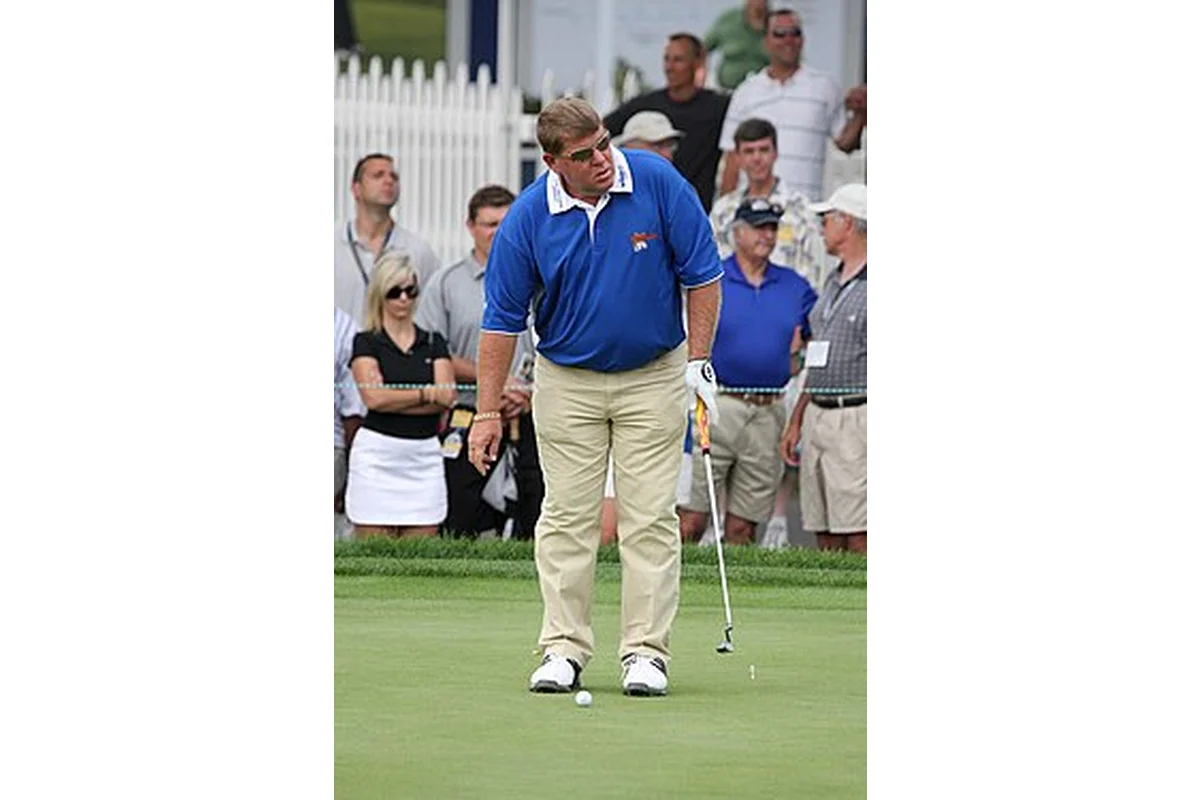
John Daly Bio
John Patrick Daly (born April 28, 1966) is an American professional golfer known for his exceptional driving distance, his colorful personality, and his remarkable career comebacks. He remains one of the most popular figures in professional golf, earning the nickname “Long John” for his prodigious power off the tee. Over a professional career that began in 1987, Daly has played on the PGA Tour, the European Tour, the Champions Tour, and various international circuits, and he is also an active golf course designer and musician.
Widely recognized for his unconventional appearance, exceptionally long backswing, and streak of brilliant performances punctuated by off-course struggles, Daly captured two major championships: the 1991 PGA Championship and the 1995 Open Championship. He has since continued to compete, primarily on the PGA Tour Champions, while also pursuing business ventures, music projects, and public advocacy.
Early Life and Background
John Patrick Daly was born on April 28, 1966, in Carmichael, California, to Jim Daly, a construction worker for industrial plants, and Lou Daly, a homemaker. The working-class family moved frequently during his childhood, eventually settling in Dardanelle, Arkansas, when he was four years old. It was there, at the Bay Ridge Boat and Golf Club, that Daly first picked up a golf club at the age of five. From those earliest days, he admired Jack Nicklaus, the dominant professional player of the time, and began shaping the powerful swing that would later define his career.
Throughout his youth, Daly continued to relocate with his family across the Southern states, including time in Virginia and Louisiana, before attending Helias High School in Jefferson City, Missouri. He became a junior golf member at the Jefferson City Country Club and lettered in both football and golf, serving as the punter and place-kicker for the football team that compiled a perfect 10–0 record in 1983. In golf, he won the 1983 Missouri State Amateur Championship, and he later won the 1984 Arkansas State Amateur Championship, signaling his arrival as a serious competitive talent.
Daly attended the University of Arkansas from 1984 to 1987 on a golf scholarship, where he played for the Razorbacks golf team under coaches Steve Loy and Bill Woodley. Although his college years were marked by turbulent relationships with his coaches and struggles with class attendance due to personal issues, he qualified for the 1986 U.S. Open as an amateur, missing the 36-hole cut. He left the university without completing his degree, opting to turn professional in the summer of 1987.
Path to Professional Golf
Daly’s first professional victory came shortly after turning pro, when he won the 1987 Missouri Open. From 1987 to 1989, he competed primarily in minor events across the United States, gradually building his competitive resume. His first significant international experience came during the 1989–90 season on the Southern African Tour, where he won the AECI Charity Classic and the Hollard Royal Swazi Sun Classic, gaining valuable confidence against established international professionals.
His success abroad led to full playing privileges on the Ben Hogan Tour for 1990, and he won the qualifying tournament for the developmental circuit. That year, he also captured the 1990 Ben Hogan Utah Classic. He completed the year by finishing tied for 12th at the 1990 PGA Tour Qualifying Tournament, earning his PGA Tour card on his fourth attempt and setting the stage for his historic rookie season in 1991.
John Daly Career
Early Career (1987–1990)
During his earliest professional years, Daly worked to refine the raw talent that had made him a dominant amateur. His transition from the amateur ranks to the paid professional circuits came with adjustments in competition level and travel demands. He steadily built experience by competing in regional and developmental events, gradually earning the respect of peers and tournament organizers for both his powerful ball-striking and his engaging personality.
His breakthrough stretch came in 1990, when wins in South Africa, Swaziland, and on the Ben Hogan Tour established him as a player ready for the top level. The confidence gained from these victories allowed him to qualify for the PGA Tour, opening the door to the most prestigious events in professional golf and the platform on which he would soon become a household name.
PGA Tour Breakthrough (1991–1995)
Daly joined the PGA Tour in 1991 and quickly announced his arrival by winning the PGA Championship that August at Crooked Stick Golf Club near Indianapolis. Entering the tournament as the ninth and final alternate after Nick Price withdrew, Daly was a virtual unknown who had driven through the night to claim his spot. He delivered rounds of 69-67-69-71 to win by three strokes over veteran Bruce Lietzke, earning the PGA Tour Rookie of the Year award and becoming the first rookie to win a major since Jerry Pate in 1976.
He added to his major tally in 1995 by winning The Open Championship at the Old Course at St Andrews in a four-hole playoff over Costantino Rocca. Trailing Michael Campbell entering the final round, Daly played superb golf in difficult windy conditions to set the clubhouse lead. After Rocca famously sank a long birdie putt on the 18th hole to force a playoff, Daly took control, finishing the four extra holes at one under par to claim his second major title.
During this period, Daly also captured additional PGA Tour victories, including the 1992 B.C. Open by six strokes, the 1994 BellSouth Classic following a stint in alcohol rehabilitation, and international wins such as the 2001 BMW International Open. His powerful game and his improbable 1991 victory created a cult-like fan base drawn to his swashbuckling style.
Comeback Era (2004–Present)
Daly’s last PGA Tour victory came at the 2004 Buick Invitational in San Diego, where he won in a playoff against Luke Donald and Chris Riley, marking his first win in 189 PGA Tour events. He was named PGA Tour Comeback Player of the Year for 2004, and his form that season saw him rise from 299th in the world rankings into the top 50. From 2007 onward, he competed primarily on sponsor exemptions and past champion status, while also playing on the European Tour after a six-month PGA Tour suspension in late 2008.
After turning 50 on April 28, 2016, Daly became eligible for the PGA Tour Champions, making his debut at the Insperity Invitational in May 2016. He won that same tournament on May 7, 2017, finishing at 14 under par for his first victory on a PGA Tour-affiliated circuit since 2004. He continues to compete semi-regularly on the Champions Tour, where his career earnings have surpassed $10 million, while also making appearances via sponsor exemptions on the PGA Tour.
Driving Style and Strengths
Daly’s game has always been built around raw power and exceptional club head speed generated by an extremely long backswing with pronounced coiling of the arms and shoulders. This swing produces extraordinary driving distance, and in 1997 he became the first PGA Tour player to average more than 300 yards per drive over a full season, a feat he repeated every year from 1999 through 2008. The trade-off has been inconsistency, since near-perfect timing is required to execute such a powerful motion, but on his best days his ball-striking has been virtually unmatched in professional golf.
Notable Events and Milestones
Beyond his major championship victories, Daly is remembered for numerous signature moments, including apparently being the first player to reach the green of the famous 630-yard 17th hole at Baltusrol Golf Club’s Lower Course in two strokes during the 1993 U.S. Open. He remains the only eligible two-time major winner never selected to play in the Ryder Cup. In entertainment, he appeared as a fictionalized version of himself in the 2025 film Happy Gilmore 2, and he has also been featured in several golf video games, including the Tiger Woods PGA Tour series and his own title, John Daly’s Prostroke Golf.
John Daly Career Wins
John Daly has accumulated a diverse collection of professional victories across multiple tours since turning pro in 1987. His wins span the PGA Tour, the European Tour, the Ben Hogan Tour, the PGA Tour Champions, the Southern Africa Tour, and the Asian PGA Tour, reflecting both his global competitive reach and his longevity in the sport.
PGA Tour and Major Highlights
Daly has recorded five PGA Tour victories, headlined by his two major championship wins at the 1991 PGA Championship and the 1995 Open Championship. Other PGA Tour titles include the 1992 B.C. Open, the 1994 BellSouth Classic, and the 2004 Buick Invitational. He has also won three European Tour events, including the 2001 BMW International Open, and one PGA Tour Champions title at the 2017 Insperity Invitational. His first professional win came at the 1987 Missouri Open, and he added the 1990 Ben Hogan Utah Classic during his developmental years.
Other Wins and Performances
In addition to his major tour victories, Daly has posted wins in South Africa, Swaziland, Scotland, Germany, South Korea, Turkey, and Canada, along with a victory at the 2003 Korea Open, his most prestigious Asian result. He was also a member of the winning PGA Tour team at the Wendy’s 3-Tour Challenge in both 2002 and 2003, and he won the 1995 Alfred Dunhill Cup with Fred Couples and Payne Stewart.
John Daly Family
Family Background and Racing Lineage
John Patrick Daly was raised in a working-class family headed by his father, Jim Daly, a construction worker for industrial plants, and his mother, Lou Daly, a homemaker. He grew up with an older sister and an older brother, Jamie, as the family moved frequently across the Southern United States during his formative years. His father often worked night shifts, sometimes commuting long distances between job sites and home, which shaped the peripatetic nature of Daly’s childhood and early introduction to golf.
Personal Life
Daly has been married multiple times. He married his first wife, Dale Crafton, in 1987, with the couple divorcing in 1990. He then married Bettye Fulford in 1992, and the couple had a daughter before divorcing in 1995. That same year, he married Paulette Dean, with whom he had a second daughter born on June 1, 1995; they divorced in 1999. On July 29, 2001, Daly married Sherrie Miller, and the couple had a son born on July 23, 2003. The couple’s later years were marked by highly publicized legal disputes, including a 2010 court ruling that awarded custody of their son to Daly. Daly has publicly battled issues with alcohol throughout his life, and he has spoken openly about growing up with an alcoholic and abusive father.
2025 Season Performance
As of 2025, John Patrick Daly continues to compete on the PGA Tour Champions, where he remains a fan favorite known for his aggressive play and charismatic presence. He regularly relies on sponsor invitations to enter PGA Tour events, since his career earnings and exemption status do not automatically qualify him for full-field access to elite tournaments. His exempt status extends to lifetime entry in the PGA Championship and the AT&T Pebble Beach National Pro-Am, and he remains exempt in the Open Championship until age 60.
Daly’s 2025 calendar includes his continued participation on the Champions Tour, where he is a past champion at the Insperity Invitational, and he made a notable crossover appearance as a fictionalized version of himself in the 2025 film Happy Gilmore 2. He also maintains a busy schedule of business activities, including his golf course design company, JD Designs, his LoudMouth Golf apparel partnership, and his line of cannabis products launched in 2023.
Looking ahead, Daly’s outlook for 2025 centers on selective Champions Tour appearances, special sponsor exemptions into marquee PGA Tour events, and continued public engagement through his various business and entertainment ventures. While his competitive results vary, his enduring popularity and his status as one of golf’s most recognizable figures remain firmly intact as he builds on a career now in its fourth decade.