
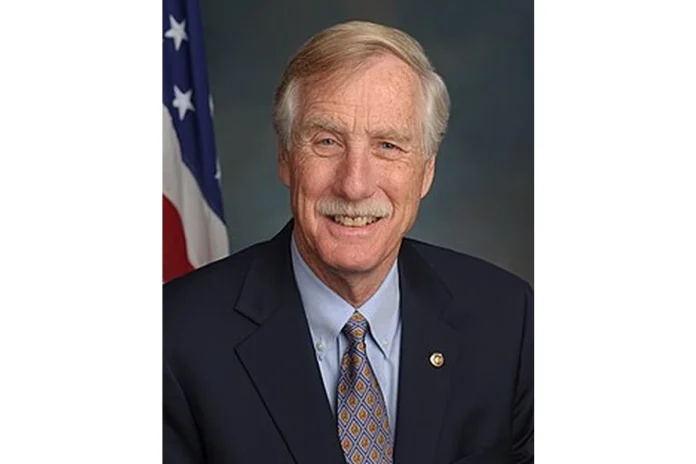
Angus King
Angus Stanley King Jr. (born March 31, 1944) is an American lawyer, businessman, and politician who has served as the junior United States Senator from Maine since 2013. A political independent, he caucuses with the Senate Democratic Caucus and is one of two independents in the upper chamber, alongside Bernie Sanders of Vermont. King previously served as the 72nd Governor of Maine from 1995 to 2003, winning election as an independent in a four-way 1994 race and reelection in a 1998 landslide. He is known for working across the aisle on energy, healthcare, gun safety, and bipartisan governance.
Early Life and Background
Angus Stanley King Jr. was born in Alexandria, Virginia, the son of Ellen Archer Ticer and Angus Stanley King, a lawyer who served as a U.S. magistrate for the Eastern District of Virginia. He grew up in Northern Virginia and graduated from Francis C. Hammond High School in Alexandria. As a young man, King developed an interest in public affairs and the law, an interest that would shape his future career in politics and public service.
King enrolled at Dartmouth College, where he earned a Bachelor of Arts degree in 1966. He joined the Delta Upsilon social fraternity during his undergraduate years. He then attended the University of Virginia School of Law, graduating with a Juris Doctor in 1969. His legal training laid the foundation for both his early work in government and his later success as a private attorney in Maine.
Path to Politics
Soon after law school, King moved to Maine and joined Pine Tree Legal Assistance in Skowhegan as a staff attorney. In 1972, he served as chief counsel to the U.S. Senate Subcommittee on Alcoholism and Narcotics, and later worked as a legislative assistant to Democratic Senator William Hathaway of Maine. He also became well known statewide as a host on public television, which helped him build a name across the region.
In 1973, at age 29, King was diagnosed with an aggressive form of melanoma, an experience he has said convinced him of the importance of health coverage. After recovery, he returned to Maine in 1975 to practice law with Smith, Loyd and King in Brunswick. In 1983, he was appointed vice president of Swift River/Hafslund Company, which developed alternative energy projects in New England. In 1989, King founded Northeast Energy Management, Inc., a company that developed electrical energy conservation projects, which he sold in 1994.
Angus King Career
Early Career (1972–1993)
King’s early career blended legal practice, public service, and media work. After his time in the Senate and in private practice, he built a reputation in Maine as a thoughtful attorney and a familiar public-television personality. His work on energy conservation through Northeast Energy Management positioned him as a business leader with a focus on environmental stewardship.
Throughout the 1980s and early 1990s, King maintained ties to the Democratic Party while building an independent profile. By 1993, he had grown critical of the Maine Democratic Party’s direction and decided to leave it behind, a step that set the stage for his run for governor.
Governor of Maine (1995–2003)
In May 1993, King announced that he would run for Governor of Maine as an independent in the 1994 election. The race was a four-way contest against Republican Susan Collins, Democrat and former Governor Joseph E. Brennan, and Green Party nominee Jonathan Carter. King invested early in television advertising, positioned himself as a pragmatic environmentalist focused on jobs and education, and narrowly won the November 8, 1994 election with 35 percent of the vote, edging out Brennan by about 7,800 votes.
During his tenure, King was the only U.S. governor unaffiliated with a political party, alongside Jesse Ventura of Minnesota. He signed legislation requiring fingerprinting and background checks for all school employees. Riding a 75 percent approval rating, he won reelection in 1998 in a landslide, taking 59 percent of the vote, the highest share for a Maine gubernatorial candidate since 1982. In 2002, he launched the Maine Learning Technology Initiative, the first program of its kind in the nation to provide laptops to every public middle-school student in the state.
U.S. Senate (2013–Present)
On March 5, 2012, King announced his campaign for the U.S. Senate seat being vacated by Republican Olympia Snowe. On November 6, 2012, he won the race with 53 percent of the vote, defeating Democrat Cynthia Dill and Republican Charlie Summers. He then announced he would caucus with Senate Democrats, citing both the practical need for committee access and the party’s majority status.
King was reelected in 2018 after Maine’s inaugural instant-runoff voting election, defeating Republican Eric Brakey and Democrat Zak Ringelstein. He won a third term on November 5, 2024, defeating Republican Demi Kouzounas, Democrat David Costello, and independent Jason Cherry. Upon turning 81 on March 31, 2025, he became the oldest U.S. senator in Maine history. Throughout his Senate career, he has been active on energy, the environment, healthcare, gun safety, immigration, and bipartisan reform.
Notable Events and Milestones
One of King’s most recognized achievements came in 2018, when his 2017 petition to the Unicode Consortium helped lead to the introduction of the lobster emoji, which he called great news for Maine. In 2014, he was chosen to read George Washington’s Farewell Address to the Senate. He participated in the certification of the 2021 Electoral College vote count when Trump supporters attacked the U.S. Capitol, calling the event a violent insurrection and supporting invocation of the 25th Amendment. In 2024, he was one of 19 senators to vote for a bill to block arms sales to Israel during the Gaza war.
Angus King Career Wins
Angus King has compiled a steady record of electoral success at both the state and federal levels. He has won four major statewide elections: the 1994 Maine gubernatorial race, the 1998 gubernatorial reelection, the 2012 U.S. Senate race, and the 2018 Senate reelection, followed by a third Senate term in 2024. His 1998 reelection, with 59 percent of the vote, remains the strongest performance by a Maine gubernatorial candidate in modern history until 2018.
Senate Election Highlights
King first won the U.S. Senate in 2012 with 53 percent of the vote, giving him a clear mandate in a three-way race. He followed that with a 2018 victory under Maine’s new instant-runoff voting system, reinforcing his appeal across party lines. In 2024, he secured a third term, an unusual feat for an independent in the modern Senate.
Other Wins and Achievements
Beyond elections, King has been recognized for his bipartisan work. In 2023, the Lugar Center ranked him in the top fifth of senators for bipartisanship. In 2024, he received the 24th Bruce F. Vento Public Service Award from the National Park Trust. He has also been honored for his work on energy policy and environmental stewardship throughout his career.
Angus King Family
Family Background and Personal Life
Angus Stanley King Jr. was raised in Alexandria, Virginia, in a family with deep roots in the legal profession. His father, Angus Stanley King, was a lawyer and U.S. magistrate for the Eastern District of Virginia, while his mother, Ellen Archer Ticer, raised the family in Northern Virginia. King’s own legal training followed naturally from that family background.
King’s first wife was Edie Birney, with whom he had three elder sons. He and Birney divorced in 1982. Since 1984, King has been married to Mary Herman. He has five children and six grandchildren. One of his children, Angus King III, is a Democratic candidate in the 2026 Maine gubernatorial election. King is an Episcopalian and attends St. Paul’s Episcopal Church in Brunswick, Maine. He is known for riding a Harley-Davidson motorcycle, and according to OpenSecrets.org, his net worth was more than $9.4 million as of 2018.