
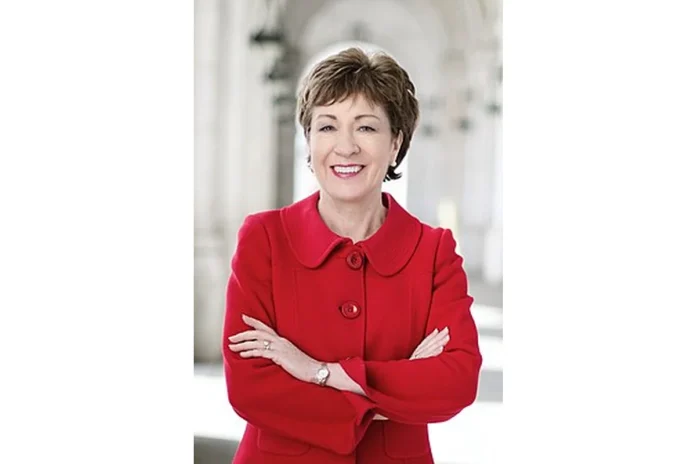
Susan Collins Bio
Susan Margaret Collins (born December 7, 1952) is an American politician serving as the senior United States senator from Maine, a seat she has held since 1997. A member of the Republican Party, she is Maine’s longest-serving member of Congress and the longest-serving Republican woman in the Senate. Generally regarded as a moderate Republican, she is often a pivotal Senate vote and has chaired committees including Appropriations and Homeland Security.
A graduate of St. Lawrence University, Collins built a career in public service before her election to the Senate, including roles in congressional staff, state government, and the Small Business Administration. In 2025, she became chair of the Senate Appropriations Committee. Collins is known for crossing party lines on select issues, including judicial confirmations and key bipartisan legislation.
Early Life and Background
Susan Margaret Collins was born on December 7, 1952, in Caribou, Maine. She grew up in the small northern Maine community and attended Caribou High School, where she completed her secondary education. Her parents are Donald Collins and Patricia McGuigan, and she was raised in a family with strong ties to the region’s civic and professional life.
Collins went on to attend St. Lawrence University in Canton, New York, where she earned a Bachelor of Arts degree. Her time at St. Lawrence helped shape her interest in public service and government, setting the stage for her future career in Washington and Maine politics. She has often spoken about the influence of her family and her northern Maine upbringing on her political values.
Path to US Politics
Collins began her political career in 1975 as a staff assistant for Senator William Cohen of Maine. By 1981, she had risen to become staff director of the Oversight of Government Management Subcommittee of the Committee on Governmental Affairs, gaining firsthand experience with the workings of the U.S. Senate.
In 1987, Maine Governor John R. McKernan Jr. appointed Collins commissioner of the Maine Department of Professional and Financial Regulation. Four years later, in 1992, President George H. W. Bush appointed her director of the Small Business Administration’s regional office in Boston. After a brief stint in 1993 as a deputy state treasurer in Massachusetts, Collins returned to Maine and in 1994 became the first female major-party nominee for governor of Maine, finishing third in a four-way race. She later became the founding director of the Center for Family Business at Husson University in Bangor, Maine, before launching her successful Senate campaign in 1996.
Susan Collins Career
Early Career (1997–2002)
Collins was elected to the U.S. Senate in 1996, pledging to serve only two terms. She quickly established herself as a pragmatic legislator. During the 1990s, she played an important role during the Senate’s impeachment trial of President Bill Clinton, co-sponsoring a motion with Senator Olympia Snowe that would have allowed the Senate to vote separately on the charges and the sentence. The motion failed, and Collins voted to acquit, believing that while Clinton had committed perjury, it was not grounds for removal from office.
In her first term, Collins served on key committees and became known for bipartisan work. In 2001, she authored a measure granting the U.S. Secretary of Education authority to grant waivers to relieve reservists, members of the National Guard, and victims of the September 11 attacks from making federal student loan payments during active duty. The bill passed both chambers in December 2001.
Senate Committee Leadership (2003–2014)
From 2003 to 2007, Collins chaired the Senate Committee on Homeland Security and Governmental Affairs. In November 2002, the Senate approved the creation of the Department of Homeland Security, with Collins among those who secured an “ironclad promise” from Republican leaders and the White House to rescind certain provisions in subsequent legislation.
In 2004, Collins was one of the primary sponsors of legislation overhauling the U.S. intelligence community, creating the position of Director of National Intelligence to oversee budgets and assets of spy agencies, and mandating minimum federal standards for driver’s licenses and birth certificates. Known as the Intelligence Reform and Terrorism Prevention Act, the bill was signed by President George W. Bush on December 17, 2004. In May 2005, Collins was one of 14 senators who forged a compromise on the use of the judicial filibuster, allowing votes on several of President Bush’s appellate court nominees.
Reelection and Bipartisan Work (2014–2020)
Collins was reelected in 2014, defeating Shenna Bellows with 68.5% of the vote, carrying every county in Maine. From 2015 to 2021, she chaired the Senate Special Committee on Aging, focusing on policies affecting older Americans.
In 2016, Collins authored the Safe Treatments and Opportunities to Prevent Pain Act and the Infant Plan of Safe Care Act, both included in the Comprehensive Addiction and Recovery Act signed by President Barack Obama on July 22, 2016. On August 8, 2016, she announced she would not vote for Donald Trump, citing his “disregard for the precept of treating others with respect.” In October 2020, she was the only Republican senator to vote against the confirmation of Amy Coney Barrett to the Supreme Court. She also voted “not guilty” on both articles of impeachment during Trump’s first trial in February 2020.
Appropriations Committee Era (2021–Present)
In January 2021, Collins was present in the Senate chamber when Trump supporters attacked the U.S. Capitol on January 6. She called the experience “frightening and appalling” and later voted to certify the Electoral College count. On February 13, 2021, she was one of seven Republican senators to vote to convict Trump in his second impeachment trial.
On October 28, 2021, Collins cast her 8,000th consecutive roll call vote, a streak surpassed in Senate history only by Chuck Grassley and William Proxmire. By April 19, 2024, the Senate recognized her 9,000th consecutive vote, surpassing Grassley’s record. In 2025, Collins became chair of the Senate Appropriations Committee. She voted to confirm Ketanji Brown Jackson to the Supreme Court, making her one of only three Republican senators to support the nomination.
Notable Events and Milestones
Collins is Maine’s longest-serving member of Congress and the longest-serving Republican woman in the Senate, a record she set in 2021 when she surpassed Margaret Chase Smith. She has been recognized as the most bipartisan senator during the first session of the 115th Congress by The Lugar Center and Georgetown University. Her record of consecutive roll call votes is among the longest in Senate history, and her pivotal role in swing votes on health care, judicial nominations, and impeachment has defined her career.
Susan Collins Career Wins
Throughout her Senate career, Susan Margaret Collins has built a record of electoral success and legislative achievement. She has won five Senate elections, beginning in 1996, and has been reelected every six years. Her first three reelection bids, in 2002, 2008, and 2014, were won by wide margins, and she carried every county in Maine each time.
Senate Election Highlights
Collins was first elected to the Senate in 1996. She won her 2002 reelection over State Senator Chellie Pingree, 58.4% to 41.6%, her 2008 race against Representative Tom Allen, 61.5% to 38.5%, and her 2014 contest against Shenna Bellows, 68.5% to 31.5%. Her most competitive race came in 2020, when she was challenged by Democratic State House Speaker Sara Gideon. Despite trailing in every public poll, Collins won decisively, making the contest the most expensive in Maine history, with Collins spending $23 million and Gideon nearly $48 million.
Other Wins and Achievements
Beyond elections, Collins has earned recognition for her legislative work. She received the Spirit of Enterprise Award in 2013, the Publius Award in 2014, the Veterans of Foreign Wars Congressional Award in 2017, the Golden Plate Award from the Academy of Achievement in 2022, and was named to the BBC 100 Women list in 2024. National Journal recognized her with a Perfect Attendance award in 2014, and Elle magazine included her among the 10 Most Powerful Women in D.C. that same year.
Susan Collins Family
Family Background and Public Service
Susan Margaret Collins was born to Donald Collins and Patricia McGuigan in Caribou, Maine. She grew up in northern Maine, where her family was part of the local community. Her early life in Caribou shaped her appreciation for the values of rural New England and influenced her path into public service.
Personal Life
Collins married Thomas Daffron in 2012. She is a graduate of St. Lawrence University and has spent much of her professional life in Maine and Washington, D.C. Known for her moderate stance and bipartisan approach, Collins has built a career that reflects her commitment to independent thought and constituent service.