
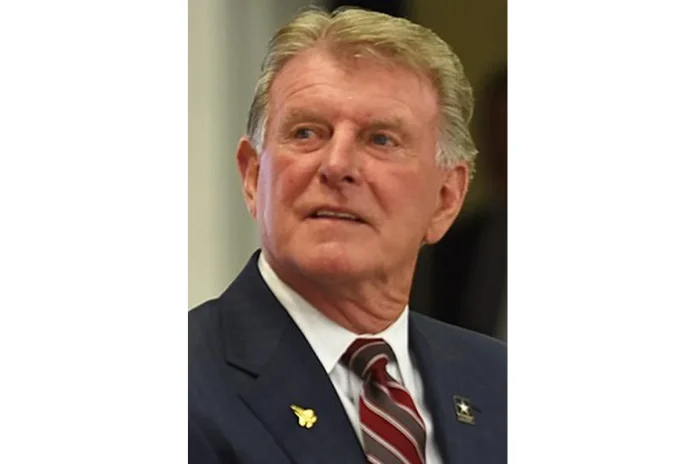
Butch Otter Bio
Clement Leroy “Butch” Otter, born on May 3, 1942, in Caldwell, Idaho, is an American businessman and Republican politician who built one of the longest careers in Idaho political history. He served as the 32nd Governor of Idaho from 2007 to 2019, preceded by 14 years as Lieutenant Governor and six years representing Idaho’s 1st congressional district in the U.S. House of Representatives. Before entering full-time public service, Otter spent three decades at Simplot International, the agribusiness firm founded by his former father-in-law, J.R. Simplot, ultimately rising to the role of company president. He is Idaho’s second longest-serving governor, trailing only Cecil Andrus, and he remains a defining figure in the modern Republican Party in his home state.
Early Life and Background
Butch Otter was born in Caldwell, Idaho, into a modest Roman Catholic family headed by his parents, Regina Mary (née Buser) and Joseph Bernard Otter. His father worked as a journeyman electrician, and the family moved frequently through rural communities across the Midwest and West during his childhood, an experience that required young Otter to attend fifteen different schools. His nickname “Butch” reportedly came from a few schoolyard scuffles that left him with minor bruises, while Catholic nuns at his schools first called him “Clem” after a character from the Red Skelton Show.
He graduated from St. Teresa’s Academy, a Catholic high school in Boise that later became Bishop Kelly High School, in 1962. A childhood accident in which gasoline severely burned his younger brother forced Otter to delay his studies for a year, which is why he finished high school at age twenty. While in school, he worked as a janitor, theater usher, and lawn boy, contributing to his family’s household income. He then briefly attended St. Martin’s College in Lacey, Washington, before returning to Idaho to study at Boise Junior College, and he ultimately earned a Bachelor of Arts in political science from the College of Idaho in 1967. He was the first member of his family to graduate from college and made the dean’s list during his final term.
Path to US Politics
Otter’s entry into Idaho politics came in 1972, when he won a seat in the state legislature representing Canyon County. He was re-elected to the House in 1974 and served until 1976, building a reputation as a young conservative voice in state government. In January 1977, when Democratic Governor Cecil Andrus was appointed U.S. Secretary of the Interior under President Jimmy Carter, Lieutenant Governor John Evans succeeded him, and Otter announced in June 1977 his intention to seek the governorship in 1978. In a six-man Republican primary, Otter finished a close third with 26.0 percent of the vote, behind winner Allan Larsen and Vern Ravenscroft, before incumbent Evans easily won the general election.
After his 1978 setback, Otter returned to the private sector, taking on major responsibilities at Simplot International, the agribusiness giant founded by J.R. Simplot. He spent roughly three decades at the company, starting in a low-level position and eventually being named president, a path that cemented his connections to Idaho’s business establishment. Following Ronald Reagan’s 1980 presidential victory, Otter received appointments to the administration’s Task Force on International Private Enterprise, the World Bank’s Agricultural Advisory Committee, and the Center for International Private Enterprise, sharpening his profile in national policy circles. These experiences positioned him for a successful return to elective office in the mid-1980s.
Butch Otter Career
Early Career (1972-1986)
Butch Otter’s early political career began with his 1972 election to the Idaho House of Representatives from Canyon County, followed by re-election in 1974 and service through 1976. His 1978 bid for governor ended in a close third-place finish in the Republican primary, but the campaign introduced him to a statewide audience. He then focused on his executive roles at Simplot International while serving in various Republican Party positions, including time on the Idaho Republican Party Central Committee and as Chairman of the Canyon County Republican Party.
His business reputation grew steadily at Simplot, where he was eventually appointed president of the company, a position that gave him both financial security and statewide name recognition. In August 1992, Otter was arrested on suspicion of driving under the influence near Meridian on Interstate 84, and in March 1993 a jury convicted him, resulting in 72 hours of community service, 16 hours in an alcohol treatment program, a $700 fine, and a license revocation. He later acknowledged that the incident could have ended his political career and led him to defer an anticipated run for governor in 1994 in favor of seeking re-election as lieutenant governor.
Lieutenant Governor Era (1986-2001)
In 1986, Otter returned to Idaho politics by winning election as Lieutenant Governor, a post he would hold for a record-setting 14 years. He was re-elected in 1990, 1994, and 1998, serving under three different governors: Democrat Cecil Andrus and Republicans Phil Batt and Dirk Kempthorne. In 1991, when the Idaho Senate was evenly split between 21 Republicans and 21 Democrats, Otter’s tie-breaking votes were decisive in keeping the chamber under Republican control. Midway through his fourth term in 2001, he resigned to accept a seat in the U.S. Congress, finishing his tenure as the longest-serving lieutenant governor in Idaho history.
Breakthrough: U.S. House of Representatives (2001-2007)
Otter entered the Republican primary for Idaho’s 1st congressional district in 2001 and quickly became the favorite thanks to his statewide name recognition. He won the primary easily and cruised to victory in the general election, going on to win re-election in 2002 and 2004 without serious difficulty. In Congress, he built a record that was largely conservative with a slight libertarian streak, most notably becoming one of only three Republicans, alongside Bob Ney of Ohio and Ron Paul of Texas, to vote against the USA PATRIOT Act in 2001.
He later stated that “much of the USA PATRIOT Act is needed to help protect us in a dangerous age of stateless zealots and mindless violence,” and he was also sharply critical of the Bush Administration’s Terrorist Surveillance Program. On social issues, he supported a constitutional amendment defining marriage as between “one man and one woman,” and he was a strong advocate for Second Amendment rights who opposed federal restrictions on gun sales. On economic policy, he voted for a 2001 bankruptcy overhaul requiring partial debt repayment, supported a balanced budget amendment to the U.S. Constitution, and backed broad-based tax cuts including the elimination of estate and marriage taxes. He also voted to authorize the 2003 invasion of Iraq.
Republican Era: Governor of Idaho (2007-2019)
Otter announced his candidacy for governor in December 2005, won the May 2006 Republican primary with 70 percent of the vote, and then defeated Democrat Jerry Brady 53 percent to 44 percent in the closest gubernatorial race in Idaho since 1994. Sworn in as the 32nd Governor of Idaho in 2007, he was re-elected in 2010, defeating Democrat Keith Allred 59 percent to 33 percent, and won a third consecutive term in November 2014. During his tenure, he pursued wide-ranging education reforms, including a $1.36 billion proposed increase in state educational funding and the elimination of teacher tenure, and he later signed “Luna laws” limiting collective bargaining for teachers and tying pay to performance, although those measures were overturned in three state referendums in 2012.
He issued an executive order in April 2011 prohibiting state agencies from implementing the federal Patient Protection and Affordable Care Act, and he supported expanding offshore oil drilling, tax incentives for alternative fuels, and a national goal of 25 percent renewable energy by 2025. In January 2007, he announced support for reducing Idaho’s gray wolf population, and in March 2014 he established the “Wolf Control Fund and State Board” to continue that policy. In 2015, he vetoed Senate Bill 1146a, which would have legalized CBD oil for severe epilepsy, citing concerns about federal law and potential misuse. He endorsed fellow Republican John Kasich for president in 2016 and joined other Republican attorneys general in 2017 in threatening legal action to end the Deferred Action for Childhood Arrivals policy. In January 2019, the State Central Committee of the Idaho Republican Party passed a resolution condemning and censuring him for endorsing an independent candidate over the party’s primary nominee.
Notable Events and Milestones
Among the most defining moments of Otter’s career was his 14-year run as Lieutenant Governor, the longest tenure in Idaho history, and his subsequent service as the 32nd Governor, making him the state’s second longest-serving chief executive. His 1992 DUI arrest and 1993 conviction stood as a serious personal and political setback from which he openly recovered, and his narrow 53 percent to 44 percent victory in the 2006 governor’s race marked the closest Idaho gubernatorial contest since 1994. In the summer of 2007, actress Dawn Wells presented him with the Idaho Visionary Award at the SpudFest Family Film and Music Festival for his support of Idaho filmmakers.
Butch Otter Career Wins
Butch Otter compiled a lengthy record of electoral victories across more than four decades in Idaho politics, winning races for the state legislature, lieutenant governor, U.S. House, and governor. His wins included four consecutive terms as Lieutenant Governor, three congressional victories in Idaho’s 1st district, and three consecutive terms as Governor of Idaho.
Idaho Gubernatorial Highlights
Otter first won the governorship in 2006, defeating Democrat Jerry Brady 53 percent to 44 percent after a closer-than-expected general election campaign. He followed that victory with a 59 percent to 33 percent win over Democrat Keith Allred in 2010, and he secured a third consecutive term in November 2014. Together, these three gubernatorial wins made him the second longest-serving governor in Idaho history.
Other Wins and Achievements
Beyond his statewide victories, Otter won election to the Idaho House of Representatives from Canyon County in 1972 and 1974, and he was elected Lieutenant Governor of Idaho four times, in 1986, 1990, 1994, and 1998. In 2007, he received the Idaho Visionary Award in recognition of his support for Idaho filmmakers at the SpudFest Family Film and Music Festival in Driggs.
| Position | Wins | Year |
|---|---|---|
| Idaho State House (Canyon County) | 2 | 1972, 1974 |
| Lieutenant Governor of Idaho | 4 | 1986, 1990, 1994, 1998 |
| U.S. House (Idaho 1st District) | 3 | 2000, 2002, 2004 |
| Governor of Idaho | 3 | 2006, 2010, 2014 |
Butch Otter Family
Family Background and Roots
Butch Otter was born into a small Roman Catholic family headed by his parents, Joseph Bernard Otter, a journeyman electrician, and Regina Mary (née Buser) Otter. Because of his father’s work, the family moved frequently through rural parts of the Midwest and West, an experience that shaped Otter’s early years and exposed him to a wide range of communities across the American heartland. He was the first member of his family to graduate from college, a distinction that reflected both his upbringing and his determination to build a career beyond the manual labor that had employed his parents.
Personal Life
In 1964, Otter married Gay Simplot, the sister of Scott Simplot and the only daughter of Idaho businessman J.R. Simplot. After 28 years of marriage, the couple amicably divorced in 1992, and the marriage was later annulled by the Catholic Church. In 2006, Otter married his longtime girlfriend Lori Easley, a former Miss Idaho USA, in a ceremony held in Meridian on August 18.