
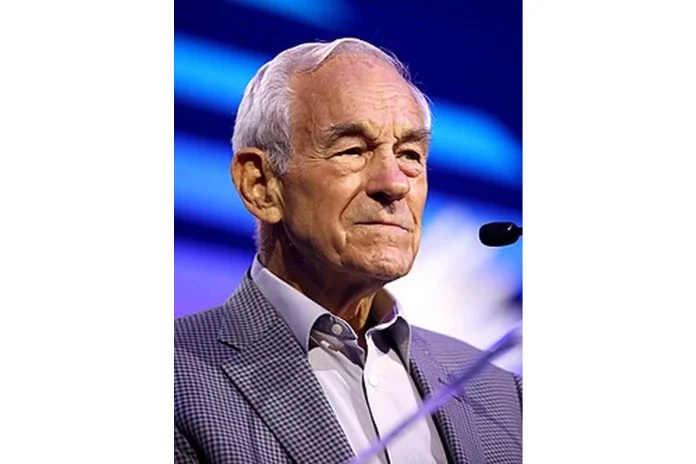
Ron Paul Bio
Ronald Ernest Paul (born August 20, 1935) is an American author, activist, physician, and retired politician who served multiple terms as the U.S. Representative from Texas. He first represented the 22nd congressional district from 1976 to 1977 and again from 1979 to 1985, before returning to Congress in 1997 to serve the 14th congressional district until 2013. A self-described constitutionalist and prominent voice of libertarianism within and outside the Republican Party, Paul sought the U.S. presidency as the Libertarian Party nominee in 1988 and as a Republican candidate in 2008 and 2012.
Paul is widely known for his advocacy of limited government, noninterventionist foreign policy, the abolition of the Federal Reserve, and free-market economics. A former obstetrician-gynecologist and U.S. Air Force flight surgeon, he founded the Foundation for Rational Economics and Education and remains active as an author and political commentator.
Early Life and Background
Ronald Ernest Paul was born on August 20, 1935, in Pittsburgh, Pennsylvania, to Howard Caspar Paul and Margaret Paul, née Dumont. He was raised in a household that shaped his lifelong interest in economics and individual liberty, values that would later define his political career. Paul attended Dormont High School in Pennsylvania before continuing his education at Gettysburg College, where he earned a Bachelor of Science degree.
He went on to attend Duke University School of Medicine, earning his medical degree and eventually specializing in obstetrics and gynecology. Paul was raised as a Lutheran and later became a Baptist. His medical training, combined with his growing interest in free-market economics and the Austrian School, gave him a unique perspective that he would carry into public life.
Paul served as a flight surgeon in the U.S. Air Force from 1963 to 1968, an experience that informed his later noninterventionist foreign policy views. After completing his military service, he returned to Texas and began a successful medical practice as an obstetrician-gynecologist, working in Brazoria County where he became a trusted local physician.
Path to U.S. Politics
Paul’s entry into politics was driven by his strong convictions about constitutional government and free-market economics. In 1974, he challenged incumbent Robert R. Casey for Texas’s 22nd congressional district but was defeated. The political landscape changed quickly when President Gerald Ford appointed Casey to the Federal Maritime Commission, opening the door for Paul to win an April 1976 special election to the vacant seat.
After losing his next regular election to Democrat Robert Gammage by fewer than 300 votes, Paul defeated Gammage in a 1978 rematch and was reelected in 1980 and 1982. During his early years in Congress, he served on the House Banking Committee, where he blamed the Federal Reserve for inflation and spoke against the banking mismanagement that contributed to the savings and loan crisis.
Frustrated with the political establishment and the rising power of special interests, Paul decided in 1984 to retire from the House in order to run for the U.S. Senate. He lost the Republican primary to Phil Gramm, who had recently switched parties from Democrat to Republican. On Paul’s departure, his House seat was assumed by former state representative Tom DeLay, who would later become House majority leader.
Ron Paul Career
Early Career (1976–1985)
Paul’s first tenure in Congress began with a special election victory in 1976 and continued through three full terms. During this period, he quickly established himself as a vocal critic of federal monetary policy and a champion of the gold standard, working with Senator Jesse Helms to convince Congress to study the issue. He also spoke against the reinstatement of registration for the military draft in 1980, opposing both President Jimmy Carter and the majority of his fellow Republican members of Congress.
In 1976, Paul founded the Foundation for Rational Economics and Education (FREE), a non-profit think tank dedicated to promoting principles of limited government and free-market economics. In 1984, he became the first chairman of the Citizens for a Sound Economy (CSE), a conservative political group founded by Charles and David Koch to advocate for less government, lower taxes, and less regulation. The organization later became a key player in the Tea Party movement of 2009.
1988 Libertarian Presidential Bid (1987–1988)
Following his Senate primary loss, Paul left the Republican Party in 1987 and launched a presidential bid on the Libertarian Party ticket. His candidacy drew attention because of the party’s platform support for freedom of choice on abortion, which Paul personally opposed. Native American activist Russell Means challenged Paul for the nomination, emphasizing his support for abortion rights.
Despite raising more funds than Means, Paul was frequently outpaced in media coverage. He was on the ballot in 46 states and received 432,179 votes, about 0.5 percent of the popular vote, finishing third nationally. Paul said his campaign was about more than winning office; he wanted to promote libertarian ideas to school and university groups, hoping to influence future voters and their parents.
Republican Comeback (1996–2012)
After years away from electoral politics, Paul returned to Congress in 1997, winning Texas’s 14th congressional district as a Republican. His comeback was aided by baseball pitcher and constituent Nolan Ryan, publisher Steve Forbes, and commentator Pat Buchanan. In his new tenure, he became known for rarely missing a vote and for casting two-thirds of all lone negative votes in the House during a 1995–1997 period.
Paul sponsored over 620 bills during his combined congressional career, but only one was signed into law, giving him a success rate of less than 0.3 percent. That sole measure allowed for a federal customhouse to be sold to a local historic preservation society in 2009. He also used amendments to restrict funding for national identification numbers, federal teacher certification, International Criminal Court jurisdiction over U.S. military personnel, and surveillance of peaceful First Amendment activities.
In 2008, Paul sought the Republican presidential nomination and finished second in delegate count behind John McCain. He repeated the feat in 2012, finishing second behind Mitt Romney and winning four state primaries. During both campaigns, he refused to endorse the Republican nominees. In July 2011, Paul announced he would not seek reelection to the House in order to focus on his 2012 presidential bid, ending his congressional career on January 3, 2013.
Post-Congressional Career (2013–Present)
After leaving Congress, Paul founded the Ron Paul Institute for Peace and Prosperity in April 2013, a foreign policy think tank that promotes non-interventionist views. He also began offering the Ron Paul Curriculum, an online homeschool program developed from a free-market and Christian perspective. In 2013, he established the Ron Paul Channel, an internet broadcast with the slogan “Turn Off Your TV. Turn On the Truth,” though he later ended that venture.
In 2015, Paul began co-hosting The Ron Paul Liberty Report, a web show on YouTube that continues to feature his political commentary. He has been a senior fellow and distinguished counselor of the Mises Institute and has authored several books on Austrian School economics, including End the Fed in 2009. In 2016, Paul became the oldest person ever to receive an electoral vote when a Texas faithless elector cast a ballot for him in the presidential election.
Notable Events and Milestones
When his son Rand Paul was elected as a U.S. Senator from Kentucky in 2011, Ronald Ernest Paul became the first U.S. representative in history to serve concurrently with a child in the Senate. He is widely regarded as the “intellectual godfather” of the Tea Party movement, a fiscally conservative political movement that emerged in 2007 and grew dramatically in 2009. Paul is also notable for being the only member of Congress to vote against H.Res.199 in 2005, which commemorated the Srebrenica massacre, and for his vocal opposition to the PATRIOT Act and mass surveillance programs.
Ron Paul Career Wins
Ronald Ernest Paul won a total of 12 congressional elections across his three tenures in the U.S. House of Representatives, including a 1976 special election and subsequent victories in 1978, 1980, 1982, 1996, 1998, 2000, 2002, 2004, 2006, 2008, and 2010. His 2008 Republican primary victory over Chris Peden came with more than 70 percent of the vote, and in 2010, he defeated three opponents with 80 percent of the vote.
Congressional Highlights
Paul’s first major congressional win came in the April 1976 special election for Texas’s 22nd district, which he won after a runoff. He then lost his next regular election to Democrat Robert Gammage by fewer than 300 votes, only to defeat Gammage in a 1978 rematch. His most recent congressional victory came in 2010, after which he chose not to seek reelection in 2012 to focus on his presidential campaign.
Other Wins and Achievements
Beyond his electoral successes, Paul secured a landmark legislative achievement in 2009 when his bill allowing a federal customhouse to be sold to a local historic preservation society was signed into law. He also successfully amended multiple bills to prohibit federal funding for national identification numbers, federal teacher certification, and International Criminal Court jurisdiction over U.S. military personnel. In 1984, he became the first chairman of the Citizens for a Sound Economy, a group that would later evolve into influential conservative organizations.
Ron Paul Family
Family Background and Political Lineage
Ronald Ernest Paul was born to Howard Caspar Paul and Margaret Paul, née Dumont. He grew up in a household that encouraged his later interests in economics and individual liberty. His most notable political descendant is his son Rand Paul, who serves as a United States Senator from Kentucky. Rand’s election in 2011 made Ron the first U.S. representative to serve concurrently with a child in the Senate.
Personal Life
Paul has been married to Carol (Carolyn) Wells since 1957. The couple met in 1952 when Wells asked Paul to escort her to her 16th birthday party, and they have since built a family of five children: Ronald, Lori, Randal, Robert, and Joy. The children were baptized Episcopalian, and Paul himself was raised Lutheran before becoming a Baptist. Since 1995, Carol Paul has published the Ron Paul Family Cookbook, with proceeds partly supporting Ron’s political campaigns. Paul and his wife reside in Lake Jackson, Texas.