
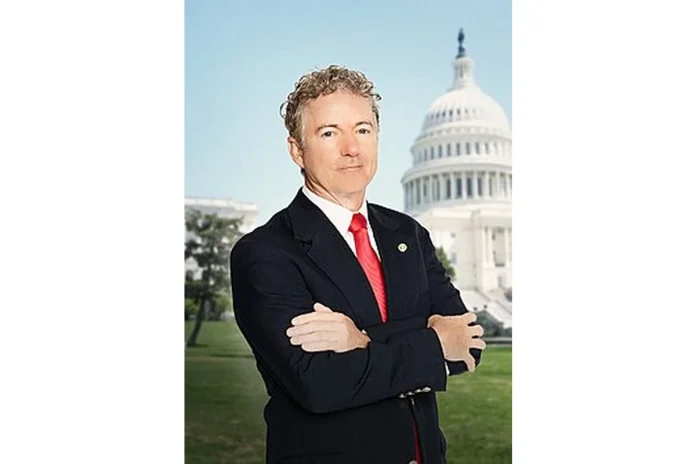
Rand Paul Bio
Randal Howard Paul (born January 7, 1963) is an American politician and physician serving as the junior United States senator from Kentucky since 2011. A member of the Republican Party, he currently serves as chair of the Senate Homeland Security Committee. Trained as an ophthalmologist, Paul earned his medical degree from the Duke University School of Medicine and practiced medicine in Bowling Green, Kentucky before entering public office.
The son of former U.S. congressman and three-time presidential candidate Ron Paul, Rand Paul is associated with constitutional conservatism and the libertarian wing of the Republican Party. He has been closely identified with the Tea Party movement since its rise and mounted his own campaign for the 2016 Republican presidential nomination. During his Senate tenure, he has focused on limited government, civil liberties, criminal justice reform, and fiscal restraint.
Early Life and Background
Randal Howard Paul was born on January 7, 1963, in Pittsburgh, Pennsylvania, to Carol (née Wells) and Ron Paul, a physician who was also a politician. He is the middle child of five siblings, with brothers Ronald Paul Jr. and Robert Paul and sisters Lori Paul Pyeatt and Joy Paul LeBlanc. The Paul family relocated to Lake Jackson, Texas, in 1968, where Rand was raised while his father began a medical practice in Brazoria County.
Paul was baptized in the Episcopal Church and identified as a practicing Christian throughout his teenage years. Growing up, he went by the nickname “Randy” until his wife later shortened it to “Rand.” When he was 13, his father was elected to the United States House of Representatives, and the young Paul attended the 1976 Republican National Convention alongside his father. In his teenage years, Paul studied Austrian economics and the writings of philosopher Ayn Rand.
Paul attended Brazoswood High School, where he swam competitively and played defensive back on the football team. He later enrolled at Baylor University in 1981 as part of the honors program, completing his pre-medical coursework in two and a half years while joining the swim team, the Young Conservatives of Texas, and the NoZe Brotherhood. He contributed regularly to The Baylor Lariat student newspaper before leaving Baylor without a baccalaureate degree to attend the Duke University School of Medicine, where he earned his Doctor of Medicine in 1988 and completed his ophthalmology residency in 1993.
Path to US Politics
After completing his medical training, Paul moved to Bowling Green, Kentucky, where he worked at Downing McPeak Vision Centers for five years before joining the Graves Gilbert Clinic in 1998. In 2008, he opened his own private ophthalmology practice across the street from his former employer. He specialized in cataract and glaucoma surgeries, LASIK procedures, and corneal transplants, and in 2009 he founded the Southern Kentucky Lions Eye Clinic to provide free eye surgery and exams to those who could not afford care.
Paul’s political activity intensified in early 2009 when supporters of his father encouraged him to consider a Senate bid to replace retiring Republican Jim Bunning. That April, he delivered his first political speech at a Tea Party rally in Bowling Green that drew more than 700 attendees. When Bunning announced he would not seek a third term, Paul launched his Senate campaign, mounting an energetic primary effort that raised roughly $3 million and featured record-setting online fundraising drives.
Rand Paul Career
Early Career (2010-2011)
Paul won the Republican primary in May 2010 with 59 percent of the vote, defeating Kentucky Secretary of State Trey Grayson after a campaign that emphasized Paul’s outsider status. During the general election, he faced Democratic Kentucky Attorney General Jack Conway in a race that drew roughly $8.5 million in outside spending. Paul prevailed with 56 percent of the vote, propelled by Tea Party enthusiasm and his pledge not to accept money from lobbyists.
His campaign was not without controversy. Paul drew criticism for comments about the Civil Rights Act of 1964 before walking them back and affirming his support for the legislation. He also faced criticism for characterizing Obama administration statements about the Deepwater Horizon oil spill as “un-American.” He took office in January 2011 as the junior senator from Kentucky.
Senate Breakthrough (2011-2015)
Upon arriving in the Senate, Paul quickly established himself as one of the chamber’s most vocal fiscal conservatives, introducing budget proposals that sought to slash federal spending. In 2013, he delivered the Tea Party response to President Barack Obama’s State of the Union address, an appearance that positioned him as a leading voice in the movement and prompted speculation about a potential presidential run. That year he also won the Conservative Political Action Conference straw poll, a result he repeated in 2014 and 2015.
Paul drew bipartisan attention in 2013 when he staged a nearly 13-hour filibuster to demand answers from the Obama administration on the use of drone strikes against American citizens on U.S. soil. He also traveled to Guatemala in 2015 to perform pro bono eye surgeries, reinforcing his dual identity as physician and lawmaker. By the end of 2015, he had positioned himself as a leading candidate for the 2016 Republican presidential nomination.
2016 Presidential Campaign and Senate Re-election (2015-2017)
Paul officially announced his candidacy for the 2016 Republican presidential nomination on April 7, 2015, raising $1 million within a day of his announcement. He built a campaign organization focused on libertarian-leaning Republican voters and participated in numerous primary debates. His candidacy, however, struggled to gain traction in early primary states, and he suspended his campaign in February 2016 after a series of disappointing finishes.
Later in 2016, Paul won re-election to a second Senate term. Following his re-election, he continued to push for criminal justice reform, civil liberties protections, and an audit of the Federal Reserve. In November 2017, he was assaulted by a neighbor, Rene Boucher, while mowing his lawn, sustaining five broken ribs that ultimately required partial removal of one of his lungs two years later. Boucher eventually pleaded guilty in federal court to assaulting a member of Congress.
Third Senate Term (2022-Present)
Paul won a third Senate term in 2022, having previously signed a pledge in support of a constitutional amendment limiting senators to two terms but reversing course on applying that limit to himself. In 2025, he became chair of the Senate Homeland Security Committee, a position that expanded his influence over border security and government accountability policy.
Throughout his third term, Paul has continued his advocacy for fiscal restraint, publishing an annual Festivus report highlighting wasteful federal spending. He has also worked with Senator Cory Booker on bipartisan legislation, including the FDA Modernization Act 2.0, signed into law in 2022, which reduced animal testing requirements for new pharmaceuticals. In 2023, he published Deception: The Great Covid Cover-Up, a book examining his views on the federal pandemic response.
Notable Events and Milestones
Among Paul’s most notable Senate moments was his nearly 13-hour filibuster in 2013 demanding clarity on domestic drone policy, which elevated his national profile. His 2016 presidential campaign, while ultimately unsuccessful, established him as a persistent voice for libertarian-leaning policy within the Republican Party. The 2017 assault and the lingering injuries he suffered stand as a defining personal challenge during his Senate career.
Rand Paul Career Wins
Rand Paul has built a political career defined by three consecutive Senate victories in Kentucky, a brief but notable presidential campaign, and a string of Conservative Political Action Conference straw poll wins. He has also distinguished himself as a prolific author and a leading voice for limited government within the Republican Party.
Senate Election Highlights
Paul first won his U.S. Senate seat in 2010 by defeating Kentucky Attorney General Jack Conway with 56 percent of the vote. He followed that victory with a re-election win in 2016 and secured a third term in 2022, demonstrating sustained appeal among Kentucky voters across more than a decade of Senate service. Each of his Senate campaigns featured heavy reliance on grassroots online fundraising.
Other Wins and Achievements
Paul won the Conservative Political Action Conference presidential straw poll three consecutive years, from 2013 to 2015, an unusual streak that reflected his strength among libertarian-leaning Republicans. He also received the Melvin Jones Fellow Award from the Lions Club International Foundation for founding the Southern Kentucky Lions Eye Clinic, and in 2014 was honored with a Distinguished Service Award from the Center for the National Interest. He was named to the Time 100 list in 2013 and 2014.
Rand Paul Family
Family Background and Political Lineage
Rand Paul is the son of Ron Paul, a former U.S. congressman from Texas and three-time presidential candidate known for his libertarian views, and Carol Paul (née Wells). He is the middle child of five siblings. Growing up in a household shaped by both medicine and politics, Paul absorbed his father’s dedication to Austrian economics and limited government from an early age, an inheritance that has informed his own political identity.
Personal Life
Paul is married to Kelley Paul (née Ashby), a freelance writer, whom he wed on October 20, 1990. The couple has three sons: William, born in 1992, Duncan, and Robert. William and Duncan attended the University of Kentucky, while Robert attended a private school in the Washington, D.C. area. The family resides in Bowling Green, Kentucky, and has attended a United Methodist church in recent years.