
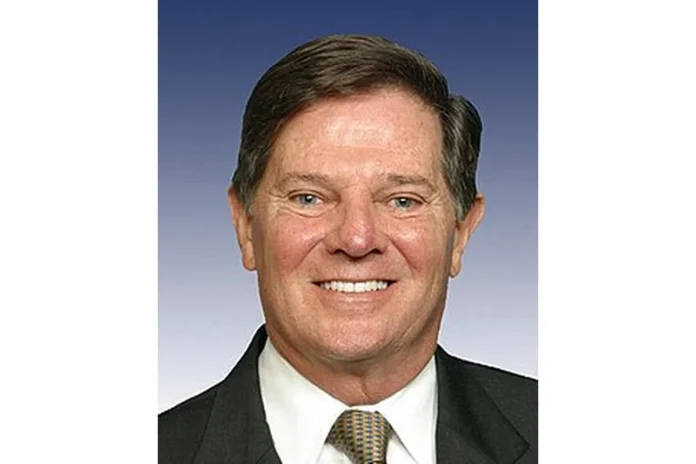
Tom DeLay Bio
Thomas Dale DeLay, widely known by his nickname “The Hammer,” is an American author and retired Republican politician who represented Texas’s 22nd congressional district in the United States House of Representatives from 1985 to 2006. Born on April 8, 1947, in Laredo, Texas, DeLay rose to become one of the most powerful figures in the modern U.S. House, serving as majority whip from 1995 to 2002 and as House majority leader from 2003 to 2005. After leaving Congress amid legal controversies, he became an author, lobbyist, and conservative commentator.
Tom DeLay Early Life and Background
Thomas Dale DeLay was born on April 8, 1947, in Laredo, Texas, to Charles Ray DeLay and Maxine Evelyn (née Wimbish) DeLay. He spent his formative years in Texas and graduated from Calallen High School. DeLay went on to attend Baylor University before transferring to the University of Houston, where he earned a Bachelor of Science degree in 1970.
After college, DeLay entered the private sector, working for three years at the pesticide manufacturer Redwood Chemical. He then purchased Albo Pest Control, which he grew into a successful regional extermination business over the next decade. This professional background in pest control earned him the lasting nickname “The Exterminator.” The United States Environmental Protection Agency’s ban on Mirex, a pesticide he had relied on, pushed him toward skepticism of government regulation, a view that would shape his political philosophy.
Path to US Politics
DeLay’s entry into politics came in 1978, when he won an open seat in the Texas House of Representatives. He was the first Republican ever to represent Fort Bend County in the state House, and he was sworn in on January 9, 1979, representing the 21st district. During his six years in the Texas Legislature, he struggled with alcoholism and earned a reputation as a playboy, gaining the nickname “Hot Tub Tom.” In 1985, after his election to Congress, DeLay became a born-again Christian and gave up hard liquor.
In 1984, DeLay set his sights on the U.S. House of Representatives, running for Texas’s 22nd congressional district after fellow Republican Ron Paul opted to pursue a Senate seat. DeLay won a crowded six-way primary with 53 percent of the vote and cruised to victory in the general election. He was one of six freshmen Republican congressmen from Texas that year, a group the media dubbed the “Texas Six Pack.”
Tom DeLay Career
Early Career (1979–1994)
DeLay served in the Texas House of Representatives from 1979 to 1985, building a reputation as a partisan fighter and a fierce advocate for limited government. His success at the state level earned him the nickname “The Hammer” for his hard-edged style. After his election to the U.S. House in 1984, he was sworn into Congress in January 1985 and immediately began rising through the Republican ranks.
In 1988, DeLay was appointed deputy minority whip, and in 1994, he played a central role in helping Newt Gingrich orchestrate the Republican Revolution that swept Democrats from power in both chambers of Congress. That wave put Republicans in control of the U.S. House of Representatives for the first time in forty years and positioned DeLay as a key architect of the party’s resurgence.
House Majority Whip Era (1995–2002)
Following the 1994 Republican victory, DeLay was elected House majority whip in 1995, even though House Speaker-elect Newt Gingrich had preferred another candidate. As whip, DeLay earned the enduring nickname “The Hammer” for his relentless enforcement of party discipline and his willingness to retaliate against members who crossed the leadership. During the 104th Congress (1995–1997), he successfully whipped 300 out of 303 bills, an extraordinary record of control.
DeLay also worked to ensure the success of the 1998 House vote to impeach President Bill Clinton, rejecting calls for a simple censure and pushing instead for full impeachment. Later that year, he helped force Speaker Gingrich out and played a decisive role in elevating Dennis Hastert to the speakership, a compromise choice DeLay proposed because he believed he himself was “too nuclear” to lead the closely divided House.
House Majority Leader Era (2003–2005)
After eight years as majority whip, DeLay was elected House majority leader in 2002 following the retirement of Dick Armey. His tenure was marked by extraordinary party discipline, aggressive redistricting efforts, and the continued evolution of the K Street Project, an initiative he co-launched with Senator Rick Santorum and conservative activist Grover Norquist to expand Republican influence in Washington, D.C.’s lobbying industry. DeLay also became one of the party’s most effective fundraisers, with his political action committee ARMPAC contributing more than $980,000 to Republican candidates during the 2004 cycle alone.
On September 28, 2005, a Travis County grand jury indicted DeLay on a charge of criminal conspiracy, and a second indictment on October 3 added money laundering charges. He became the first congressional leader in U.S. history to be indicted. DeLay temporarily stepped down as majority leader but announced in January 2006 that he would not seek to return to the post. On June 9, 2006, he resigned from Congress entirely.
Campaign Finance Case and Aftermath (2005–2013)
DeLay was charged in 2005 with money laundering and conspiracy related to campaign finance activities during the 2002 Texas elections. He turned himself in to the Harris County Sheriff’s Office in Houston on October 20, 2005. His trial began on October 26, 2010, in Austin, and on November 24, 2010, a Travis County jury found him guilty on both counts. He was sentenced to three years in prison on the conspiracy charge and ten years’ probation on the money laundering charge.
DeLay appealed his conviction to the Texas Court of Appeals for the Third District at Austin. On September 19, 2013, the court overturned the convictions and entered an acquittal, ruling that the evidence was legally insufficient to support the jury’s verdict. The acquittal was later upheld on further appeal, effectively ending the legal saga.
Notable Events and Milestones
Beyond his leadership roles, DeLay is remembered for several signature moments, including the 2004 House Ethics Committee admonishment related to a 2002 energy bill, his central role in the 2005 Terri Schiavo federal intervention, and his appearance on the ninth season of Dancing with the Stars in 2009, where his professional partner was two-time champion Cheryl Burke. He also became a central figure in the Jack Abramoff lobbying investigation, though the federal government ended its inquiry into his ties to Abramoff in August 2010 without bringing charges against him.
Tom DeLay Family
Family Background and Personal Life
Thomas Dale DeLay married Christine Furrh in 1967, having known her since his high school years. The couple had one daughter, Danielle DeLay, born in 1972, who later became a public school math teacher. Christine DeLay died on April 27, 2024, leaving Tom DeLay a widower. The couple was active in foster care advocacy, founding Rio Bend, a Christ-centered community in Richmond, Texas, that opened in 2005 to provide safe, permanent homes for abused and neglected children.
Faith and Personal Transformation
During his years in the Texas Legislature, DeLay struggled with alcoholism, reportedly drinking up to a dozen martinis a night at receptions and fundraisers. Following his 1984 election to Congress, he became a born-again Christian in 1985 and credits the evangelical minister Ken Wilde, founder of the National Prayer Center in Washington, D.C., with helping him overcome his addiction. DeLay has frequently described his faith as the driving force behind both his political career and his post-Congress work rebuilding the conservative base of the Republican Party.