
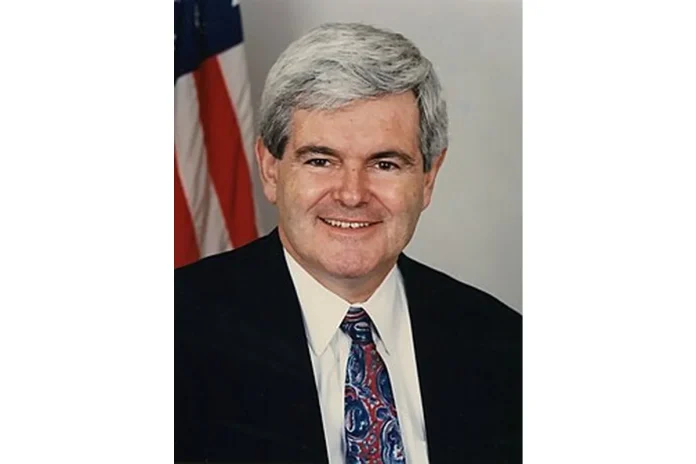
Newt Gingrich Bio
Newton Leroy Gingrich (born June 17, 1943) is an American politician, historian, and author who served as the 50th Speaker of the United States House of Representatives from 1995 to 1999. A Republican from Georgia, he represented the state’s 6th congressional district from 1979 to 1999 and was a principal architect of the 1994 “Contract with America” that helped Republicans win control of the House of Representatives for the first time in four decades. Time magazine named him Man of the Year in 1995 for his role in that political shift. After leaving Congress, Gingrich founded policy organizations, wrote books, worked as a consultant, and later became a vocal supporter and advisor to President Donald Trump.
Early Life and Background
Newton Leroy Gingrich was born as Newton Leroy McPherson at Harrisburg Hospital in Harrisburg, Pennsylvania, on June 17, 1943. His mother, Kathleen “Kit” Daugherty, and biological father, Newton Searles McPherson, married in September 1942, but the marriage fell apart within days. His biological father struggled with stability, and in 1946 his mother married Robert Gingrich, a career Army officer, who adopted him and gave him the Gingrich surname. From his mother, Gingrich has three younger half-siblings, and he also has a half-sister and half-brother from his biological father’s side.
The family moved frequently because of Robert Gingrich’s military service, including assignments in Orléans, France, and Stuttgart, Germany. Gingrich was raised in Hummelstown, Pennsylvania, near Harrisburg, and on various military bases. The family’s religion was Lutheran, and Gingrich has English, German, Scottish, and Irish ancestry. During his teenage years in France, he visited the site of the Battle of Verdun, an experience that shaped his early interest in political leadership and sacrifice.
In 1960, the family moved to Georgia at Fort Benning, and Gingrich graduated from Baker High School in Columbus, Georgia, in 1961. He earned a Bachelor of Arts degree in history from Emory University in 1965 and continued at Tulane University, where he completed a Master of Arts degree in 1968 and a PhD in European history in 1971. While at Tulane, he spent time in Brussels working on his dissertation about Belgian education policy in the Congo.
Path to US Politics
After completing his doctorate, Gingrich joined the history faculty at West Georgia College in 1970, where he also coordinated an environmental studies program and was later moved to the geography department. He became increasingly active in Republican politics, taking unpaid leave to run for the U.S. House of Representatives twice and losing both times before eventually leaving the college in 1977 after being denied tenure. These early campaigns gave him grassroots experience in Georgia politics and helped him build a network of supporters.
In November 1978, Gingrich won election to the U.S. House of Representatives, becoming the first Republican ever elected from Georgia’s 6th congressional district, which covered north Atlanta and nearby areas. His victory reflected a gradual shift in the South toward the Republican Party. He was reelected multiple times and rose through the House leadership ranks, serving as House minority whip from 1989 to 1995.
Newt Gingrich Career
Early Career (1979–1988)
Entering Congress as a freshman in 1979, Gingrich quickly established himself as a combative and media-savvy lawmaker who frequently challenged the Democratic majority. He built relationships with conservative policy organizations and used television appearances to promote his ideas about tax cuts, welfare reform, and a stronger national defense. During the 1980s, he worked closely with the Reagan administration on domestic and foreign policy priorities.
As his influence grew, Gingrich positioned himself as the leading voice for a more confrontational approach to the Democratic leadership in the House. His televised speeches and willingness to take on established party leaders earned him both loyal supporters and harsh critics. By the end of the 1980s, he had risen to the position of House minority whip, the second-highest ranking position among House Republicans.
Contract with America and Speakership (1994–1999)
In 1994, Gingrich co-authored the “Contract with America,” a list of ten policy proposals that Republican candidates pledged to bring to a vote if the party won the majority. The November 1994 elections delivered a historic Republican victory, ending forty years of Democratic control of the House. Republicans gained 54 seats, and in January 1995 Gingrich was elected Speaker of the House. Time magazine named him Man of the Year for his role in that political transformation.
As Speaker, Gingrich pushed major legislation including the Congressional Accountability Act of 1995, the Personal Responsibility and Work Opportunity Act of 1996, and the Taxpayer Relief Act of 1997, which included the largest capital gains tax cut in U.S. history at that time. He also led negotiations during two government shutdowns in 1995 and 1996, totaling 28 days, in a budget standoff with President Bill Clinton. In 1998, the House impeached President Clinton on a party-line vote, a move that was widely associated with Gingrich’s leadership.
Following a disappointing midterm showing for Republicans in 1998 and an ethics reprimand against him in the House, Gingrich announced that he would not seek another term as Speaker. He resigned from the House on January 3, 1999, the same day his speakership ended. The New York Times later described him as “an expert in how to seize power, but a novice in holding it.”
Think Tanks and 2012 Presidential Run (2000–2012)
After leaving Congress, Gingrich built a network of policy and consulting organizations, including the Center for Health Transformation, founded in 2003, and American Solutions for Winning the Future, a 527 political group established in 2007. He co-founded Advocates for Opioid Recovery with former congressman Patrick J. Kennedy and former Obama adviser Van Jones. He also served on several national security commissions, including the Hart–Rudman Commission, and taught at the United States Air Force’s Air University for more than two decades.
In January 2012, Gingrich entered the race for the Republican presidential nomination, drawing on his conservative policy ideas and debate experience. He won the South Carolina Republican primary in a decisive upset but struggled to raise enough money or win enough subsequent primaries to remain competitive. He withdrew from the race in May 2012 and endorsed eventual nominee Mitt Romney. Between 2001 and 2010, Gingrich and his wife Callista received almost $100 million in revenues from their companies, much of it from health-sector clients.
Trump Era and Beyond (2016–Present)
Gingrich became one of the earliest and most prominent establishment Republicans to support Donald Trump’s 2016 presidential campaign, encouraging party unity after Trump secured the nomination. He was reportedly among Trump’s final three choices for vice president before Mike Pence was selected. After Trump’s victory, Gingrich did not join the cabinet but continued as a frequent commentator and advisor. His wife, Callista Gingrich, served as U.S. Ambassador to the Holy See beginning in 2017.
During the 2020 presidential election, Gingrich supported President Trump’s claims of fraud and refused to acknowledge Joe Biden’s victory. In January 2021, Trump appointed Gingrich to the Defense Policy Board Advisory Committee, though Biden’s Defense Secretary Lloyd Austin removed those appointees in February 2021. As of 2022, Gingrich was advising House Republicans and remained active in conservative media and policy circles.
Notable Events and Milestones
Among the most defining moments of Gingrich’s career was the 1994 Republican Revolution, the 1995 and 1996 government shutdowns, the 1997 Taxpayer Relief Act, and the 1998 impeachment of President Clinton. His receipt of Time’s Man of the Year honor in 1995 recognized his role in reshaping U.S. politics in the 1990s. His 2012 South Carolina primary victory also remains a memorable moment from his presidential bid.
Newt Gingrich Career Wins
Over a political career spanning more than four decades, Newt Gingrich built a long record of electoral victories beginning with his 1978 upset win in Georgia’s 6th congressional district and continuing through his rise to Speaker of the House in 1995.
Congressional Wins
Gingrich won ten consecutive elections to the U.S. House of Representatives from Georgia’s 6th congressional district, beginning with his historic 1978 victory and continuing through his reelection in 1998. His first win was particularly significant because he became the first Republican ever elected from that district, breaking a long Democratic streak in the South. His most recent House win came in 1998, even as Republicans nationally lost ground during that midterm election.
Other Wins and Achievements
Beyond his congressional victories, Gingrich won the South Carolina Republican presidential primary in January 2012, a decisive win that briefly revived his campaign. He also secured Time magazine’s Man of the Year recognition in 1995 for his role in the Republican Revolution. He has co-authored multiple New York Times bestsellers and continues to be recognized as one of the most influential Republican figures of the late twentieth century.
Newt Gingrich Family
Family Background and Political Lineage
Gingrich’s family life was shaped by military service and frequent moves during his childhood. His adoptive father, Robert Gingrich, was a career Army officer who served in Korea and Vietnam, while his biological father, Newton Searles McPherson, struggled with personal instability. From his mother, Gingrich has three younger half-siblings, and he also has a half-sister and half-brother from his biological father’s side of the family. These early experiences gave him a broad understanding of American life beyond his Pennsylvania birthplace.
Personal Life
Gingrich has been married three times. His first marriage to Jacqueline May “Jackie” Battley lasted from 1962 to 1981. He then married Marianne Ginther in 1981, and that marriage ended in divorce in 2000. In 2000, he married Callista Bisek, who later served as U.S. Ambassador to the Holy See. Gingrich has two daughters, Kathy and Jackie Sue, from his first marriage. He converted to Catholicism, his third wife’s faith, on March 29, 2009, after years of gradual spiritual development. Gingrich and his wife currently reside in McLean, Virginia.