
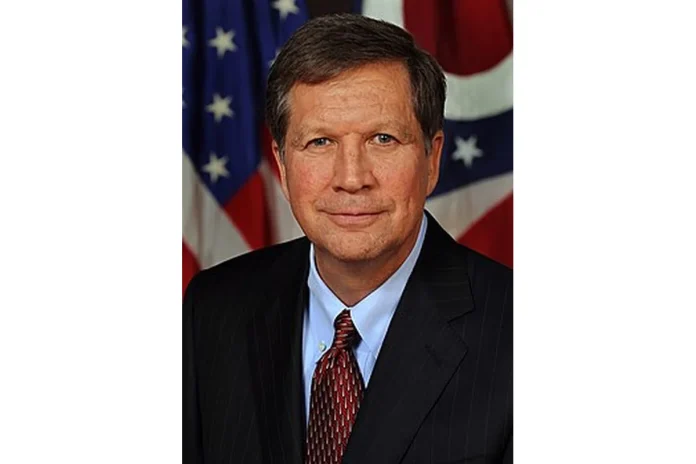
John Kasich Bio
John Richard Kasich Jr. (born May 13, 1952) is an American politician and author who served as the 69th governor of Ohio from 2011 to 2019. A member of the Republican Party, he represented Ohio’s 12th congressional district in the United States House of Representatives from 1983 to 2001 and chaired the House Budget Committee, playing a central role in the Balanced Budget Act of 1997 and welfare reform legislation of the 1990s. Kasich sought the Republican presidential nomination in 2000 and again in 2016, winning only his home state in 2016. After leaving Congress, he worked in finance and media, and has been an analyst for NBC News since March 2023.
As governor, Kasich expanded Medicaid under the Affordable Care Act and prioritized battling the opioid crisis. He is widely regarded as one of the more moderate voices within the modern Republican Party and is known as one of President Donald Trump’s most prominent critics within his own party, even endorsing Democratic nominee Joe Biden at the 2020 Democratic National Convention.
Early Life and Background
John Richard Kasich Jr. was born on May 13, 1952, in McKees Rocks, Pennsylvania, a small working-class community near Pittsburgh. He grew up in a tight-knit family shaped by the values of that blue-collar town. His father, John Richard Kasich, and his mother, Anne Vukovich, raised him in an environment that emphasized hard work, faith, and public service. The values of his hometown would later influence his political identity and his focus on economic opportunity for working Americans.
Kasich’s parents were killed in a car crash caused by a drunk driver on August 20, 1987, a personal tragedy that later drew him closer to his faith. He was raised Catholic but, as an adult, joined the Episcopal Church and later affiliated with the Anglican Church in North America, a conservative denomination. He has said that he belongs to St. Augustine’s in Westerville, Ohio, and that he does not always find God in church.
Kasich moved to Ohio in 1970 to attend Ohio State University, where he earned a Bachelor of Arts degree. His college years exposed him to the political climate of Ohio and helped set the stage for his future career in public service.
Path to US Politics
Kasich’s entry into politics began at the state level. In 1978, at just 26 years old, he won a seat in the Ohio State Senate representing the 15th district, becoming one of the youngest members ever elected to that body. He defeated Democratic incumbent Robert O’Shaughnessy with 56 percent of the vote and quickly made a name for himself by refusing a pay raise and by drafting his own budget proposal when he disagreed with leadership’s tax approach.
His early reputation as a fiscal conservative and a persistent campaigner caught the attention of national Republican strategists. When the opportunity arose to run for federal office, Kasich transitioned to the national stage. In 1982, he won election to the United States House of Representatives from Ohio’s 12th congressional district, beginning a long career in Congress that would establish him as a leading voice on budgets, defense, and economic policy.
John Kasich Career
Early Career (1978-1982)
Kasich’s political career began with a single term in the Ohio State Senate, where he served from 1979 to 1982. During his time in the state legislature, he positioned himself as a reformer willing to challenge members of his own party, including by writing his own budget proposal rather than supporting a plan he believed would raise taxes. His energetic campaigning and willingness to take unpopular stands earned him a reputation that extended beyond Ohio.
After four years in the state senate, Kasich set his sights on Congress. In 1982, he won the seat representing Ohio’s 12th congressional district, a victory that launched what would become a long and influential tenure in the United States House of Representatives.
U.S. House of Representatives Breakthrough (1983-2000)
Kasich served nine terms in the United States House of Representatives from 1983 to 2001, representing Ohio’s 12th congressional district. Over those 18 years, he became a senior figure on the House Armed Services Committee, where he focused on national security and military reform. He eventually rose to chair the House Budget Committee, a powerful position that allowed him to shape the nation’s fiscal policy during a pivotal era.
As Budget Committee chairman, Kasich played a central role in passing the Balanced Budget Act of 1997 and was a key figure in the 1996 welfare reform legislation. These accomplishments cemented his standing as a leading voice for fiscal discipline within the Republican Party. In 2000, he chose not to seek re-election to the House and instead ran for the Republican presidential nomination, eventually withdrawing from the race before the primaries.
Post-Congress and 2010 Gubernatorial Run (2001-2010)
After leaving Congress, Kasich pursued opportunities in media and finance. He hosted Heartland with John Kasich on Fox News from 2001 to 2007, giving him a regular platform to discuss political issues. In 2001, he also joined the investment banking division of Lehman Brothers as a managing director in Columbus, Ohio, a position he held until the firm declared bankruptcy in 2008.
His time at Lehman Brothers later became a point of political criticism, given the firm’s central role in the 2008 financial crisis. On May 1, 2009, Kasich filed papers to run for governor of Ohio against Democratic incumbent Ted Strickland, formally announcing his campaign on June 1, 2009. He chose Ohio State Auditor Mary Taylor as his running mate and won the Republican nomination unopposed.
Governor of Ohio Era (2011-2019)
On November 2, 2010, Kasich defeated Strickland in a closely contested race to win the governorship. He was sworn in on January 10, 2011, in a private ceremony at the Ohio Statehouse, followed by a public inauguration at the Ohio Theatre. As governor, Kasich made several defining decisions, including accepting the Medicaid expansion under the Affordable Care Act, a move that angered some members of his own party but extended health coverage to hundreds of thousands of low-income Ohioans.
He was re-elected in November 2014 in a landslide, defeating Democrat Ed FitzGerald 64 percent to 33 percent and winning 86 of Ohio’s 88 counties. During his two terms, he pursued tax cuts, signed a controversial labor law restricting collective bargaining, pushed for charter school expansion, and secured a $2 billion increase in the state’s rainy day fund. Term-limited, he left office in January 2019 and was succeeded by fellow Republican Mike DeWine.
Notable Events and Milestones
One of Kasich’s most defining moments came during the 2016 Republican presidential primaries, when he finished fourth nationally but won his home state of Ohio and finished second in New Hampshire. He declined to support Donald Trump as the Republican nominee and did not attend the 2016 Republican National Convention, which was held in Ohio. In 2020, he went further by endorsing Democratic nominee Joe Biden at the Democratic National Convention, drawing both praise and criticism from members of both parties.
John Kasich Personal Life
Family Background and Lineage
Kasich was raised in McKees Rocks, Pennsylvania, by his father, John Richard Kasich, and his mother, Anne Vukovich. His parents remained an important part of his life until their deaths in a car crash caused by a drunk driver in 1987, a tragedy that reshaped his outlook on life and faith. The working-class values of his hometown and family shaped his political identity for decades.
Personal Life
Kasich has been married twice. His first marriage was to Mary Lee Griffith from 1975 to 1980, and they had no children. In March 1997, he married Karen Waldbillig, a former public relations executive, and the couple has twin daughters, Emma Kasich and Reese Kasich. The family has lived in Ohio for most of Kasich’s political career, including his time in Westerville.