
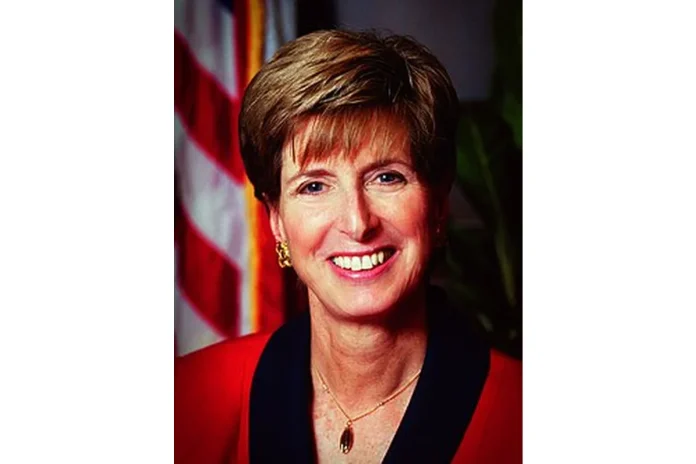
Christine Todd Whitman Bio
Christine Temple Whitman (born September 26, 1946) is an American politician and author who served as the 50th governor of New Jersey from 1994 to 2001 and as Administrator of the United States Environmental Protection Agency under President George W. Bush from 2001 to 2003. A graduate of Wheaton College and a New Jersey native from a prominent Republican family, she was the first woman to serve as governor of New Jersey. Long described as a moderate or Rockefeller Republican, Whitman went on to write on party reform and remained active in civic and policy organizations after leaving public office, joining the centrist Forward Party in 2022.
Christine Todd Whitman Early Life and Background
Early Life and Background
Christine Temple Todd was born in New York City on September 26, 1946, to Eleanor Prentice Todd and the businessman Webster B. Todd. Both the Todds and the Schleys were wealthy and prominent New Jersey political families, and the Schleys were among the first New Yorkers to settle in Far Hills, New Jersey, a popular suburb for wealthy, moderate Republicans. Her father built a fortune as a building contractor on projects including Rockefeller Center and Radio City Music Hall, donated to Republican politicians, served as an advisor to Dwight D. Eisenhower, and chaired the New Jersey Republican State Committee twice.
Her mother, Eleanor Prentice Todd, served as a Republican national committeewoman, led the New Jersey Federation of Republican Women, and served as vice chair of the Republican National Committee. A newspaper once speculated that she could be a viable candidate for governor, although she never chose to run for office. Christine Todd grew up on her family’s farm, Pontefract, in Oldwick, New Jersey, alongside three older siblings, including her brothers Webster and Danny. At the age of nine, she attended the 1956 Republican National Convention and met President Eisenhower, an early brush with national politics that shaped her sense of public service.
As a child, Todd attended Far Hills Country Day School before being sent to boarding school at Foxcroft in Virginia, where she was unhappy being far from home. After a year, she transferred to the Chapin School in Manhattan, a change that allowed her to return home on weekends and remain close to her family in New Jersey. After graduating from Wheaton College in 1968 with a Bachelor of Arts degree in government, she went to work on Nelson Rockefeller’s presidential campaign, beginning her long association with moderate Republican politics.
Christine Todd Whitman Path to US Politics
Path to US Politics
Christine Todd married John R. Whitman in 1974, a year after they met at an inaugural ball for President Richard Nixon. Her husband was a businessman and investment banker and the grandson of early 20th-century New York Governor Charles S. Whitman. She began her career working for the Office of Economic Opportunity and the Republican National Committee, and later served on the board of trustees of Somerset County College, which was later renamed Raritan Valley Community College.
Whitman was elected to two terms on the Somerset County Board of Chosen Freeholders, serving for five and a half years beginning in 1983. From 1988 to 1990, during the tenure of Governor Thomas Kean, she served as president of the New Jersey Board of Public Utilities, an appointment that raised her profile in state government. In 1990, she ran for the United States Senate against Democratic incumbent Bill Bradley, losing a close race in which she was outspent twelve to one. Her strong performance as an underdog endeared her to the party base and made her the leading public advocate of the anti-tax cause in New Jersey.
After the 1990 race, Whitman founded the Committee for an Affordable New Jersey, a political action committee through which she campaigned for Republican candidates in the 1991 midterm elections. She took on a full campaign speaking schedule through October 1992 and, in 1993, helped to found the Committee for Responsible Government, an advocacy group espousing moderate positions within the Republican Party. In 1997, the group renamed itself the Republican Leadership Council, a body that would shape her political identity for years to come.
Christine Todd Whitman Career
Early Career (1983–1993)
Whitman’s first sustained experience in elected office came on the Somerset County Board of Chosen Freeholders, where she served from 1983 to 1988. In that role, she built a reputation for fiscal discipline and bipartisan cooperation, traits that later defined her statewide campaigns. Her appointment as president of the New Jersey Board of Public Utilities under Governor Thomas Kean gave her a higher public platform and familiarity with the regulatory issues she would face as governor.
Her 1990 United States Senate run against Bill Bradley, while a loss, served as her political launching pad. Outspent twelve to one, she came within three percentage points of unseating the popular incumbent and emerged as the state’s most visible anti-tax voice. That near-victory, combined with her work founding the Committee for an Affordable New Jersey and the Committee for Responsible Government, prepared her for a successful run for governor in 1993.
Breakthrough (1993–1997)
After winning the Republican primary, Whitman ran against incumbent James Florio for governor of New Jersey in the 1993 general election. She won the election by a plurality, defeating Florio by one percentage point to become the first female governor in New Jersey history, a record that stood until Mikie Sherrill was sworn in decades later. Charges of suppression of minority votes surfaced during the campaign when her campaign manager, Ed Rollins, bragged about spending $500,000 to suppress the Black vote; Whitman denied the claim and demanded an apology and retraction, and an investigation found no wrongdoing.
Once in office, Whitman kept her campaign pledge to lower state taxes by 10 percent a year for three years. In 1995, the Republican Party selected her to deliver the party’s State of the Union response, making her the first woman to deliver a State of the Union response by herself and the first to give the address to a live audience. That same year, she faced criticism for remarks about young African American males, an apology she later voiced, and the following year she rejected a recommendation to spend tax money on a needle exchange to reduce HIV infections.
Republican Era (1997–2001)
Whitman was re-elected in 1997, narrowly defeating Democrat Jim McGreevey, the mayor of Woodbridge Township, again by a one-point margin and a plurality of the votes, with Libertarian Murray Sabrin finishing third. In her second term, she repealed the one percentage point increase to the state sales tax that her predecessor Governor Florio had imposed, reducing the rate from 7 percent to 6 percent, instituted education reforms, and removed excise taxes on professional wrestling, a change that led the World Wrestling Federation to resume events in New Jersey and earned her an honorary WWF Championship belt.
In 1999, Whitman vetoed a ban on partial-birth abortion; her veto was overridden, although the statute was later declared unconstitutional by the judiciary. She also fired Colonel Carl A. Williams, head of the New Jersey State Police, after he was quoted as making racially charged remarks about cocaine and marijuana traffickers. When Democratic Senator Frank Lautenberg announced he would not seek re-election in 2000, Whitman considered running for the United States Senate, but ultimately decided against it. She resigned from office on January 31, 2001, to become Administrator of the United States Environmental Protection Agency.
Notable Events and Milestones
Whitman’s signature moment in office came when she delivered the Republican Party’s State of the Union response in 1995, becoming the first woman to do so on her own. Her 1993 gubernatorial win made her New Jersey’s first female governor, a milestone that stood for more than three decades, and her 1997 re-election made her only the second Republican governor in modern New Jersey history to win a second term.
Christine Todd Whitman Career Wins
Electoral Highlights
Whitman’s most important electoral victory came in 1993, when she defeated Democratic incumbent Jim Florio by a single percentage point to become the first woman elected governor of New Jersey. She followed that breakthrough with a 1997 re-election win over Democrat Jim McGreevey, again by a one-point margin, in one of the closest back-to-back gubernatorial cycles in state history. Her earlier 1990 Senate run against Bill Bradley, while a loss, cemented her reputation as a competitive statewide candidate and the leading voice for tax reduction in New Jersey Republican politics.
Other Wins & Achievements
Beyond the ballot box, Whitman’s appointment by President George W. Bush to lead the United States Environmental Protection Agency in 2001 marked a notable achievement in federal public service. She was also recognized with an honorary WWF Championship belt in 1997 after the World Wrestling Federation resumed events in New Jersey, a lighthearted honor that reflected her willingness to engage with popular culture during her second term.
Christine Todd Whitman Family
Family Background and Political Lineage
Christine Todd Whitman was born into one of New Jersey’s most prominent Republican families. Her father, Webster B. Todd, was a wealthy building contractor who advised President Dwight D. Eisenhower and chaired the New Jersey Republican State Committee twice, while her mother, Eleanor Prentice Todd, served as a Republican national committeewoman and vice chair of the Republican National Committee. Her husband, John R. Whitman, whom she married in 1974, was a businessman and investment banker and the grandson of early 20th-century New York Governor Charles S. Whitman.
Personal Life
Whitman and her husband had two children, daughter Kate and son Taylor, and seven grandchildren. Kate Whitman has followed her mother into politics, including an unsuccessful run for the United States House of Representatives and a stint as executive director of the Republican Leadership Council. John R. Whitman died on July 2, 2015, at the age of 71 following a head injury. A longtime resident of Tewksbury Township, New Jersey, Whitman continues to live on her family’s historic farm property, Pontefract, in Oldwick.