
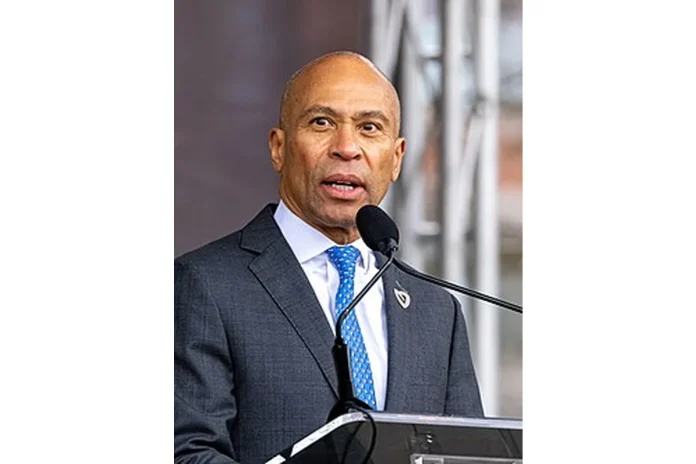
Deval Patrick Bio
Deval Laurdine Patrick, born on July 31, 1956, is an American politician, lawyer, and business executive best known for serving as the 71st governor of Massachusetts from 2007 to 2015. A member of the Democratic Party, he made history as the first African American to serve as governor of Massachusetts and only the second African American governor in modern United States history. Beyond his time in office, Patrick has built a varied career that spans civil rights law, corporate leadership, private equity, and public service.
Before his election, Patrick served as United States Assistant Attorney General for the Civil Rights Division under President Bill Clinton from 1994 to 1997. After leaving the governorship, he joined the private equity firm Bain Capital and has remained active in nonprofit leadership, academic work, and national political life. In late 2019, he briefly entered the 2020 Democratic presidential race before suspending his campaign in early 2020.
Early Life and Background
Deval Patrick was born on the South Side of Chicago, Illinois, where his family lived in a two-bedroom apartment in the Robert Taylor Homes housing projects. He is the son of Emily Mae Wintersmith Patrick and Pat Patrick, a jazz musician associated with the bandleader Sun Ra. In 1959, his father left the family to pursue music in New York City, and Deval was raised primarily by his mother, who traced her own ancestry to enslaved Americans in Kentucky.
Growing up on Chicago’s South Side, Patrick attended local schools and was recognized by a middle school teacher for his academic ability. This led to a referral to A Better Chance, a national nonprofit that placed promising minority students in strong preparatory schools. The organization helped him secure a scholarship to Milton Academy in Milton, Massachusetts, an experience that took him far from his childhood neighborhood and shaped the rest of his life.
Patrick graduated from Milton Academy in 1974 and went on to attend Harvard College, becoming the first in his family to earn a four-year college degree. He graduated cum laude in 1978 with a Bachelor of Arts in English and American literature. While at Harvard, he was a member of the Fly Club and won the Best Oralist award in the Ames Moot Court Competition, judged in part by Judge Henry Friendly of the United States Court of Appeals for the Second Circuit.
Path to US Politics
After college, Patrick earned a Juris Doctor degree from Harvard Law School in 1982, graduating cum laude. He served as a law clerk for Judge Stephen Reinhardt on the United States Court of Appeals for the Ninth Circuit before joining the NAACP Legal Defense Fund in 1983, where he worked on death penalty and voting rights cases. It was during this period that he first met Bill Clinton, who was then Governor of Arkansas, when Patrick sued him in a voting case.
In 1986, Patrick joined the Boston law firm Hill & Barlow, where he was named partner in 1990 at the age of 34. He handled high-profile matters at the firm, including serving as attorney for Desiree Washington in her civil lawsuit against boxing champion Mike Tyson. His growing reputation in civil rights and corporate law led to his selection by President Bill Clinton in 1994 to lead the Civil Rights Division of the United States Department of Justice.
Deval Patrick Career
Early Career (1994–2006)
President Bill Clinton nominated Deval Patrick as United States Assistant Attorney General for the Civil Rights Division in 1994, and the United States Senate confirmed him. In that role, Patrick defended federal affirmative action policy during a period of intense legal and political scrutiny and worked on issues including racial profiling, police misconduct, and the treatment of incarcerated individuals. Between 1995 and 1997, he coordinated a major federal investigation into a series of arsons at predominantly Black churches across the South, an effort that produced more than 100 arrests and was the largest federal investigation of its kind until the September 11, 2001 attacks.
After leaving government in 1997, Patrick returned to private practice in Boston and was appointed by a federal court to chair Texaco’s Equality and Fairness Task Force, overseeing reforms after a race discrimination settlement. In 1999, he became General Counsel of Texaco and helped guide its merger with Chevron Corporation, which was announced in October 2000. In 2001, he joined The Coca-Cola Company as Executive Vice President, General Counsel, and Secretary, where he recommended an independent inquiry into allegations of abuse at Colombian bottling plants before leaving the company in 2004. He later served on the board of ACC Capital Holdings, the parent company of subprime lender Ameriquest, before entering the 2006 Massachusetts governor’s race.
Governor of Massachusetts (2007–2015)
Deval Patrick was elected governor of Massachusetts in 2006, defeating Republican Kerry Healey with 55 percent of the vote. He took office on January 4, 2007, succeeding Mitt Romney, and was reelected in 2010, defeating Republican Charlie Baker. He served two full terms and left office on January 8, 2015, choosing not to seek a third term. As governor, he focused on education reform, transportation funding, healthcare expansion, energy policy, and economic development.
During his two terms, Patrick oversaw the implementation of the state’s 2006 healthcare reform program, increased funding for public schools and the life sciences industry, and won a major federal Race to the Top education grant. He signed legislation creating the Massachusetts Department of Transportation by merging smaller agencies, raised the state sales tax from 5 percent to 6.25 percent, and increased the minimum wage from $8 per hour to $11 per hour by 2017. He also signed a 2011 law authorizing three resort-style casinos and a single slot parlor, and joined Massachusetts to the National Popular Vote Interstate Compact in 2010 and the Regional Greenhouse Gas Initiative to reduce greenhouse gas emissions.
Patrick faced controversy during his tenure, including criticism early in his first term for spending on drapery and an upgrade of the governor’s vehicle, which he later reimbursed. He drew additional scrutiny for contacting a former Clinton cabinet secretary on behalf of Ameriquest, a subprime lender with ties to Massachusetts, and for a 2014 decision to fire the chair of the state’s Sex Offender Registry Board over the handling of his brother-in-law’s case. Despite these episodes, he remained broadly popular and was an influential national voice for the Democratic Party.
Deval Patrick Family
Family Background and Personal Life
Deval Patrick married Diane Bemus, a lawyer specializing in labor and employment law, in 1984. The couple has lived in Milton, Massachusetts, since 1989, and they also own a home in Richmond, Massachusetts. Patrick and his wife have two daughters, Sarah Patrick and Katherine Patrick, and in 2013 they became grandparents when Sarah gave birth to a son, Gianluca Noah Patrick Morgese.
In July 2008, Katherine Patrick publicly came out as a lesbian and noted that her father had not known about her orientation while he was fighting against a proposed constitutional amendment to ban same-sex marriage in Massachusetts. In a joint interview, Patrick expressed support for his daughter and said he was proud of her. In 2013, Illinois Governor Pat Quinn renamed a section of Wabash Avenue in Chicago, where Patrick grew up, as Deval Patrick Way in his honor, and on May 28, 2015, Harvard University awarded him an honorary Doctor of Laws degree.
Post-Governorship and 2020 Presidential Campaign
After leaving office in January 2015, Patrick joined the private equity firm Bain Capital as a managing director. He has since served on the boards of the Obama Foundation and the telehealth company American Well, chaired the fellowship and incubator program Our Generation Speaks, and supported Boston’s bid for the 2024 Summer Olympics. In 2024, he joined The Vistria Group as a senior advisor and was named a senior partner later the same year. In January 2022, he became co-director of the Harvard Kennedy School’s Center for Public Leadership and a professor of the practice of public leadership.
Patrick entered the 2020 Democratic presidential primary on November 14, 2019, after initially ruling out a campaign the previous December. Running as a moderate who opposed Medicare for All in favor of a public option attached to the Affordable Care Act, he struggled to gain traction and polled below 1 percent in most surveys. Following a poor showing in the New Hampshire primary, he suspended his campaign in February 2020. In May 2020, he launched TogetherFundPAC, a super PAC in support of Joe Biden’s presidential campaign, and he has continued to speak publicly on national political issues, including the future of the Biden candidacy in 2024.