
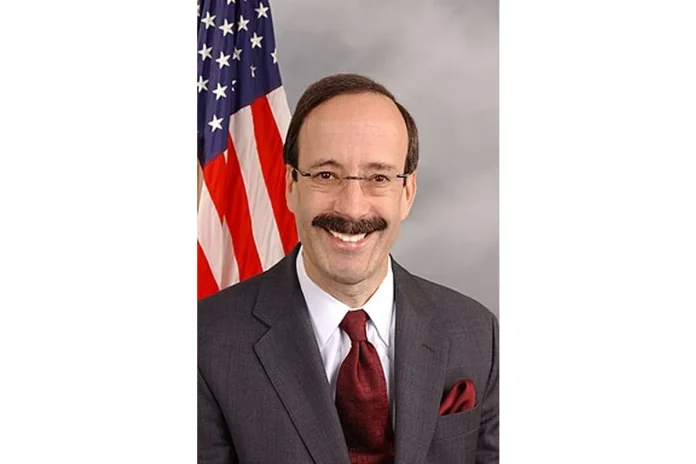
Eliot Engel Bio
Eliot Lance Engel (born February 18, 1947) is an American politician who served as a United States Representative from New York from 1989 to 2021. A member of the Democratic Party, he represented a congressional district that covered portions of the north Bronx and southern Westchester County. Over the course of his career, Engel earned a reputation as a steady voice on international affairs, healthcare, and human rights, and he rose to become chairman of the influential House Foreign Affairs Committee.
Engel was first elected to Congress in 1988, defeating ten-term incumbent Mario Biaggi in the Democratic primary, and went on to serve sixteen consecutive terms. He became ranking member of the House Foreign Affairs Committee in 2013 and was elevated to chairman in 2019. In the 2020 Democratic primary, Engel was defeated by middle school principal Jamaal Bowman, ending his long tenure in the House of Representatives.
Early Life and Background
Eliot Lance Engel was born on February 18, 1947, in the Bronx, New York City. He is the son of Philip Engel, an ironworker, and Sylvia Engel, whose maiden name was Bleend. His grandparents were immigrants from the Russian Empire and were of Ukrainian Jewish background, giving the family deep roots in the immigrant experience that shaped much of New York in the twentieth century.
Growing up in the Bronx, Engel attended local public schools before going on to higher education. In 1969, he graduated from the Bronx campus of Hunter College with a Bachelor of Arts in history. He later returned to the same institution, by then renamed Lehman College, where he earned a Master of Science in guidance and counseling in 1973. In February 1987, he completed his legal education at New York Law School, receiving a Juris Doctor degree that prepared him for both public service and the practice of law.
Path to U.S. Politics
Engel’s entry into politics came in 1977, when a special election was held for a seat in the New York State Assembly after the incumbent Democrat Alan Hochberg was forced to resign. Running as the Liberal Party nominee, Engel won the closely contested race on March 1, 1977, defeating Democratic nominee Ted Weinstein and Republican nominee Arlene Siegel by a margin of just 103 votes. The narrow victory launched a legislative career that would last more than three decades.
He served in the New York State Assembly from 1977 to 1988, representing districts in the 182nd through 187th New York State Legislatures. During his time in Albany, Engel chaired the Committee on Alcoholism and Substance Abuse, as well as the Subcommittee on the Mitchell-Lama Housing Program, gaining experience that prepared him for the national stage. His work on housing, health, and social welfare issues at the state level helped him build a record that resonated with voters in his Bronx-based district.
Eliot Engel Career
Early Career (1977–1988)
Engel spent his first decade in office as a New York State Assemblyman, steadily building a reputation as a diligent legislator focused on constituent services and progressive policy. His chairmanship of committees dealing with alcoholism, substance abuse, and housing gave him direct influence over issues affecting working-class families in the Bronx. Those years allowed him to cultivate strong ties with local Democratic leaders and community organizations.
By the late 1980s, Engel was ready to move to federal office. When longtime congressman Mario Biaggi became entangled in the Wedtech scandal and was charged by federal prosecutor Rudy Giuliani with racketeering, the political landscape in the 19th congressional district shifted dramatically. Engel entered the 1988 Democratic primary and defeated the ten-term incumbent, who had resigned his seat, with 48 percent of the vote. He then won the general election with 56 percent, beginning his long career in the United States House of Representatives.
U.S. House of Representatives Breakthrough (1989–2008)
From the moment he arrived in Congress, Engel established himself as a productive lawmaker. Early in his career, he authored a resolution declaring Jerusalem the undivided capital of Israel, a position that put him at odds with official American policy for decades. He also became deeply involved in international affairs, particularly regarding the Balkans, the Middle East, and human rights around the world.
In domestic policy, Engel focused heavily on healthcare, energy, and consumer protection. In 2005, he and Congressman Jack Kingston introduced the Fuel Choices for American Security Act, later modified and reintroduced in 2007 as the DRIVE Act, which gathered more than eighty bipartisan co-sponsors. Many of its provisions were ultimately included in the Energy Independence and Security Act, signed into law by President George W. Bush on December 19, 2007, raising fuel efficiency standards from 25 to 35 miles per gallon by 2020.
He also authored the Syria Accountability and Lebanese Sovereignty Restoration Act, signed into law on December 12, 2003, which imposed restrictions on U.S. relations with Syria over its occupation of Lebanon and ties to terrorist groups. In 2008, Engel authored the ALS Registry Act, establishing a national registry for ALS data collection, and the Paul D. Wellstone Muscular Dystrophy Act, which promoted research at Centers of Excellence for Muscular Dystrophy.
Foreign Affairs Leadership (2009–2018)
Engel’s stature in foreign policy grew steadily throughout this period. In 2009, he played a key role in negotiating the American Clean Energy and Security Act, which passed the House on June 26, 2009. That same year, he was one of fifty-three members of Congress to sign a letter urging President Barack Obama to resume enforcement of a ban on the import of foreign assault weapons.
In 2013, Engel became the ranking member of the House Foreign Affairs Committee, a position that allowed him to shape the Democratic minority’s foreign policy agenda. He became a leading congressional voice on issues ranging from the Kosovo War and its aftermath, to the Syrian civil war, to the plight of the Uyghur Muslim minority in China. He was a co-author of the Harkin-Engel Protocol, addressing child labor in cocoa fields in West Africa, and was named the first foreign dignitary to address the Kosovo parliament.
He continued his legislative work on healthcare by supporting the Affordable Care Act in 2010, after securing provisions that prevented New York from being penalized for offering more generous benefits. He also wrote the Partnering to Improve Maternity Care Quality Act and the Gestational Diabetes Act of 2010, both aimed at improving maternal health outcomes across the country.
Committee Chairmanship Era (2019–2021)
Following Democratic gains in the 2018 midterm elections, Engel was named chairman of the House Foreign Affairs Committee in 2019. In this role, he pushed the Trump administration to take a tougher line on China, leading a group of lawmakers in writing to Secretary of State Mike Pompeo in March 2019 to urge sanctions on Chinese officials responsible for human rights abuses against the Uyghur Muslim minority in Xinjiang. He also condemned the genocide of the Rohingya Muslim minority in Myanmar and called for stronger U.S. action in response.
Engel announced in August 2015 that he would oppose the Iran nuclear deal, arguing that it would not prevent Iran from acquiring a nuclear weapon. In the realm of consumer protection, the Truth in Caller ID Act of 2010, virtually identical to a bill Engel had introduced, was signed into law by President Obama on December 22, 2010. In 2012, he introduced the Social Network Online Protection Act to bar employers and schools from requesting social media passwords from job applicants and students.
Notable Events and Milestones
One of Engel’s most memorable traditions was shaking hands with the President at every televised State of the Union address, a streak he maintained from his arrival in Congress in 1989 until 2017, when he declined to shake President Donald Trump’s hand. In January 2020, he revealed that former National Security Adviser John Bolton had suggested, unprompted, that the Foreign Affairs Committee look into the recall of Ambassador Marie Yovanovitch. Engel’s career-defining moments include his 1988 primary victory over Mario Biaggi, his 2019 elevation to chairman of the House Foreign Affairs Committee, and the signing of the DRIVE Act and the Syria Accountability and Lebanese Sovereignty Restoration Act into law.
Eliot Engel Career Wins
Eliot Engel’s career was marked by a string of electoral victories, legislative achievements, and public honors that spanned more than four decades. He won election to the New York State Assembly in 1977 and then won sixteen consecutive terms in the United States House of Representatives, beginning with his 1988 victory in the 19th congressional district.
Congressional Election Highlights
Engel first won his congressional seat in 1988 with 56 percent of the general election vote, following a Democratic primary win over Mario Biaggi. In 1994, he defeated musician Willie Colon 62 percent to 38 percent. In 2000, he won a competitive primary against State Senator Larry Seabrook, 50 percent to 41 percent, despite Seabrook’s support from Bronx County Democratic Party Chairman Roberto Ramirez.
His most recent electoral contest came in 2020, when he was challenged in the Democratic primary by Jamaal Bowman. After a hot-mic gaffe in which Engel said, “If I didn’t have a primary, I wouldn’t care,” he lost momentum and was ultimately defeated. With all votes counted, Bowman led Engel 55.4 percent to 40.6 percent, a margin of 13,218 votes, and the race was called on July 17, 2020.
Other Wins and Achievements
Beyond electoral victories, Engel received numerous awards for his legislative work. In 2007, he was honored with the National Association of Public Hospitals Safety Net Award, The AIDS Institute National HIV/AIDS Care and Treatment Award, and the George Paraskevaides Award for his contributions to Cyprus and Hellenic causes. In 2008, he was named Distinguished Community Health Superhero by the National Association of Community Health Centers and recognized as a Friend of the Farm Bureau by the American Farm Bureau Federation and the New York Farm Bureau. On November 11, 2011, the Municipality of Peje, Kosovo, granted him the title of Honorary Citizen, and in July 2019, a highway section between Gjakove, Kosovo and Fierze, Albania was named Eliot Engel Drive in his honor.
Eliot Engel Family
Family Background and Political Lineage
Eliot Lance Engel was born into a working-class family in the Bronx. His father, Philip Engel, worked as an ironworker, and his mother, Sylvia Engel, whose maiden name was Bleend, raised the family in New York City. His grandparents were immigrants from the Russian Empire and were of Ukrainian Jewish background, shaping the cultural and family values that influenced Engel’s lifelong commitment to public service and the concerns of immigrant communities.
Personal Life
Eliot Engel is married to Patricia Ennis. His personal life has remained largely outside the public spotlight throughout his decades in politics. Even amid a lengthy career in the national legislature, Engel continued to be identified closely with the Bronx neighborhood where he grew up and the district he represented for sixteen terms in Congress.