
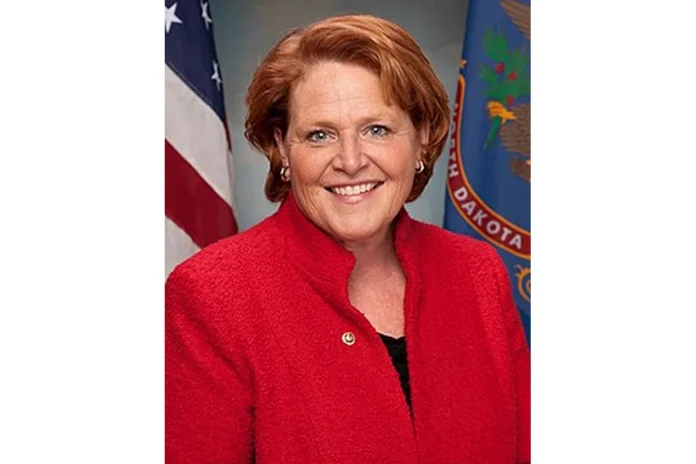
Heidi Heitkamp Bio
Mary Kathryn “Heidi” Heitkamp, born on October 30, 1955, is an American politician and lawyer best known for serving as a United States senator from North Dakota from 2013 to 2019. A member of the North Dakota Democratic–Nonpartisan League Party, she became the first woman elected to Congress from her state, an achievement that helped reshape the political landscape of a traditionally Republican region.
Before joining the Senate, Heitkamp built a long career in state government, serving as North Dakota’s Tax Commissioner from 1986 to 1992 and as the state’s Attorney General from 1992 to 2000. After her time in Washington, she moved into media and education, becoming a CNBC contributor and later directing the University of Chicago Institute of Politics.
Early Life and Background
Heidi Heitkamp was born in Breckenridge, Minnesota, the fourth of seven children in a working-class family. Her mother, Doreen LaVonne Heitkamp, worked as a school cook, and her father, Raymond Bernard Heitkamp, worked as a janitor and in construction. Her father was of German descent, while her mother had Norwegian and German ancestry, giving Heidi Heitkamp a strong Midwestern and Northern European heritage.
She was raised in the small community of Mantador, North Dakota, where she attended local public schools. As a young student, she chose the nickname “Heidi” in first grade to stand out from two classmates who were also named Mary and Kathy. The name stayed with her for the rest of her life and became the public name she used throughout her political career.
Heitkamp went on to earn a Bachelor of Arts degree from the University of North Dakota in 1977, followed by a Juris Doctor from Lewis and Clark Law School in 1980. Her education gave her a strong foundation in both public policy and law, which shaped the path she would later take into government service.
Path to US Politics
Heitkamp’s entry into public life began early. She interned for the United States Congress in 1976 and worked in the North Dakota Legislative Assembly in 1977. These early experiences gave her firsthand exposure to the legislative process and helped her build relationships across the political establishment in her state.
After finishing law school, she worked as an attorney for the Environmental Protection Agency in 1980 and 1981. She then returned to North Dakota to serve as an attorney for State Tax Commissioner Kent Conrad. In 1984, she ran for state auditor and lost to the incumbent Republican, an early setback that did not stop her from continuing her political journey.
In 1986, when Kent Conrad resigned as tax commissioner to join the U.S. Senate, Governor George A. Sinner appointed Heitkamp to the post. She then won election to the office with 66 percent of the vote, beginning a long and successful run in statewide office that would eventually carry her all the way to the United States Senate.
Heidi Heitkamp Career
Early Career (1986–2000)
Heitkamp served as North Dakota’s Tax Commissioner from 1986 to 1992, winning election with broad support. In that role, she focused on managing the state’s tax system and became a respected voice in fiscal policy. Her work helped her build a reputation as a practical, detail-oriented leader.
In 1992, when state Attorney General Nick Spaeth left office to run for governor, Heitkamp won the attorney general’s race with 62 percent of the vote. She was reelected in 1996 with 64 percent, demonstrating consistent voter trust. As attorney general, she led North Dakota’s legal efforts against tobacco companies, a battle that contributed to the national Tobacco Master Settlement Agreement.
Statewide Races and Senate Breakthrough (2000–2012)
In 2000, Heitkamp ran for governor of North Dakota, facing Republican John Hoeven, then CEO of the Bank of North Dakota. During the campaign, she was diagnosed with breast cancer, which later went into remission. Despite her battle with the disease, Hoeven defeated her 55 percent to 45 percent, and Heitkamp won 12 of the state’s 53 counties.
After the governor’s race, Heitkamp stepped back from elected office. From 2001 to 2012, she served as an external director on the board of the Dakota Gasification Company’s Great Plains synfuels plant. She also considered running for the U.S. Senate in 2010 but ultimately decided against it.
In November 2011, Heitkamp announced her candidacy for the U.S. Senate seat being vacated by Kent Conrad. Her 2012 campaign was fiercely competitive, and on November 6, 2012, she narrowly defeated Republican Congressman Rick Berg by just 2,936 votes, in what was the closest Senate race of that year. Her victory made her the first woman elected to the Senate from North Dakota and the first woman elected to Congress from the state.
United States Senate Era (2013–2019)
Heitkamp served in the Senate from January 3, 2013, to January 3, 2019, representing a heavily Republican state as a Democrat. She quickly established a reputation as a moderate willing to work across party lines, voting with President Donald Trump’s positions more often than most of her Democratic colleagues.
On September 13, 2017, Heitkamp announced she would seek a second term, emphasizing infrastructure, tax reform, and energy and farm policy. In the November 6, 2018 election, Republican Kevin Cramer defeated her with 55.4 percent of the vote, even though Heitkamp had raised far more campaign funds. Her time in the Senate ended with her status as the last Democrat to have won statewide office in North Dakota.
Beyond legislation, Heitkamp was active in several policy debates, including healthcare, energy, and gun rights. She was one of 14 members of a bipartisan Senate group that helped end the 2013 federal government shutdown and was a chief architect of a bank deregulation bill that rolled back parts of Dodd-Frank, drawing both praise and criticism.
Notable Events and Milestones
Among Heidi Heitkamp’s most defining moments was her 2012 Senate victory, which made her the first woman elected to Congress from North Dakota. Her willingness to break with her party on issues like gun control and financial regulation set her apart as a moderate voice in a divided political environment.
Heidi Heitkamp Career Wins
Heidi Heitkamp built a record of electoral success across more than three decades in North Dakota politics. Her victories at the state and federal levels reflect her broad appeal in a conservative-leaning state and her skill at connecting with rural voters across party lines.
U.S. Senate Highlights
Heitkamp’s most prominent win came in 2012, when she captured a U.S. Senate seat by defeating Republican Rick Berg in one of the closest Senate races of the cycle. She went on to serve a single six-year term before losing her 2018 reelection bid to Kevin Cramer.
Other Wins and Achievements
Before reaching the Senate, Heitkamp won three major statewide races: Tax Commissioner in 1986, Attorney General in 1992, and reelection as Attorney General in 1996. Her consistent victories across more than a decade established her as one of North Dakota’s most durable political figures.
Heidi Heitkamp Family
Family Background and Political Lineage
Heidi Heitkamp grew up in a large family in the upper Midwest as the fourth of seven children. Her parents, Raymond Bernard Heitkamp and Doreen LaVonne Heitkamp, both worked hard to support the family, and her upbringing shaped her strong work ethic. Her brother, Joel Heitkamp, is a radio talk-show host and former North Dakota state senator, carrying the family’s tradition of public service into the next generation.
Personal Life
Heidi Heitkamp is married to Darwin Lange, a family practitioner. Together, they have two adult children, Ali and Nathan, and the family resides in Mandan, North Dakota. In 2000, Heitkamp survived a bout with breast cancer, a personal challenge she faced while campaigning for governor. She is a member of the Catholic Church and has remained closely tied to her North Dakota community throughout her career.