
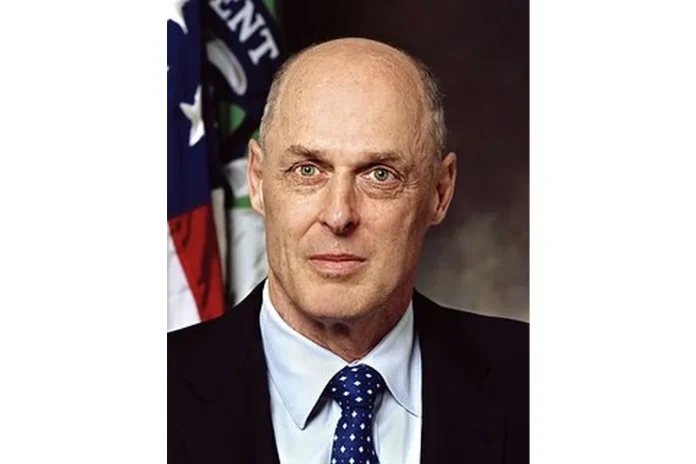
Henry Paulson Bio
Henry Merritt “Hank” Paulson Jr., born on March 28, 1946, is an American investment banker, financier, and former public official who served as the 74th United States Secretary of the Treasury. He is a member of the Republican Party and is widely recognized for his central role in guiding the United States government’s response to the 2008 financial crisis. Paulson later founded the Paulson Institute and has remained an active voice on climate policy and U.S.–China economic relations.
Before entering government, Paulson spent more than three decades at Goldman Sachs, rising to become chairman and chief executive officer. He is also the author of two major books, On the Brink and Dealing with China, which document his time in public service and his long engagement with Chinese business and political leaders.
Early Life and Background
Henry Merritt Paulson Jr. was born on March 28, 1946, in Palm Beach, Florida. He is the son of Henry Merritt Paulson, a wholesale jeweler, and Marianne Gallauer. His family later settled on a farm in Barrington, Illinois, where Paulson was raised as a Christian Scientist. He has Norwegian, German, and English Canadian ancestry.
Paulson attended Barrington High School, where he played football and competed in wrestling, graduating in 1964. He earned the rank of Eagle Scout in the Boy Scouts of America and was later recognized with the Distinguished Eagle Scout Award, an honor reflecting long-standing service to his community.
He went on to attend Dartmouth College, where he graduated Phi Beta Kappa in 1968 with a degree in English. At Dartmouth, he was a member of Sigma Alpha Epsilon and earned All-Ivy, All-East, and honorable mention All-American recognition as an offensive lineman. He completed his Master of Business Administration at Harvard Business School in 1970, and declined a scholarship to study at the University of Oxford.
Path to US Politics
Paulson’s first steps into public service came in Washington, where he served as a Staff Assistant to the Assistant Secretary of Defense at the Pentagon from 1970 to 1972. He then joined the Nixon administration, working as an assistant to John Ehrlichman from 1972 to 1973. These early government positions gave him direct experience with federal policymaking before he returned to the private sector.
After his time in the Nixon administration, Paulson joined Goldman Sachs in 1974, beginning a long career in investment banking. He became a partner in 1982, led the firm’s Investment Banking group for the Midwest Region from 1983 to 1988, and rose through senior leadership ranks, eventually being named chief executive officer. He built close relationships with business and political leaders in China during this period, visiting the country more than 70 times while at the firm.
On May 30, 2006, President George W. Bush nominated Paulson to serve as Secretary of the Treasury, succeeding John Snow. He was confirmed unanimously by the United States Senate on June 28, 2006, and was sworn in on July 10, 2006, returning to government service after more than three decades on Wall Street.
Henry Paulson Career
Early Career (1970–1974)
Paulson’s early professional years were split between government and the private sector. He served as Staff Assistant to the Assistant Secretary of Defense at the Pentagon from 1970 to 1972, followed by work in the Nixon White House as an assistant to John Ehrlichman from 1972 to 1973. These positions introduced him to federal economic and security policy.
In 1974, Paulson joined Goldman Sachs in the firm’s Chicago office, covering large industrial companies in the Midwest. This move launched a long career in investment banking that would eventually place him at the top of one of the world’s most powerful financial institutions.
Goldman Sachs Years (1974–2006)
Paulson spent more than three decades at Goldman Sachs, steadily rising through senior leadership. He became a partner in 1982, led the firm’s Investment Banking group for the Midwest Region from 1983 to 1988, and became managing partner of the Chicago office in 1988. He served as co-head of Investment Banking from 1990 to November 1994, and as Chief Operating Officer from December 1994 to June 1998.
Paulson eventually succeeded Jon Corzine as chief executive officer of Goldman Sachs, becoming one of the most influential figures on Wall Street. His total compensation at the firm has been estimated at $480 million, and his reported compensation package was $37 million in 2005. He was required to liquidate his Goldman Sachs stock holdings, valued at over $600 million, before becoming Treasury Secretary.
During his tenure as CEO, Paulson also became a leading voice on conservation, overseeing the corporate donation of 680,000 acres of forested land in Chilean Tierra del Fuego. He later pledged his entire fortune to conservation causes upon his death.
Treasury Secretary Era (2006–2009)
Paulson was confirmed as the 74th United States Secretary of the Treasury in 2006 and served until January 20, 2009. He quickly focused on long-term economic challenges, identifying the wide gap between the richest and poorest Americans as a major issue. He also helped to create the Hope Now Alliance to assist struggling homeowners during the subprime mortgage crisis.
Paulson led the U.S. response to the 2008 financial crisis, pushing through legislation authorizing the Treasury to use $700 billion to stabilize the financial system. Working with Federal Reserve Chairman Ben Bernanke, he influenced the decision to create an $85 billion credit facility for American International Group to prevent its collapse. These efforts were widely labeled the “Paulson Plan” in the press.
He also initiated and led the U.S.–China Strategic Economic Dialogue, becoming a key architect of economic relations between the two countries. In spring 2007, he warned an audience at the Shanghai Futures Exchange that China needed to open its capital markets to sustain growth.
Notable Events and Milestones
Paulson’s most defining moment came during the September 2008 collapse of Lehman Brothers, which he worked to contain alongside Federal Reserve Bank of New York President Timothy Geithner. He led the passage of the Troubled Assets Relief Program, which stabilized major American banks. Time named him a runner-up for 2008 Person of the Year, calling him the face of the financial crisis response.
Henry Paulson Career Highlights
Treasury and Government Highlights
Paulson’s most prominent achievements came during his time at the U.S. Treasury, where he managed the federal response to the worst financial crisis since the Great Depression. He oversaw the $700 billion Troubled Assets Relief Program and the $85 billion AIG credit facility, measures credited with preventing a deeper collapse of the U.S. financial system. He also led the U.S.–China Strategic Economic Dialogue from 2006 through 2008.
Other Wins and Achievements
Paulson received an Honorary Doctorate of Laws and Environmental Policy from Washington College in 2015. He is the recipient of the Distinguished Eagle Scout Award, recognizing his lifelong service to the Boy Scouts of America. He also led the corporate donation of 680,000 acres of land in Chilean Tierra del Fuego while CEO of Goldman Sachs and later pledged his entire fortune to conservation causes upon his death.
Henry Paulson Family
Family Background and Public Service
Paulson is the son of Henry Merritt Paulson, a wholesale jeweler, and Marianne Gallauer. He was raised as a Christian Scientist on a farm in Barrington, Illinois, and earned the rank of Eagle Scout in the Boy Scouts of America. He was later honored with the Distinguished Eagle Scout Award, recognizing his long-standing commitment to community service.
Personal Life
Paulson met his wife, Wendy Judge, a Wellesley College graduate, during his senior year at Dartmouth College. The couple has two adult children: Henry Merritt Paulson III, commonly known as Merritt Paulson, a sports-team owner and Dartmouth graduate, and Amanda Paulson, a journalist and Dartmouth graduate. The Paulsons became grandparents in June 2007 and maintain homes in both Chicago and Barrington Hills, Illinois. Wendy Paulson is Chair Emerita of the conservation organization Rare.