
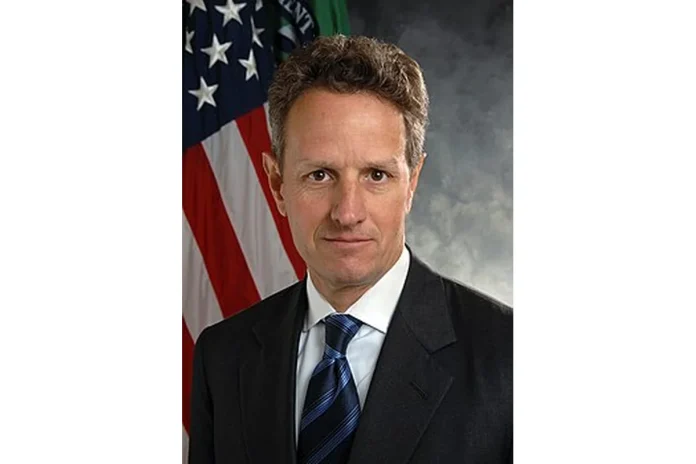
Timothy Geithner Bio
Timothy Franz Geithner, born on August 18, 1961, is an American former central banker and government official who served as the 75th United States Secretary of the Treasury under President Barack Obama from 2009 to 2013. He is widely recognized for his central role in the U.S. response to the 2008 financial crisis and the Great Recession. After leaving government service, Geithner transitioned to the private sector, joining the global private equity firm Warburg Pincus in a senior leadership role.
Earlier in his career, Geithner served as President of the Federal Reserve Bank of New York from 2003 to 2009, where he helped manage crises involving major financial firms. He also held senior positions at the U.S. Department of the Treasury during the Clinton administration and at the International Monetary Fund. Geithner is the author of the memoir Stress Test: Reflections on Financial Crises, published in 2014, and he continues to advise on financial and economic matters.
Early Life and Background
Timothy Franz Geithner was born in Manhattan, New York, to Peter Franz Geithner and Deborah Moore. His father was a German American who directed the Ford Foundation’s Asia program in New York during the 1990s, following earlier work for the United States Agency for International Development in Zambia and Zimbabwe. His paternal grandfather, Paul Herman Geithner, immigrated with his parents to the United States in 1908 from Zeulenroda, Germany.
His mother, a Mayflower descendant, came from a New England family. Her father, Charles Frederick Moore Jr., served as vice president of public relations for the Ford Motor Company from 1952 to 1964 and advised presidents and presidential candidates, including Dwight D. Eisenhower, Nelson Rockefeller, and George W. Romney. Geithner grew up in a household with strong ties to public policy, international development, and corporate America, which shaped his future interests in economics and government service.
Because of his father’s international work, Geithner spent most of his childhood abroad, including extended periods in Zimbabwe, Zambia, India, and Thailand. He completed high school at the International School Bangkok. He later studied Mandarin at Peking University in 1981 and at Beijing Normal University in 1982. He also studied Japanese. Geithner then attended Dartmouth College, following in the footsteps of his father, paternal grandfather, and uncle, graduating in 1983 with an A.B. in Government and Asian studies. He went on to earn a M.A. in international economics and East Asian studies from Johns Hopkins University’s School of Advanced International Studies in 1985.
Path to U.S. Politics
Geithner began his professional career in 1985 at Kissinger Associates in Washington, D.C., where he worked until 1988. That year, he joined the International Affairs division of the U.S. Department of the Treasury, beginning a long career in public service focused on international finance. During the Clinton administration, he served in a series of increasingly senior Treasury roles, including deputy assistant secretary for international monetary and financial policy, senior deputy assistant secretary for international affairs, and assistant secretary for international affairs.
He was later named Under Secretary of the Treasury for International Affairs, serving from 1998 to 2001 under Secretaries Robert Rubin and Lawrence Summers, who are widely regarded as his mentors. In that role, he helped the United States manage financial crises in Brazil, Mexico, Indonesia, South Korea, and Thailand. After leaving the Treasury, he joined the Council on Foreign Relations as a Senior Fellow in International Economics and served as director of the Policy Development and Review Department at the International Monetary Fund from 2001 to 2003.
Timothy Geithner Career
Early Career (1985-2003)
Geithner’s early career combined international advisory work with government service focused on monetary policy and financial stability. His time at Kissinger Associates introduced him to global economic strategy, while his subsequent positions at the Treasury Department allowed him to develop expertise in cross-border financial issues. As Under Secretary of the Treasury for International Affairs, he was a key figure in coordinating the U.S. response to a series of emerging market crises during the late 1990s.
In 2001, Geithner transitioned to think-tank and multilateral work, joining the Council on Foreign Relations. He then moved to the International Monetary Fund, where he directed the Policy Development and Review Department from 2001 to 2003. These positions expanded his understanding of global financial systems and helped prepare him for the senior role he would soon assume at the Federal Reserve Bank of New York.
Federal Reserve Bank of New York Era (2003-2009)
In October 2003, Geithner was named President of the Federal Reserve Bank of New York, where he also served as Vice Chairman of the Federal Open Market Committee. In 2006, he became a member of the Group of Thirty. As head of the New York Fed, he became a central figure in the U.S. government’s response to the 2008 financial crisis. In March 2008, together with Treasury Secretary Henry Paulson, he arranged the rescue and fire sale of Bear Stearns to JPMorgan Chase, a transaction that included Fed financing and support for up to $30 billion of less-liquid assets.
As the crisis deepened, Geithner helped manage the collapse of Lehman Brothers in September 2008 and, days later, the federal rescue of the American International Group (AIG). With Treasury Secretary Henry Paulson, he proposed an $85 billion loan to AIG in exchange for a 79.9 percent equity stake and veto rights over dividend payments. He also helped orchestrate the transformation of Goldman Sachs and Morgan Stanley into bank holding companies to stabilize the financial system.
Secretary of the Treasury Era (2009-2013)
On November 24, 2008, President-elect Barack Obama announced his intention to nominate Geithner to be Treasury Secretary. After confirmation hearings in which Geithner addressed past payroll-tax issues, the U.S. Senate confirmed his appointment on January 26, 2009, by a vote of 60 to 34. He was sworn in by Vice President Joe Biden and witnessed by President Obama. As Treasury Secretary, Geithner oversaw the allocation of $350 billion under the Troubled Asset Relief Program and helped design the Financial Stability Plan to address toxic assets on bank balance sheets.
He also managed efforts to restructure financial regulation, stabilize the housing and auto industries, and negotiate with foreign governments on global economic issues. In 2010, he led the Obama administration’s opposition to extending the Bush-era tax cuts for the wealthiest Americans, citing their projected $700 billion ten-year cost. In late 2012, he served as the president’s lead negotiator on the fiscal cliff and the increase in the federal debt limit, publicly stating the administration was willing to let tax cuts expire if Republicans refused to raise rates on higher earners.
Notable Events and Milestones
Among the defining moments of Geithner’s career were the 2008 rescue of Bear Stearns, the September 2008 bankruptcy of Lehman Brothers, the $85 billion federal bailout of AIG, and the implementation of the Troubled Asset Relief Program. He was also a central figure in the U.S.-China Strategic and Economic Dialogue, where he pressed China on currency practices and intellectual property protection. After leaving government, his testimony in the 2014 Starr v. United States case examined whether the government had shortchanged AIG shareholders in the 2009 rescue.
Timothy Geithner Post-Government Career
Private Equity and Public Engagement
Geithner left the Obama administration on January 25, 2013, and rejoined the Council on Foreign Relations as a Distinguished Fellow. He also began lecturing at the Yale School of Management and serving as co-chair of the board of directors of the International Rescue Committee. In March 2014, he became president and managing director of Warburg Pincus, a global private equity firm headquartered in New York City, and was named chairman of the firm in July 2023.
His memoir, Stress Test: Reflections on Financial Crises, was published in May 2014. In 2016, he joined seven other former Treasury secretaries in calling on the United Kingdom to remain a member of the European Union ahead of the June 2016 referendum. In 2022, he contributed to the Handbook of Financial Stress Testing, reflecting on lessons from past crises and proposing reforms.
Timothy Geithner Family
Family Background and Political Connections
Geithner comes from a family with deep roots in public service and international affairs. His father, Peter Franz Geithner, worked for the United States Agency for International Development in Africa and later led the Ford Foundation’s Asia program, where he collaborated with Ann Dunham Soetoro, the mother of Barack Obama, on microfinance initiatives in Indonesia. His maternal grandfather, Charles Frederick Moore Jr., advised presidents and political figures through his work at the Ford Motor Company.
Personal Life
Geithner married Carole Marie Sonnenfeld, his classmate at Dartmouth College, on June 8, 1985, at his parents’ summer home in Orleans, Massachusetts. Carole Geithner is a licensed clinical social worker and an assistant clinical professor of psychiatry and behavioral sciences at the George Washington University School of Medicine, where she teaches listening skills to medical students. She is the author of a children’s novel about grief, and her father, Albert Sonnenfeld, was a professor of French and Comparative Literature at Princeton University.