

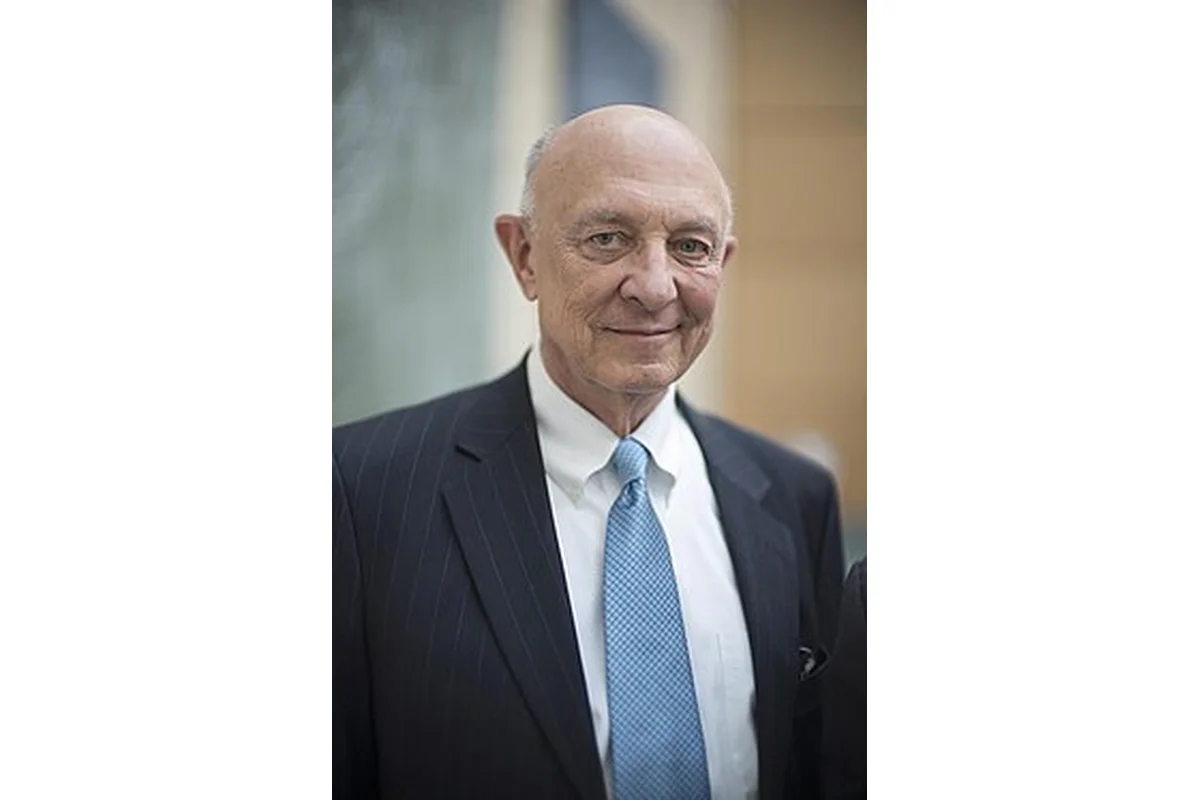
James Woolsey Bio
Robert James Woolsey Jr., widely known as James Woolsey, is an American lawyer, politician, and former intelligence chief whose career has spanned government service, the military, the private sector, and public policy advocacy. Born in Tulsa, Oklahoma in 1941, he rose to national prominence as Director of Central Intelligence from 1993 to 1995 under President Bill Clinton, after earlier serving as United States Under Secretary of the Navy. A Rhodes Scholar and Yale Law School graduate, Woolsey has advised presidential campaigns, testified before Congress, and remained an active commentator on national security, foreign policy, and energy issues.
Early Life and Background
Robert James Woolsey Jr. was born on September 21, 1941, in Tulsa, Oklahoma, the son of Robert James Woolsey Sr. and Clyde (Kirby) Woolsey. He grew up in Tulsa and attended Tulsa Central High School, where he prepared for a rigorous academic path that would carry him to some of the most respected institutions in the country.
Woolsey earned a Bachelor of Arts from Stanford University in 1963, graduating with high honors and membership in Phi Beta Kappa. He was then awarded a Rhodes Scholarship and studied at the University of Oxford, where he received a second Bachelor of Arts degree in 1965, later converting it to a Master of Arts in accordance with the tradition of the time. In 1968, he completed his Bachelor of Laws at Yale Law School, setting the stage for a career that would combine legal training with public service.
Path to US Politics
Woolsey began his professional career in 1969 as a United States Army officer, serving in the Intelligence and Special Operations communities, an experience that grounded him in the national security establishment. He later joined the Washington law firm of Shea & Gardner, where he worked as an associate from 1973 to 1977, advising clients on defense and policy matters while building the relationships that would lead to senior government appointments.
In 1977, Woolsey was appointed United States Under Secretary of the Navy by President Jimmy Carter, a role he held until 1979. He returned to Shea & Gardner as a partner in 1979 and continued to deepen his involvement in arms control and foreign policy, eventually serving on the U.S. delegation to the Intermediate-Range Nuclear Forces Treaty negotiations with the Soviet Union in the 1980s. These experiences positioned him at the intersection of law, defense, and diplomacy, paving the way for his nomination as Director of Central Intelligence in 1993.
James Woolsey Career
Early Career (1969–1989)
Woolsey launched his career in 1969 as a United States Army officer in intelligence and special operations, an early chapter that gave him direct exposure to the workings of the national security apparatus. Transitioning to the legal profession, he joined Shea & Gardner as an associate in 1973, working on defense and policy matters that would shape his government portfolio.
His first major government role came in 1977, when he was named United States Under Secretary of the Navy, serving until 1979 under President Jimmy Carter. Returning to Shea & Gardner as a partner, he remained actively involved in defense policy and was a member of the U.S. delegation to the INF Treaty negotiations with the Soviet Union, contributing to one of the most significant arms control agreements of the Cold War era.
Director of Central Intelligence (1993–1995)
Woolsey was confirmed as Director of Central Intelligence in 1993, taking office on February 5 of that year under President Bill Clinton. His tenure coincided with a period of significant turbulence for the Central Intelligence Agency, including the February 1994 arrest of Aldrich Ames for espionage, an event that prompted congressional scrutiny of the agency’s counterintelligence failures.
Woolsey’s relationship with President Clinton was widely described as distant, with reports indicating that he had limited one-on-one access to the commander in chief. His decision not to dismiss or demote any CIA personnel in the wake of the Ames scandal drew sharp criticism on Capitol Hill. After roughly two years in office, he announced his resignation on December 28, 1994, and left the post on January 10, 1995.
Post-Government and Private Sector (1995–Present)
Following his tenure at the Central Intelligence Agency, Woolsey returned to private life as a lawyer, venture capitalist, and investor. He became a senior vice president at Booz Allen Hamilton for Global Strategic Security in 2002, joined VantagePoint Venture Partners as a venture partner in 2008, and took on a similar role at Lux Capital in 2011. He has served on multiple corporate and advisory boards, including the strategic advisory board of Genie Energy, and has remained active in policy circles.
Woolsey has also continued to be a vocal public figure. He has advised Republican presidential candidates, including serving on John McCain’s 2008 campaign as an advisor on energy and climate change, and briefly joining Donald Trump’s team as a senior adviser in 2016. His advocacy has spanned national security, energy independence, and election integrity, and he has been a frequent commentator on intelligence and foreign policy matters.
Notable Events and Milestones
Among the defining episodes of his career, Woolsey’s handling of the Aldrich Ames espionage case stands out, as does his role in negotiating the INF Treaty during the 1980s. In 1998, he served on the Rumsfeld Commission, which assessed the ballistic missile threat to the United States, and he was a signatory to the January 26, 1998, letter to President Clinton calling for the removal of Saddam Hussein. More recently, his involvement in the September 2016 meeting involving Michael Flynn and Turkish officials drew federal scrutiny, and he has been publicly identified in the Gal Luft indictment as a former senior U.S. government official referenced in connection with foreign recruitment efforts.
James Woolsey Career Wins
Woolsey’s career achievements include senior appointments across four U.S. presidential administrations, the negotiation of landmark arms control agreements, and influential roles in shaping national security and energy policy. He has been recognized with an honorary doctorate from the Institute of World Politics in 2011, and he has led and advised numerous organizations, including the Foundation for Defense of Democracies and the Set America Free Coalition.
Political and Policy Highlights
Woolsey’s policy contributions include co-founding the United States Energy Security Council in 2011 alongside Robert McFarlane, advocating for energy independence through organizations such as the Set America Free Coalition and Plug In America, and serving on advisory boards for groups including the Washington Institute for Near East Policy and the Henry Jackson Society. He has also been active on election security, commenting publicly on foreign interference in U.S. democratic processes and supporting enhanced cybersecurity measures.
Other Achievements
Beyond government service, Woolsey has contributed to public discourse on a wide range of national security and energy topics, including appearances in documentaries such as The Weight of Chains 2 and Who Killed the Electric Car?. He has authored or co-authored works including the book Shariah: The Threat to America and Operation Dragon: Inside the Kremlin’s Secret War on America, and his estimated net worth was reported to be more than seven million dollars as of 2024.
James Woolsey Family
Family Background and Lineage
Woolsey was born in Tulsa, Oklahoma, to Robert James Woolsey Sr. and Clyde (Kirby) Woolsey. He is a descendant of George (Joris) Woolsey, one of the earliest settlers of New Amsterdam, and Thomas Cornell, linking him to a long line of American colonial ancestry.
Personal Life
Woolsey was married to Suzanne Haley Woolsey for 48 years before their divorce. He later married Nancye Miller, who passed away from cancer in March 2019. He has been a resident of the Washington, D.C. area for much of his professional life and continues to be an influential voice in policy debates.