
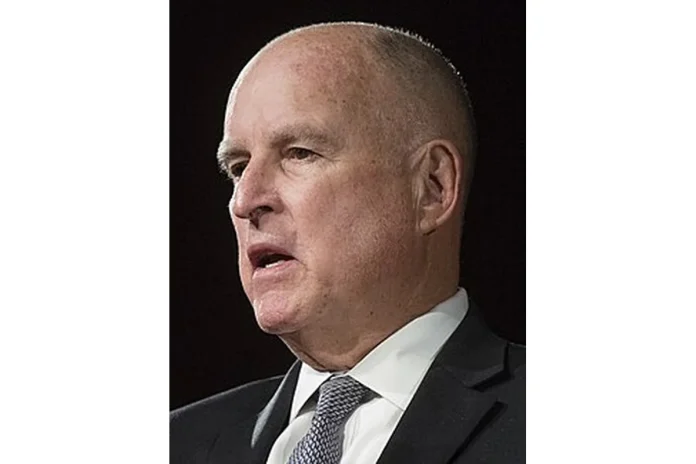
Jerry Brown Bio
Edmund Gerald “Jerry” Brown Jr. (born April 7, 1938) is an American lawyer, author, and politician who served as the 34th and 39th governor of California from 1975 to 1983 and again from 2011 to 2019. A member of the Democratic Party, he also served as California secretary of state (1971–1975), mayor of Oakland (1999–2007), and California attorney general (2007–2011). Brown is the fourth-longest-serving governor in United States history, having spent more than 16 years in office across four terms. He is widely known for his fiscal restraint, environmental initiatives, and unconventional political style, and is the son of Pat Brown, the 32nd governor of California.
Early Life and Background
Edmund Gerald Brown Jr. was born on April 7, 1938, in San Francisco, California, to Edmund Gerald “Pat” Brown Sr. and Bernice Layne Brown. His father served as the 32nd governor of California from 1959 to 1967, and growing up in a politically active household gave Brown an early familiarity with public life. He attended St. Ignatius High School in San Francisco before enrolling at Santa Clara University. He later transferred to the University of California, Berkeley, where he earned a Bachelor of Arts degree.
After college, Brown continued his education at Yale University, where he received his Bachelor of Laws (LLB) degree. He then returned to California and began practicing law, drawing on the legal training that would later support his long career in public office. His upbringing, education, and family political background laid the foundation for his entry into state government in the late 1960s.
Path to US Politics
Jerry Brown’s first formal step into politics came when he was elected to the Los Angeles Community College District Board of Trustees, where he served from 1969 to 1971. In 1970, he won election as the 23rd secretary of state of California, a statewide office that gave him a public platform and statewide name recognition. Two years later, he ran for governor and won, beginning a career in US politics that would span more than four decades.
Brown’s early path was shaped by his father’s legacy and by his own reputation for sharp policy thinking. He associated with a wide range of advisors and mentors, including United Farm Workers founder Cesar Chavez, labor leader Jack Henning, and Hewlett-Packard co-founder David Packard. These connections helped him build the political networks that supported his early campaigns and his rapid rise through California state government.
Jerry Brown Career
Early Career (1971–1974)
Brown served as California secretary of state from 1971 to 1975, where he gained a reputation for reforming campaign finance practices and modernizing the office. During this period, he also continued his involvement with the Los Angeles Community College District Board of Trustees, building a record of public service before seeking higher office. His work as secretary of state positioned him as a serious candidate for governor by the mid-1970s.
In 1974, Brown won a competitive Democratic primary for governor and went on to defeat California State Controller Houston I. Flournoy in the general election. At 36, he became the youngest governor of California in 111 years, succeeding Republican Governor Ronald Reagan, who had retired after two terms. His election marked the beginning of a long and often unconventional tenure in California politics.
First Term as Governor (1975–1978)
During his first term, Brown earned a reputation as a fiscal conservative, running a budget office known for restraint and ultimately producing one of the largest surpluses in California history. He famously refused many of the perks of the governorship, choosing to rent a modest apartment in downtown Sacramento and walk or drive himself to work rather than use a chauffeured vehicle. This modest personal style became a hallmark of his public image.
Brown also pursued an active environmental agenda. He created the California Office of Appropriate Technology, appointed Sim Van der Ryn as state architect, and sponsored what has been described as the first-ever tax incentive for rooftop solar energy in 1977. He boosted funding for the California Arts Council and appointed more women and minorities to office than any previous California governor.
Second Term as Governor (1979–1983)
Brown won re-election in 1978 in a landslide over Republican state attorney general Evelle J. Younger, at a time when he also ran unsuccessfully for the 1976 and 1980 Democratic presidential nominations. During his second term, he appointed the first openly gay judge in the United States, Stephen Lachs, in 1979, and the first openly lesbian judge, Mary C. Morgan, in 1981. He also signed the Consenting Adult Sex Act and worked on a Peripheral Canal water project that voters ultimately rejected in 1982.
His second term also included a serious crisis: a Mediterranean fruit fly infestation in the San Francisco Bay Area in 1981. After initially favoring limited ground-level spraying, Brown ultimately authorized large-scale aerial spraying and the release of millions of sterile male medflies to break the reproductive cycle. The infestation was eradicated, but the episode remained controversial for years afterward.
Oakland and the Road Back (1983–1998)
Brown declined to seek a third term in 1982 and instead ran unsuccessfully for the United States Senate, losing to San Diego Mayor Pete Wilson. After leaving office, he traveled abroad, served as chairman of the California Democratic Party from 1989 to 1991, and made another unsuccessful bid for the Democratic presidential nomination in 1992, losing the primary to Bill Clinton. He later moved to the Jack London District of Oakland, where he built a work-live complex and hosted a national call-in talk radio show on Pacifica Radio station KPFA-FM beginning in 1995.
During this period, Brown became involved in Oakland civic life, including activism on bay-front development and campaign finance reform. His political action organization and radio program were both called We the People, and his shows featured guests discussing a wide range of social and political issues. He briefly left the Democratic Party to run as an independent in 1998 before returning.
Mayor of Oakland (1999–2007)
Brown was elected mayor of Oakland in 1998 and served from 1999 to 2007, becoming one of the most prominent politicians associated with the city. As mayor, he focused on downtown redevelopment, public safety, and improving city services. His tenure drew both praise and criticism but helped restore his political profile and set the stage for his return to statewide office.
Attorney General (2007–2011)
Brown served as California attorney general from 2007 to 2011, where he took on consumer protection issues, including a high-profile fraud lawsuit against mortgage lender Countrywide Financial in 2008. The suit alleged unfair and deceptive lending practices and was settled in October 2008 after Bank of America acquired Countrywide, resulting in modifications of up to $8.4 billion in troubled loans. As attorney general, he also represented the state in death-penalty appeals.
Third Term as Governor (2011–2014)
Brown won his third term as governor in 2010, defeating Republican Meg Whitman 53.8% to 40.9% in a race that became one of the most expensive in California history. After taking office in January 2011, he worked to close a $15.7 billion budget deficit through a combination of spending cuts and voter-approved tax increases. In November 2012, California voters passed Proposition 30, raising income taxes on high earners and the state sales tax, helping the state avoid nearly $6 billion in cuts to public education.
On October 7, 2013, Brown became the longest-serving governor in California history, surpassing Earl Warren. He also pursued major infrastructure and environmental initiatives, including a $25 billion plan to build two large water tunnels under the Sacramento-San Joaquin Delta and historic groundwater legislation signed in September 2014.
Fourth Term as Governor (2015–2019)
Brown won an unprecedented fourth term in 2014, defeating Republican Neel Kashkari with 60.0% of the vote. His stated goals for the term included construction of the California High-Speed Rail, completion of the Delta water tunnels, and stronger measures to curb carbon dioxide emissions. In October 2015, he signed the California End of Life Option Act, allowing terminally ill residents to access medical aid in dying under strict criteria.
During his final term, Brown signed Senate Bill 32, requiring California to cut greenhouse gas emissions to 40% below 1990 levels by 2030, and Senate Bill 54, limiting local police cooperation with federal immigration authorities. By September 2018, he had granted more than 1,100 pardons and commuted more than 82 sentences, more than any California governor in recent history. He was succeeded as governor by Gavin Newsom in January 2019.
Notable Events and Milestones
Brown’s career includes several signature moments, including becoming the youngest California governor in 111 years in 1974, becoming the longest-serving governor in California history in 2013, and serving as the fourth-longest-serving governor in United States history. He ran for the Democratic presidential nomination three times (1976, 1980, and 1992) and earned the nickname “Governor Moonbeam” early in his career. He also led the state’s response to the 1981 medfly infestation and the 2008 mortgage lending crisis.
Jerry Brown Family
Family Background and Political Lineage
Jerry Brown was born into one of California’s most prominent political families. His father, Edmund Gerald “Pat” Brown Sr., served as the 32nd governor of California from 1959 to 1967, and his mother was Bernice Layne Brown. Growing up around state government helped shape Brown’s early interest in public service and law.
Personal Life
Brown was a bachelor during his first two terms as governor and his first term as mayor of Oakland, and he drew attention for his relationship with singer Linda Ronstadt. In March 2005, he announced his engagement to Anne Gust, his girlfriend since 1990 and former chief administrative officer for the Gap. They were married on June 18, 2005, in ceremonies officiated by Senator Dianne Feinstein in Oakland and San Francisco. As of 2019, Brown and his wife live on a ranch in Colusa County, California.