
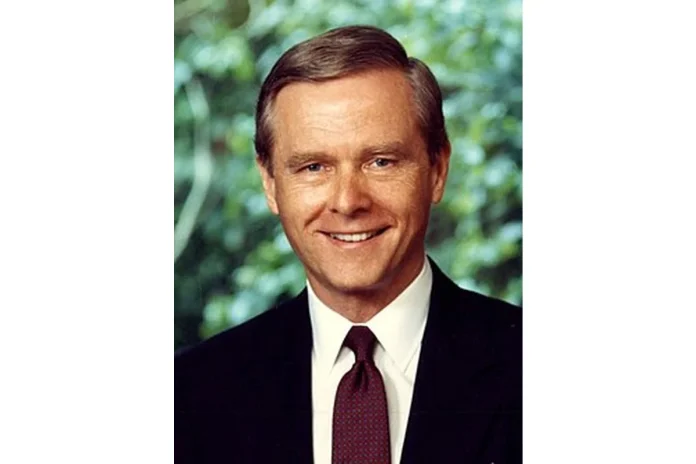
Pete Wilson Bio
Peter Barton Wilson (born August 23, 1933) is an American attorney and Republican politician who served as the 36th governor of California from 1991 to 1999. He previously represented California in the United States Senate from 1983 to 1991 and served as mayor of San Diego from 1971 to 1983. A Yale graduate and a Juris Doctor from the University of California, Berkeley School of Law, Wilson served in the United States Marine Corps before practicing law in San Diego and entering politics. After leaving office, he worked in business and with think tanks, including as a distinguished visiting fellow at the Hoover Institution.
As governor, Wilson pursued fiscal conservatism, signed the “three strikes” law, supported energy deregulation, and backed Proposition 187. His tenure shaped California policy on crime, welfare, and immigration, and helped define late-twentieth-century state politics.
Early Life and Background
Peter Barton Wilson was born on August 23, 1933, in Lake Forest, Illinois, a suburb north of Chicago, during the Great Depression. His parents were James Boone Wilson and Margaret (Callaghan) Wilson. His father had worked his way through the University of Illinois selling college fraternity jewelry and later built a career as a successful advertising executive. The Wilson family later settled in St. Louis, Missouri, when Pete was in elementary school.
Wilson attended John Burroughs School in Ladue for grades seven through nine and then St. Louis Country Day School, an exclusive private high school, where he earned a senior-year award for combined scholarship, athletics, and citizenship. In the fall of 1951, he enrolled at Yale University on a United States Navy Reserve Officers’ Training Corps scholarship, majored in English, and earned his Bachelor of Arts degree. In his junior year he elected to join the Marine Corps upon graduation.
After graduating from Yale, Wilson served three years in the United States Marine Corps as an infantry officer, eventually rising to platoon commander. Upon completing his service, he earned a Juris Doctor from the University of California, Berkeley School of Law in June 1962, setting the stage for his move to San Diego and entry into politics.
Path to US Politics
In 1962, while working as an advance man for Republican gubernatorial candidate Richard M. Nixon, Wilson met Nixon’s top aide Herb Klein, who suggested that Wilson might thrive in Southern California politics. Following that advice, Wilson moved to San Diego in 1963. He passed the bar exam on his fourth attempt and began practicing as a criminal defense attorney, but found the work low-paying and personally unsatisfying, eventually shifting to a more conventional law practice.
Wilson became increasingly active in local Republican politics, working long hours on Barry Goldwater’s 1964 presidential campaign and building relationships with party boosters. In 1966, at the age of thirty-three, he won a seat in the California State Assembly, succeeding Clair Burgener. He was re-elected to the Assembly in 1968 and 1970 before winning election as mayor of San Diego in 1971, launching a long career in public office.
Pete Wilson Career
Early Career (1966–1982)
Wilson began his political career in the California State Assembly, winning election in 1966 and earning re-election in 1968 and 1970. In 1971, he won the mayoralty of San Diego, launching a twelve-year run in which he served three terms, winning by roughly a two-to-one margin each time. As mayor he restructured the San Diego City Council, reorganized planning and civil service commissions, instituted campaign finance reform, and promoted the redevelopment of downtown San Diego. He also helped keep Major League Baseball’s San Diego Padres in the city by encouraging local businessman Ray Kroc to purchase the team.
During his time as mayor, Wilson built connections that would shape his statewide career. In 1972, he recruited Clarence M. Pendleton Jr. to head the Model Cities Program in San Diego, and Pendleton later served as chair of the United States Commission on Civil Rights. By the end of his mayoral tenure, Wilson had established a reputation as a fiscal conservative and a steady party loyalist, preparing him for a run at the United States Senate.
U.S. Senate Era (1983–1991) Breakthrough
In 1982, Wilson won the Republican primary to replace retiring U.S. Senator S. I. Hayakawa and faced Democratic former Governor Jerry Brown in the general election. Wilson campaigned on fiscal conservatism, including support for Proposition 13, and portrayed himself as tougher on crime than Brown, criticizing Brown’s appointment of California Chief Justice Rose Bird. With late visits from President Ronald Reagan and a strong Republican turnout that swept George Deukmejian into the governorship, Wilson edged out Brown to claim the seat.
During his Senate career, Wilson voted in favor of legislation establishing Martin Luther King Jr. Day and in favor of the Civil Rights Restoration Act of 1987, including voting to override President Reagan’s veto. He co-sponsored the Civil Liberties Act of 1988, which authorized redress for Japanese Americans interned during World War II and was signed into law by President Reagan. He also supported Reagan’s Strategic Defense Initiative and was named the Senate’s “Watchdog of the Treasury” for each of his eight years in office.
In 1988, Wilson won re-election against Democratic opponent Leo T. McCarthy, becoming the first Senate candidate in history to receive more than five million votes. He voted against the Omnibus Budget Reconciliation Act of 1990, a major tax increase, preserving his reputation for fiscal discipline. In January 1991, he resigned from the Senate upon being sworn in as governor of California.
Governor of California Era (1991–1999)
Wilson was sworn in as the 36th governor of California on January 7, 1991, after defeating former San Francisco Mayor Dianne Feinstein. Inheriting the state’s worst economy since the Great Depression, he insisted on strict budget discipline, raised sales and income taxes to close a massive deficit, and steered the state toward recovery. By the end of his tenure, he left California with a $16 billion budget surplus, and a 1998 Los Angeles Times poll found that 55 percent of registered voters in California viewed his performance favorably.
He signed the “Three Strikes” law mandating twenty-five-years-to-life sentences for repeat offenders, supported energy deregulation, and championed California Proposition 187, a 1994 ballot initiative to deny public services to undocumented immigrants. He also pursued welfare reform, school accountability measures, and education reforms, including statewide curriculum standards, reduced class sizes, and standardized testing. Term limits passed under Proposition 140 prevented him from running for a third term, and he was succeeded by Lieutenant Governor Gray Davis.
Notable Events and Milestones
Wilson’s career is defined by several signature moments: his 1982 Senate victory over Jerry Brown, his 1988 Senate re-election in which he became the first candidate to exceed five million votes in a single Senate race, his signing of the Three Strikes law, and his 1994 re-election as governor. His support for Proposition 187, while popular with voters, has been cited by analysts as a turning point in the long-term decline of the California Republican Party. As of 2026, his 1988 Senate re-election remains the last time a Republican won a U.S. Senate race in California.
Pete Wilson Career Wins
Wilson compiled a lengthy record of electoral victories, including three mayoral wins in San Diego, a U.S. Senate victory in 1982, a U.S. Senate re-election in 1988, and a gubernatorial re-election in 1994.
Electoral Highlights
Wilson first won statewide in 1982, defeating two-term Democratic Governor Jerry Brown for the U.S. Senate. Six years later, he set a record by becoming the first Senate candidate to surpass five million votes. As governor, he won a second term in 1994, defeating Democratic State Treasurer Kathleen Brown with 55 percent of the vote. Earlier, he had been elected mayor of San Diego three times, winning by roughly two-to-one margins in each race.
Other Wins & Achievements
Beyond elections, Wilson was named the Senate’s “Watchdog of the Treasury” for each of his eight years in office. In 2003, he co-chaired Arnold Schwarzenegger’s successful campaign to recall and replace Governor Gray Davis. He also chaired Meg Whitman’s unsuccessful 2009 campaign for governor and served as a campaign advisor for Larry Elder’s 2021 recall effort against Governor Gavin Newsom.
Pete Wilson Family
Family Background and Political Lineage
Wilson was raised in a middle-class household shaped by his father’s career in advertising. His parents, James Boone Wilson and Margaret (Callaghan) Wilson, settled the family in St. Louis, where Pete attended John Burroughs School and St. Louis Country Day School. His upbringing in a business-oriented household and his later exposure to Republican politics through figures like Richard Nixon and Barry Goldwater influenced his career trajectory.
Personal Life
Wilson married Betty Robertson in 1968; the couple divorced in 1981. He married Gayle Edlund in 1983, and they have remained married since. After leaving the governorship in 1999, Wilson received the Patriot Award from the Congressional Medal of Honor Society, was honored with a statue on the San Diego Walk of Fame in 2007, and received an honorary degree from San Diego State University in 2009. He is a distinguished visiting fellow at the Hoover Institution at Stanford University.