
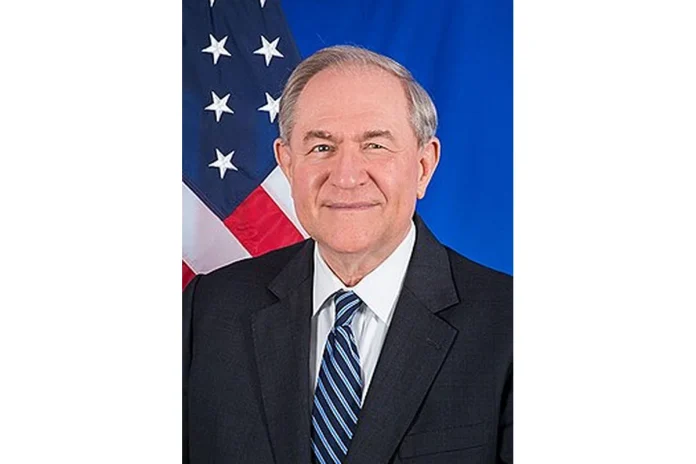
Jim Gilmore Bio
James Stuart Gilmore III (born October 6, 1949) is an American politician, diplomat, and former attorney who served as the 68th Governor of Virginia from 1998 to 2002. A member of the Republican Party, Gilmore also chaired the Republican National Committee in 2001 and later served as the U.S. Representative to the Organization for Security and Co-operation in Europe (OSCE) under the first Trump administration.
Beyond elected office, Gilmore built a career in public service that included military counterintelligence work, state-level law enforcement leadership, and national security advisory roles. He later sought the Republican presidential nomination in both 2008 and 2016 and ran unsuccessfully for the U.S. Senate in 2008. His career reflects a steady progression from local prosecutor to state chief executive to international diplomat.
Early Life and Background
Gilmore was born in Richmond, Virginia, the son of Margaret Evelyn Kandle, a church secretary, and James Stuart Gilmore Jr., a grocery store meat cutter. He grew up in the Richmond area and graduated from John Randolph Tucker High School in 1967. His upbringing in a working household shaped his early interest in public service and the law.
He went on to attend the University of Virginia, where he earned a Bachelor of Arts degree in 1971. At Virginia, he was classmates with George Allen, a future fellow governor of the commonwealth. Gilmore later returned to the University of Virginia School of Law, where he completed his Juris Doctor in 1977.
Path to US Politics
After college, Gilmore volunteered for service in the United States Army in 1971. He received intelligence training at the United States Army Intelligence Center at Fort Huachuca, Arizona, and language instruction at the Defense Language Institute in Monterey, California. He then served for three years in the 650th Military Intelligence Group, working as a counterintelligence agent in West Germany during the Vietnam War and becoming fluent in German. He received the Joint Service Commendation Medal for his service.
Following his military career, Gilmore entered legal practice and built a reputation in Virginia politics. He was elected Commonwealth’s Attorney for Henrico County and was later elected Attorney General of Virginia in 1993, defeating Democratic nominee William D. Dolan III. These positions established him as a leading Republican figure in the state and set the stage for his successful run for governor in 1997.
Jim Gilmore Career
Early Career (1977–1997)
Gilmore launched his political career with an unsuccessful run for the Virginia House of Delegates in the 32nd district in 1981. Undeterred, he continued practicing law and remained active in Republican politics throughout the 1980s. In 1987, he was elected Commonwealth’s Attorney for Henrico County and won re-election in 1991, gaining valuable experience as a prosecutor.
In 1993, Gilmore won election as Virginia’s Attorney General, securing more than 10 percentage points over his Democratic opponent. He served in that role until 1997, when he resigned to pursue the governorship. During his tenure as attorney general, he defended Virginia’s parental notification law for minors seeking abortions and traveled internationally to engage with foreign leaders.
Governor of Virginia Breakthrough (1997–2002)
Gilmore was elected the 68th Governor of Virginia in 1997, defeating Lieutenant Governor Don Beyer with 56 percent of the vote to Beyer’s 43 percent. His campaign centered on two major pledges: hiring 4,000 new teachers for public schools and phasing out Virginia’s personal property tax on automobiles. The Virginia Constitution barred consecutive gubernatorial terms, ensuring that his time in office would be limited to a single four-year span.
During his tenure, Gilmore signed a phased car tax reduction into law, pushed comprehensive Standards of Learning reforms in public schools, and signed legislation reducing public college tuition by 20 percent. He created Virginia’s first stand-alone Martin Luther King Jr. Day, established the nation’s first state Secretary of Technology, and led trade missions to South America, Asia, and Europe to promote Virginia’s economy.
Gilmore also chaired the Republican National Committee from January 2001 to January 2002 and led the Congressional Advisory Commission on Electronic Commerce, which studied internet taxation. His governorship coincided with the September 11, 2001 attacks and a subsequent economic downturn, prompting spending reductions across state agencies. He left office in January 2002, succeeded by Democrat Mark Warner.
Subsequent Office and Ambassador Era (2002–2019)
After leaving the governorship, Gilmore chaired the Gilmore Commission, a congressional advisory panel on domestic terrorism capabilities involving weapons of mass destruction, from 1999 through 2003. He also led the Free Congress Foundation, which he re-branded as the American Opportunity Foundation, and served on the board of the National Rifle Association from 2005 to 2017. He sought the Republican presidential nomination in 2008, ending his campaign in July 2007 due to fundraising challenges, and later ran again in 2016, suspending his bid in February 2016.
In 2008, Gilmore ran for the U.S. Senate seat being vacated by John Warner. After winning the Republican nomination at a state convention by a narrow margin of 65 votes, he was defeated by Democrat Mark Warner, earning only 34 percent of the general election vote. In November 2018, President Donald Trump nominated Gilmore to serve as the U.S. Representative to the OSCE with the rank of ambassador. The Senate confirmed his nomination in May 2019, and Gilmore was sworn in on June 25, 2019, presenting his credentials to the OSCE Secretary General shortly afterward.
Notable Events and Milestones
Gilmore’s career includes several defining moments, including his election as the 68th Governor of Virginia, his leadership of the Republican National Committee, and his role as U.S. Representative to the OSCE. He signed Virginia’s first stand-alone Martin Luther King Jr. holiday, created the nation’s first state Secretary of Technology position, and oversaw reforms that narrowed achievement gaps in public schools. His post-gubernatorial work on counterterrorism through the Gilmore Commission further shaped national security policy in the early 2000s.
Jim Gilmore Career Wins
Gilmore’s most significant career victory came in 1997 when he was elected Governor of Virginia, winning 56 percent of the vote. He also won the Republican nomination for the U.S. Senate in 2008 at a state convention, though he went on to lose the general election. His selection as U.S. Representative to the OSCE in 2019 represented another notable achievement in his long career of public service.
Electoral Highlights
Gilmore’s first major electoral win was his election as Commonwealth’s Attorney for Henrico County in 1987, followed by re-election in 1991. He then won the Virginia Attorney General race in 1993, defeating his Democratic opponent by more than 10 percentage points. His 1997 gubernatorial victory remains the high point of his electoral career.
Other Wins and Achievements
Beyond elections, Gilmore earned the Joint Service Commendation Medal during his military service. He received recognition for his leadership of the Gilmore Commission, which delivered five reports to U.S. presidents and Congress on terrorism preparedness. He was also honored for his contributions to conservative public policy through his leadership of the Free Congress Foundation and the American Opportunity Foundation.
Jim Gilmore Family
Family Background and Political Lineage
Gilmore was raised in Richmond, Virginia, by his father, James Stuart Gilmore Jr., a grocery store meat cutter, and his mother, Margaret Evelyn Kandle, a church secretary. His parents’ working-class background instilled in him an appreciation for public service and community engagement that would shape his career in politics and law.
Personal Life
Gilmore married Roxane Gatling on August 6, 1977, after meeting her at a Jefferson Literary and Debating Society meeting in 1974. The couple has two sons, Jay Gilmore and Ashton Gilmore. Gilmore’s time at the University of Virginia, where he earned both his undergraduate and law degrees, brought together his personal and professional life, as his wife was also a student there during their courtship.